Ciri dan struktur
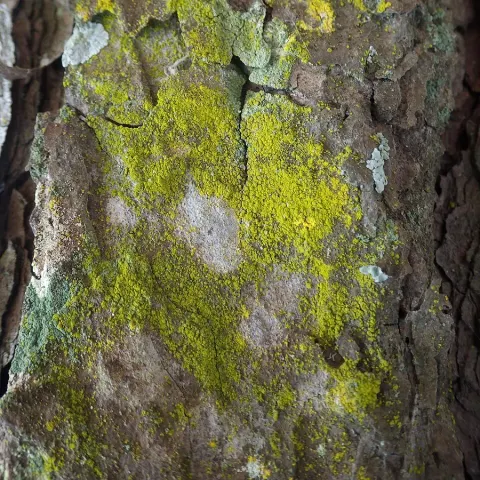
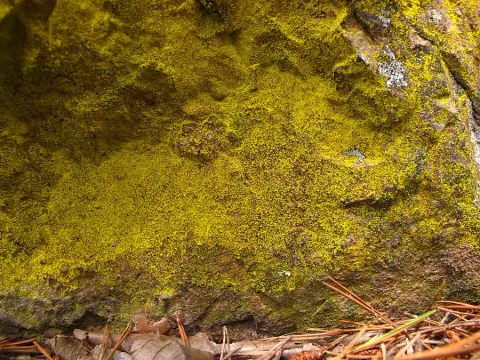
Chrysothrix chlorina is characterised by its crustaceous and (powdery) thallus. It typically forms a continuous thallus, ranging from non- to strongly areolate, that is yellow to yellow-green in colour. This crust comprises (powdery) with diameters between 0.1 and 0.2 mm, and can be up to about 1 mm thick. These granules, known as soredia (a type of reproductive propagule), consist of algal cells encased in fungal hyphae. The species does not have a thallus margin or a , and is devoid of apothecia (sexual reproductive structures) and pycnidia (asexual reproductive structures). The symbiotic in Chrysothrix chlorina belongs to the genus Chlorella, which comprises single-celled green algae. These algal cells are up to 15 μm in diameter, while the fungal hyphae have a diameter of 2–4 μm.
Habitat dan peran ekologis
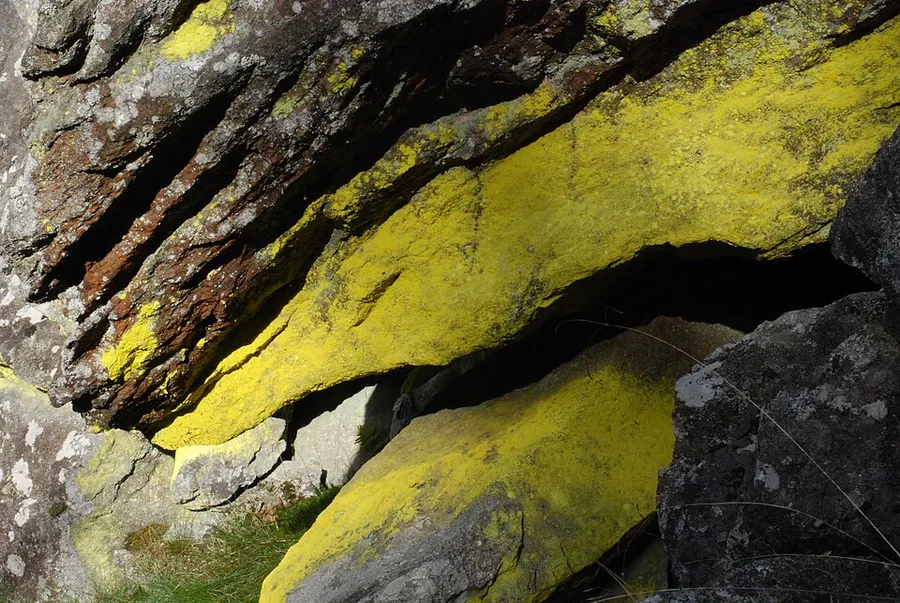
Chrysothrix chlorina has a circumboreal distribution. It predominantly grows within the boreal forest zones of Europe, spanning from northern Italy to Scandinavia. Its presence is also noted in the Himalayas and North America, where it favours shaded, dry locales under rock overhangs and crevices. On occasion, it extends to mosses and other lichens. In eastern North America, it has a northerly distribution, with documented collections reaching as far north as Lake Nipigon, Ontario, and Vermont. Additional records indicate occurrences in Macaronesia, Antarctica, and the Russian Arctic. A specimen from the Tehri Garhwal district of Uttar Pradesh, India, was collected at an altitude of 3350 m. In Nepal, C. chlorina has been reported from 3,100 to 3,200 m elevation in a compilation of published records. Chrysothrix chlorina prefers shaded environments and avoids areas with high nitrogen levels, such as near bird colonies. Its preference for shaded locations is more so than Lepraria incana, another prevalent dust lichen. Although C. chlorina infrequently grows on bark, it opts for the notably acidic trunks of conifers when it does. Instances of this lichen on man-made surfaces are rare.
- Habitat atau konteks temuan
- hutan
- Substrat
- kulit kayu
- Peran atau konteks
- Pembentuk liken
Reproduksi
Chrysothrix chlorina is characterised by its crustaceous and (powdery) thallus. It typically forms a continuous thallus, ranging from non- to strongly areolate, that is yellow to yellow-green in colour. This crust comprises (powdery) with diameters between 0.1 and 0.2 mm, and can be up to about 1 mm thick. These granules, known as soredia (a type of reproductive propagule), consist of algal cells encased in fungal hyphae. The species does not have a thallus margin or a , and is devoid of apothecia (sexual reproductive structures) and pycnidia (asexual reproductive structures).
Catatan identitas dan cakupan
- Nama diterima mengikuti Catalogue of Life Base2026-09-11; uraian mempertahankan konsep dan nama sumber aslinya.
- Original geographic, specimen and life-cycle scope retained; source import awaits individual editorial review.
- Impor dan terjemahan otomatis belum diperiksa editorial per profil. Struktur reproduktif yang disebutkan tidak membuktikan seluruh siklus hidup diketahui.
- Pengukuran pada uraian mengikuti spesimen, kultur, dan metode sumber; angka tidak diperluas ke semua populasi.
Catatan distribusi dalam narasi mengikuti sumbernya. Dokumentasi spesimen atau foto mengikuti catatan sumber. Bukti wilayah Indonesia dan penilaian konservasi tidak disimpulkan dari gambar.
Melihat dengan konteks
Dokumentasi Chrysothrix chlorina dari Wikimedia Commons. Chrysothrix chlorina (yellow), Unteres Rannatal, Austria Identifikasi mengikuti record berkas sumber.
- Jenis
- Fotografi
- Kredit
- Tigerente
- Lisensi
- CC BY-SA 3.0
- Sumber media
- Buka entri sumber
Sumber profil
- [1] Chrysothrix chlorina — Wikipedia (en)
- [2] Catalogue of Life Base2026-09-11 — Chrysothrix chlorina
- [3] Dokumentasi visual — Chrysothrix chlorina
Rujukan halaman ini
Fungi. Chrysothrix chlorina. Rilis data fungi-2026-10-12-expansion-2. https://fungi-atlas.mgadib.chatgpt.site/jamur/chrysothrix-chlorina/.
Status: impor sumber; pemeriksaan editorial per profil belum selesai. Untuk klaim biologis, gunakan rujukan pada bagian terkait dan periksa konteks sumber aslinya.