01 / Morfologi

Ciri dan struktur

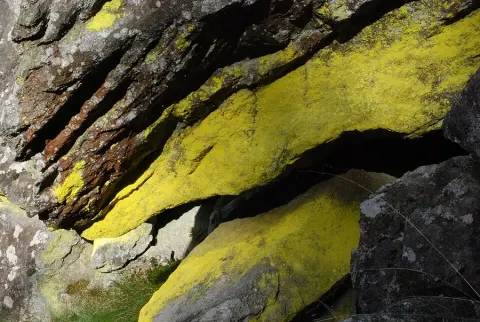
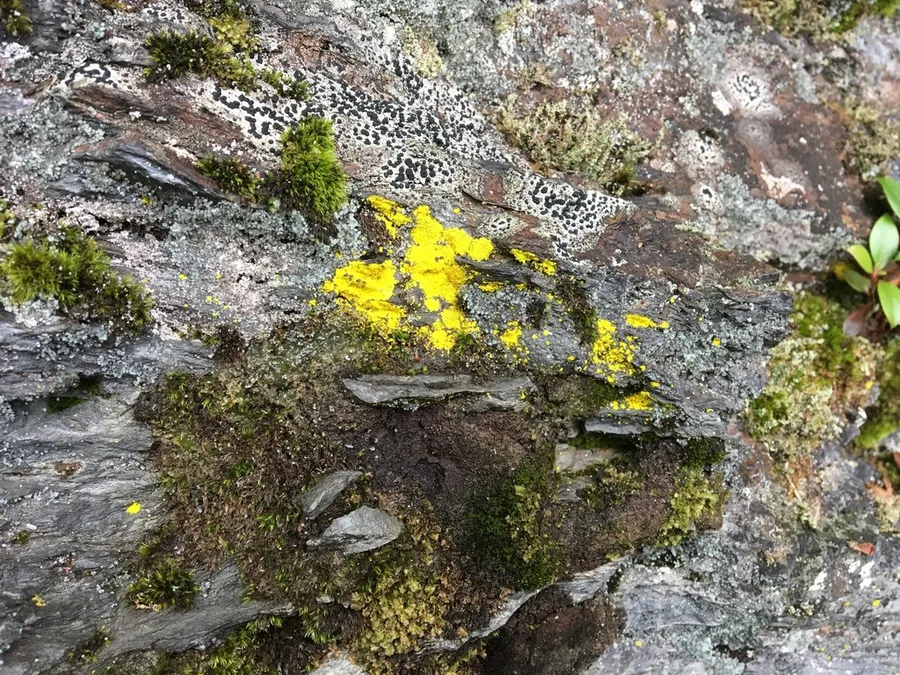
Chrysothrix onokoensis forms a crustose (crust-like), - thallus that appears as a thick, bright yellow to bright yellow-green growth on rock surfaces. The thallus lacks a protective outer layer () and is loosely attached to the , making it easy to separate from the rock. It does not form well-defined but instead creates extensive, irregularly spreading patches up to 10 cm wide and about 1 mm thick. The lichen's structure consists of two distinct layers: an upper layer of yellow granules and a lower layer of whitish to brownish (fungal filaments that attach to the substrate) up to 0.6 mm thick. These rhizohyphae are initially colorless but become brown with age, measuring 3.5–6.5 μm in thickness. The (the algal partner in the lichen symbiosis) is a green alga that is spherical in shape and measures between 7–20 μm in diameter, most commonly 10–15 μm. The granules that make up the upper layer are variable in shape, either spherical or somewhat irregular, measuring 20–80 μm across, and usually have projecting fungal filaments (hyphae). These hyphae are colorless, 2.5–4.5 μm thick, and possess a rough, colorless sheath up to 1.0 μm thick. No reproductive structures such as apothecia (fruiting bodies) or pycnidia have been observed in this species. Chemical tests (spot tests) on the lichen produce negative results, though it may show a dull orange reaction under ultraviolet light. The primary secondary metabolite present appears to be leprapinic acid, though further studies are needed to confirm this. A lookalike rock-dwelling species with a similar distribution is Chrysothrix susquehannensis.

Sebagian uraian ditampilkan dalam bahasa sumber; terjemahannya belum tersedia atau belum lolos pemeriksaan.

Rujukan: [1]

Pengukuran mengikuti objek, spesimen atau kultur, dan metode yang disebutkan sumber. Baca uraian asli untuk konteks lengkap.

02 / Kehidupan

Habitat dan peran ekologis

Chrysothrix onokoensis primarily grows on shaded sandstone rocks, with one documented exception from Alabama where it was found on limestone. It thrives in sheltered environments beneath large, damp acidic rock formations. The species has a somewhat disjunct distribution pattern, with most collections coming from the southeastern United States, particularly Arkansas, where it has been found in multiple locations within the Ozark – St. Francis National Forest, including the Boston Mountains, White Rock Wildlife Management Area, Alum Cove recreation area, and Blanchard Springs recreation area. Other documented locations include Buck's Pocket State Park in Alabama and Broxton Rocks ecological preserve in Georgia. The type locality in Glen Onoko, Carbon County, Pennsylvania appears somewhat isolated from the main distribution range of the species. However, this area is known to harbor rare plants that are disjunct from more southern regions, including species typically found in the Ozarks. Unlike the similar species Chrysothrix chlorina, which has a different distribution pattern, C. onokoensis seems to prefer the specific environmental conditions found in these scattered, protected rocky habitats of the eastern United States.

Sebagian uraian ditampilkan dalam bahasa sumber; terjemahannya belum tersedia atau belum lolos pemeriksaan.

Rujukan: [1]

Habitat atau konteks temuan
hutan
Substrat
Informasi belum tersedia pada sumber rilis ini.
Peran atau konteks
Pembentuk liken
Temukan hubungan serupa
03 / Siklus hidup

Reproduksi

The granules that make up the upper layer are variable in shape, either spherical or somewhat irregular, measuring 20–80 μm across, and usually have projecting fungal filaments (hyphae). These hyphae are colorless, 2.5–4.5 μm thick, and possess a rough, colorless sheath up to 1.0 μm thick. No reproductive structures such as apothecia (fruiting bodies) or pycnidia have been observed in this species. Chemical tests (spot tests) on the lichen produce negative results, though it may show a dull orange reaction under ultraviolet light. The primary secondary metabolite present appears to be leprapinic acid, though further studies are needed to confirm this.

Sebagian uraian ditampilkan dalam bahasa sumber; terjemahannya belum tersedia atau belum lolos pemeriksaan.

Rujukan: [1]

04 / Batas informasi

Catatan identitas dan cakupan

  • Nama diterima mengikuti Catalogue of Life Base2026-09-11; uraian mempertahankan konsep dan nama sumber aslinya.
  • Original geographic, specimen and life-cycle scope retained; source import awaits individual editorial review.
  • Impor dan terjemahan otomatis belum diperiksa editorial per profil. Struktur reproduktif yang disebutkan tidak membuktikan seluruh siklus hidup diketahui.
  • Pengukuran pada uraian mengikuti spesimen, kultur, dan metode sumber; angka tidak diperluas ke semua populasi.

Catatan distribusi dalam narasi mengikuti sumbernya. Dokumentasi spesimen atau foto mengikuti catatan sumber. Bukti wilayah Indonesia dan penilaian konservasi tidak disimpulkan dari gambar.

05 / Dokumentasi

Melihat dengan konteks

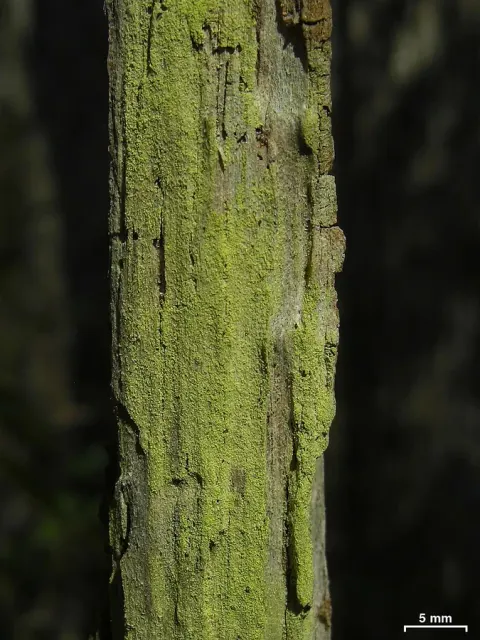
Dokumentasi Chrysothrix onokoensis menurut asosiasi foto pada record takson iNaturalist. Kredit: hansk. Identitas mengikuti sumber; bukan penentuan spesimen independen.

Jenis
Fotografi
Kredit
(c) hansk, some rights reserved (CC BY), uploaded by hansk
Lisensi
CC BY 4.0
Sumber media
Buka entri sumber

Gambar menunjukkan objek menurut identifikasi sumber, bukan verifikasi independen spesimen oleh Fungi. Tidak ada skala baru yang ditambahkan.

06 / Rujukan

Sumber profil

  1. [1] Chrysothrix onokoensis — Wikipedia (en)Bagian sumber: Frozen revision 1341958053
    Tanggal penghimpunan sumber: 2026-10-12
    Teks sumber: CC BY-SA4.0 · Wikipedia contributors
  2. [2] Catalogue of Life Base2026-09-11 — Chrysothrix onokoensisBagian sumber: ColDP NameUsage.tsv ID V2DP; accepted species; source 2073
    Tanggal penghimpunan sumber: 2026-10-12
  3. [3] Dokumentasi visual — Chrysothrix onokoensisBagian sumber: Individual media record; identification follows the source, not independent determination
    Tanggal penghimpunan sumber: 2026-10-12
    Media sumber: CC BY 4.0 · (c) hansk, some rights reserved (CC BY), uploaded by hansk

Adaptasi teks: CC BY-SA 4.0. Wikipedia contributors — Chrysothrix onokoensis — Wikipedia (en)

Uraian asli dan riwayat sumber

Riwayat atau halaman sumber

Ringkasan sumber

Chrysothrix onokoensis is a species of crustose lichen in the family Chrysotrichaceae. Originally described as an alga by Francis Wolle in 1877, it was recognized as a lichen by Asa Gray shortly after, but not formally reclassified until 2008. This distinctive bright yellow to yellow-green lichen forms loosely attached, irregularly spreading patches on rock surfaces, primarily shaded sandstone. It has a somewhat disjunct distribution in the eastern United States, with most collections coming from the Ozark–St.

Revisi sumber

Morfologi sumber

Chrysothrix onokoensis forms a crustose (crust-like), - thallus that appears as a thick, bright yellow to bright yellow-green growth on rock surfaces. The thallus lacks a protective outer layer () and is loosely attached to the , making it easy to separate from the rock. It does not form well-defined but instead creates extensive, irregularly spreading patches up to 10 cm wide and about 1 mm thick. The lichen's structure consists of two distinct layers: an upper layer of yellow granules and a lower layer of whitish to brownish (fungal filaments that attach to the substrate) up to 0.6 mm thick. These rhizohyphae are initially colorless but become brown with age, measuring 3.5–6.5 μm in thickness. The (the algal partner in the lichen symbiosis) is a green alga that is spherical in shape and measures between 7–20 μm in diameter, most commonly 10–15 μm. The granules that make up the upper layer are variable in shape, either spherical or somewhat irregular, measuring 20–80 μm across, and usually have projecting fungal filaments (hyphae). These hyphae are colorless, 2.5–4.5 μm thick, and possess a rough, colorless sheath up to 1.0 μm thick. No reproductive structures such as apothecia (fruiting bodies) or pycnidia have been observed in this species. Chemical tests (spot tests) on the lichen produce negative results, though it may show a dull orange reaction under ultraviolet light. The primary secondary metabolite present appears to be leprapinic acid, though further studies are needed to confirm this. A lookalike rock-dwelling species with a similar distribution is Chrysothrix susquehannensis.

Revisi sumber

Ekologi sumber

Chrysothrix onokoensis primarily grows on shaded sandstone rocks, with one documented exception from Alabama where it was found on limestone. It thrives in sheltered environments beneath large, damp acidic rock formations. The species has a somewhat disjunct distribution pattern, with most collections coming from the southeastern United States, particularly Arkansas, where it has been found in multiple locations within the Ozark – St. Francis National Forest, including the Boston Mountains, White Rock Wildlife Management Area, Alum Cove recreation area, and Blanchard Springs recreation area. Other documented locations include Buck's Pocket State Park in Alabama and Broxton Rocks ecological preserve in Georgia. The type locality in Glen Onoko, Carbon County, Pennsylvania appears somewhat isolated from the main distribution range of the species. However, this area is known to harbor rare plants that are disjunct from more southern regions, including species typically found in the Ozarks. Unlike the similar species Chrysothrix chlorina, which has a different distribution pattern, C. onokoensis seems to prefer the specific environmental conditions found in these scattered, protected rocky habitats of the eastern United States.

Revisi sumber

Struktur reproduksi sumber

The granules that make up the upper layer are variable in shape, either spherical or somewhat irregular, measuring 20–80 μm across, and usually have projecting fungal filaments (hyphae). These hyphae are colorless, 2.5–4.5 μm thick, and possess a rough, colorless sheath up to 1.0 μm thick. No reproductive structures such as apothecia (fruiting bodies) or pycnidia have been observed in this species. Chemical tests (spot tests) on the lichen produce negative results, though it may show a dull orange reaction under ultraviolet light. The primary secondary metabolite present appears to be leprapinic acid, though further studies are needed to confirm this.

Revisi sumber

Rujukan halaman ini

Fungi. Chrysothrix onokoensis. Rilis data fungi-2026-10-12-expansion-2. https://fungi-atlas.mgadib.chatgpt.site/jamur/chrysothrix-onokoensis/.

Status: impor sumber; pemeriksaan editorial per profil belum selesai. Untuk klaim biologis, gunakan rujukan pada bagian terkait dan periksa konteks sumber aslinya.