01 / Morfologi

Ciri dan struktur

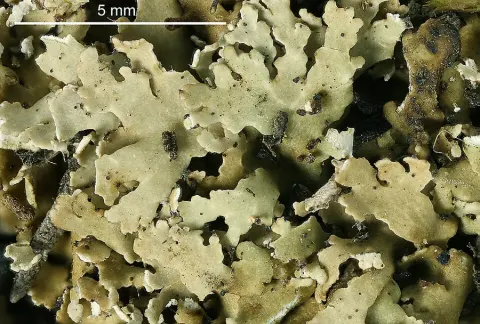
The forms a persistent mat of small (scale-like lobes) that are grey to brown, often darkening with age or weathering. Podetia (upright stalks) are produced sparingly. They are usually short, about 5–20 mm tall (occasionally taller), and typically club-shaped () to slender. The podetia have a firm outer layer (they are ) along their full length. Their surface is distinctly "checkered", made up of small, flat patches (), and they do not form cups (they are ascyphous). Small squamules on the podetia occur mainly near the base and are not abundant. Fruiting bodies are common. The podetia become fertile early and usually bear apothecia (sexual fruiting bodies) with brown discs. Asexual spore-producing structures (conidiomata/pycnidia) can occur on the primary squamules, but they are uncommon and can be easy to miss. In standard chemical spot tests, the thallus shows a yellow K reaction (K+) and a weak yellow PD reaction (PD+). The lichen substances reported for the species include atranorin and (often) homosekikaic acid. More rarely, specimens contain only homosekikaic acid, and rangiformic acid has been reported only exceptionally.

Sebagian uraian ditampilkan dalam bahasa sumber; terjemahannya belum tersedia atau belum lolos pemeriksaan.

Rujukan: [1]

Pengukuran mengikuti objek, spesimen atau kultur, dan metode yang disebutkan sumber. Baca uraian asli untuk konteks lengkap.

02 / Kehidupan

Habitat dan peran ekologis

Cladonia scotteri grows on soil, most often on calcareous (lime-rich) ground, but it has also been recorded on somewhat acidic, humus-rich soils. It is primarily a tundra species, though it has also been recorded in boreal forest habitats. The type collection from Nahanni National Park was made on disturbed ground along a trampled path near a waterfall lookout, indicating that the species can occur on lightly disturbed soil surfaces. In Greenland, it is fairly common in the west but much rarer in the east. Beyond Greenland, records extend across western North America and northeastern Asia. Its full range is still being clarified because older herbarium material from several regions likely includes additional specimens that have not yet been reviewed. Documented records include Arctic and subarctic North America (for example, the Northwest Territories and Alaska), montane sites farther south in western North America (including the southwestern United States), northeastern Asia (parts of Siberia), and one locality on the Antarctic Peninsula.

Sebagian uraian ditampilkan dalam bahasa sumber; terjemahannya belum tersedia atau belum lolos pemeriksaan.

Rujukan: [1]

Habitat atau konteks temuan
hutan
Substrat
tanah
Peran atau konteks
Pembentuk liken
Temukan hubungan serupa
03 / Siklus hidup

Reproduksi

Fruiting bodies are common. The podetia become fertile early and usually bear apothecia (sexual fruiting bodies) with brown discs. Asexual spore-producing structures (conidiomata/pycnidia) can occur on the primary squamules, but they are uncommon and can be easy to miss. In standard chemical spot tests, the thallus shows a yellow K reaction (K+) and a weak yellow PD reaction (PD+). The lichen substances reported for the species include atranorin and (often) homosekikaic acid. More rarely, specimens contain only homosekikaic acid, and rangiformic acid has been reported only exceptionally.

Sebagian uraian ditampilkan dalam bahasa sumber; terjemahannya belum tersedia atau belum lolos pemeriksaan.

Rujukan: [1]

04 / Batas informasi

Catatan identitas dan cakupan

  • Nama diterima mengikuti Catalogue of Life Base2026-09-11; uraian mempertahankan konsep dan nama sumber aslinya.
  • Original geographic, specimen and life-cycle scope retained; source import awaits individual editorial review.
  • Impor dan terjemahan otomatis belum diperiksa editorial per profil. Struktur reproduktif yang disebutkan tidak membuktikan seluruh siklus hidup diketahui.
  • Pengukuran pada uraian mengikuti spesimen, kultur, dan metode sumber; angka tidak diperluas ke semua populasi.

Catatan distribusi dalam narasi mengikuti sumbernya. Dokumentasi spesimen atau foto mengikuti catatan sumber. Bukti wilayah Indonesia dan penilaian konservasi tidak disimpulkan dari gambar.

05 / Dokumentasi

Melihat dengan konteks

Dokumentasi visual yang memenuhi pemeriksaan subjek dan hak penggunaan belum tersedia. Foto gejala, label, dan gambar yang meragukan tidak dihitung.

06 / Rujukan

Sumber profil

  1. [1] Cladonia scotteri — Wikipedia (en)Bagian sumber: Frozen revision 1336145499
    Tanggal penghimpunan sumber: 2026-10-12
    Teks sumber: CC BY-SA4.0 · Wikipedia contributors
  2. [2] Catalogue of Life Base2026-09-11 — Cladonia scotteriBagian sumber: ColDP NameUsage.tsv ID VPLF; accepted species; source 2073
    Tanggal penghimpunan sumber: 2026-10-12

Adaptasi teks: CC BY-SA 4.0. Wikipedia contributors — Cladonia scotteri — Wikipedia (en)

Uraian asli dan riwayat sumber

Riwayat atau halaman sumber

Ringkasan sumber

Cladonia scotteri (Scotter's lichen) is a species of lichen in the family Cladoniaceae. Described in 2011 from Nahanni National Park Reserve in the Northwest Territories, Canada, this mainly tundra lichen forms a persistent mat of small, grey-to-brown (scale-like lobes). It also produces short, club-shaped podetia (upright stalks) with a distinctly checkered surface, usually topped with brown apothecia (fruiting bodies). It grows mainly on calcareous (lime-rich) soils in Arctic and subarctic regions, and is recorded from western North America, Greenland, and northeastern Asia (with one reported record from the Antarctic Peninsula).

Revisi sumber

Morfologi sumber

The forms a persistent mat of small (scale-like lobes) that are grey to brown, often darkening with age or weathering. Podetia (upright stalks) are produced sparingly. They are usually short, about 5–20 mm tall (occasionally taller), and typically club-shaped () to slender. The podetia have a firm outer layer (they are ) along their full length. Their surface is distinctly "checkered", made up of small, flat patches (), and they do not form cups (they are ascyphous). Small squamules on the podetia occur mainly near the base and are not abundant. Fruiting bodies are common. The podetia become fertile early and usually bear apothecia (sexual fruiting bodies) with brown discs. Asexual spore-producing structures (conidiomata/pycnidia) can occur on the primary squamules, but they are uncommon and can be easy to miss. In standard chemical spot tests, the thallus shows a yellow K reaction (K+) and a weak yellow PD reaction (PD+). The lichen substances reported for the species include atranorin and (often) homosekikaic acid. More rarely, specimens contain only homosekikaic acid, and rangiformic acid has been reported only exceptionally.

Revisi sumber

Ekologi sumber

Cladonia scotteri grows on soil, most often on calcareous (lime-rich) ground, but it has also been recorded on somewhat acidic, humus-rich soils. It is primarily a tundra species, though it has also been recorded in boreal forest habitats. The type collection from Nahanni National Park was made on disturbed ground along a trampled path near a waterfall lookout, indicating that the species can occur on lightly disturbed soil surfaces. In Greenland, it is fairly common in the west but much rarer in the east. Beyond Greenland, records extend across western North America and northeastern Asia. Its full range is still being clarified because older herbarium material from several regions likely includes additional specimens that have not yet been reviewed. Documented records include Arctic and subarctic North America (for example, the Northwest Territories and Alaska), montane sites farther south in western North America (including the southwestern United States), northeastern Asia (parts of Siberia), and one locality on the Antarctic Peninsula.

Revisi sumber

Struktur reproduksi sumber

Fruiting bodies are common. The podetia become fertile early and usually bear apothecia (sexual fruiting bodies) with brown discs. Asexual spore-producing structures (conidiomata/pycnidia) can occur on the primary squamules, but they are uncommon and can be easy to miss. In standard chemical spot tests, the thallus shows a yellow K reaction (K+) and a weak yellow PD reaction (PD+). The lichen substances reported for the species include atranorin and (often) homosekikaic acid. More rarely, specimens contain only homosekikaic acid, and rangiformic acid has been reported only exceptionally.

Revisi sumber

Rujukan halaman ini

Fungi. Cladonia scotteri. Rilis data fungi-2026-10-12-expansion-2. https://fungi-atlas.mgadib.chatgpt.site/jamur/cladonia-scotteri/.

Status: impor sumber; pemeriksaan editorial per profil belum selesai. Untuk klaim biologis, gunakan rujukan pada bagian terkait dan periksa konteks sumber aslinya.