01 / Morfologi

Ciri dan struktur

The body (thallus) is a thin, spreading crust that is whitish to greenish gray and may be inconspicuous or partly disrupt the bark surface; it is usually bordered by reddish-brown boundary lines (). The algal partner () is from the green algal genus Trentepohlia, with oval (ellipsoid) cells arranged in short chains. The fruiting bodies (ascomata) develop in the outermost bark layers and may be partly covered by a thin bark film when young. They are irregularly rounded to elongated and often forked, with poorly defined margins, and they sit level with the thallus as flat, crimson-red patches with a powdery () surface. In cross-section they are about 70–120 μm thick. Under the microscope, the uppermost tissue layer () is packed with crimson crystals and is only weakly gelatinized (described as water-repellent), with a largely colorless (hyaline) spore-bearing layer (hymenium) beneath. The tissue below the hymenium () also contains red crystals, but less densely. The asci are widely dispersed, nearly spherical (subglobose), and each contains eight ascospores. The ascospores are colorless, oval to pear-shaped (ellipsoid to ), typically with 6–7 transverse septa (rarely with an additional longitudinal one), measuring about 34–40 × 13–17 μm. In chemical tests, the crimson pigments dissolve in K (potassium hydroxide solution), giving a purplish-orange reaction. Grube characterised several purplish pigment fractions (Pyr1–Pyr3) by thin-layer chromatography from the fruiting bodies.

Sebagian uraian ditampilkan dalam bahasa sumber; terjemahannya belum tersedia atau belum lolos pemeriksaan.

Rujukan: [1]

Pengukuran mengikuti objek, spesimen atau kultur, dan metode yang disebutkan sumber. Baca uraian asli untuk konteks lengkap.

02 / Kehidupan

Habitat dan peran ekologis

Coniarthonia pyrrhula is an epiphytic, bark-dwelling lichen reported from bark of angiosperms. Its range spans North, Central, and South America, with additional records from Macaronesia. Because it is often collected in a sterile or poorly fertile state, it can be confused with C. gregarina when mature asci and spores are absent.

Sebagian uraian ditampilkan dalam bahasa sumber; terjemahannya belum tersedia atau belum lolos pemeriksaan.

Rujukan: [1]

Habitat atau konteks temuan
Informasi belum tersedia pada sumber rilis ini.
Substrat
Informasi belum tersedia pada sumber rilis ini.
Peran atau konteks
Pembentuk liken
Temukan hubungan serupa
03 / Siklus hidup

Reproduksi

The fruiting bodies (ascomata) develop in the outermost bark layers and may be partly covered by a thin bark film when young. They are irregularly rounded to elongated and often forked, with poorly defined margins, and they sit level with the thallus as flat, crimson-red patches with a powdery () surface. In cross-section they are about 70–120 μm thick. Under the microscope, the uppermost tissue layer () is packed with crimson crystals and is only weakly gelatinized (described as water-repellent), with a largely colorless (hyaline) spore-bearing layer (hymenium) beneath. The tissue below the hymenium () also contains red crystals, but less densely. The asci are widely dispersed, nearly spherical (subglobose), and each contains eight ascospores.

Sebagian uraian ditampilkan dalam bahasa sumber; terjemahannya belum tersedia atau belum lolos pemeriksaan.

Rujukan: [1]

Sinonim menurut acuan taksonomi rilis: Arthonia pyrrhula
04 / Batas informasi

Catatan identitas dan cakupan

  • Nama diterima mengikuti Catalogue of Life Base2026-09-11; uraian mempertahankan konsep dan nama sumber aslinya.
  • Original geographic, specimen and life-cycle scope retained; source import awaits individual editorial review.
  • Impor dan terjemahan otomatis belum diperiksa editorial per profil. Struktur reproduktif yang disebutkan tidak membuktikan seluruh siklus hidup diketahui.
  • Pengukuran pada uraian mengikuti spesimen, kultur, dan metode sumber; angka tidak diperluas ke semua populasi.

Catatan distribusi dalam narasi mengikuti sumbernya. Dokumentasi spesimen atau foto mengikuti catatan sumber. Bukti wilayah Indonesia dan penilaian konservasi tidak disimpulkan dari gambar.

05 / Dokumentasi

Melihat dengan konteks

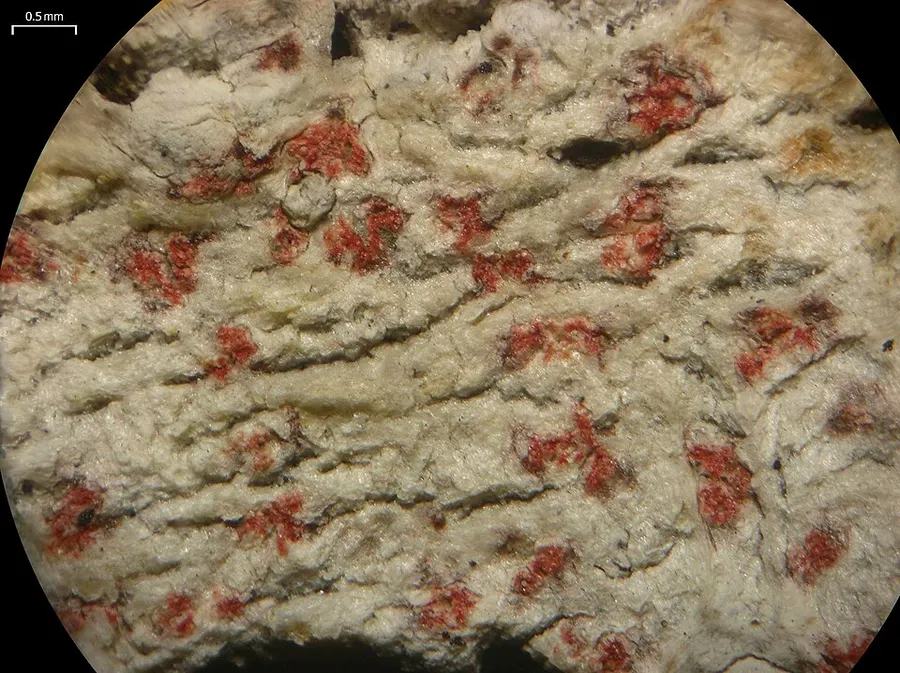
Dokumentasi Coniarthonia pyrrhula dari Wikimedia Commons. on Myrica, Chincoteague National Wildlife Refuge, Delmarva, MD, 20140319 ver. J. Lendemer 6103, at NY stacked with CombineZP Identifikasi mengikuti record berkas sumber.

Jenis
Fotografi
Kredit
Jason Hollinger
Lisensi
CC BY 2.0
Sumber media
Buka entri sumber

Gambar menunjukkan objek menurut identifikasi sumber, bukan verifikasi independen spesimen oleh Fungi. Tidak ada skala baru yang ditambahkan.

06 / Rujukan

Sumber profil

  1. [1] Coniarthonia pyrrhula — Wikipedia (en)Bagian sumber: Frozen revision 1343695560
    Tanggal penghimpunan sumber: 2026-10-12
    Teks sumber: CC BY-SA4.0 · Wikipedia contributors
  2. [2] Catalogue of Life Base2026-09-11 — Coniarthonia pyrrhulaBagian sumber: ColDP NameUsage.tsv ID XLRL; accepted species; source 2073
    Tanggal penghimpunan sumber: 2026-10-12
  3. [3] Dokumentasi visual — Coniarthonia pyrrhulaBagian sumber: Individual media record; identification follows the source, not independent determination
    Tanggal penghimpunan sumber: 2026-10-12
    Media sumber: CC BY 2.0 · Jason Hollinger

Adaptasi teks: CC BY-SA 4.0. Wikipedia contributors — Coniarthonia pyrrhula — Wikipedia (en)

Uraian asli dan riwayat sumber

Riwayat atau halaman sumber

Ringkasan sumber

Coniarthonia pyrrhula is a species of crustose lichen-forming fungus in the family Arthoniaceae. It is a bark-dwelling lichen with a thin, whitish crust and flat, crimson-red fruiting bodies with a floury surface, found across the Americas and in Macaronesia. It is the type species of the genus Coniarthonia, described originally in 1885 and transferred to that genus in 2001.

Revisi sumber

Morfologi sumber

The body (thallus) is a thin, spreading crust that is whitish to greenish gray and may be inconspicuous or partly disrupt the bark surface; it is usually bordered by reddish-brown boundary lines (). The algal partner () is from the green algal genus Trentepohlia, with oval (ellipsoid) cells arranged in short chains. The fruiting bodies (ascomata) develop in the outermost bark layers and may be partly covered by a thin bark film when young. They are irregularly rounded to elongated and often forked, with poorly defined margins, and they sit level with the thallus as flat, crimson-red patches with a powdery () surface. In cross-section they are about 70–120 μm thick. Under the microscope, the uppermost tissue layer () is packed with crimson crystals and is only weakly gelatinized (described as water-repellent), with a largely colorless (hyaline) spore-bearing layer (hymenium) beneath. The tissue below the hymenium () also contains red crystals, but less densely. The asci are widely dispersed, nearly spherical (subglobose), and each contains eight ascospores. The ascospores are colorless, oval to pear-shaped (ellipsoid to ), typically with 6–7 transverse septa (rarely with an additional longitudinal one), measuring about 34–40 × 13–17 μm. In chemical tests, the crimson pigments dissolve in K (potassium hydroxide solution), giving a purplish-orange reaction. Grube characterised several purplish pigment fractions (Pyr1–Pyr3) by thin-layer chromatography from the fruiting bodies.

Revisi sumber

Ekologi sumber

Coniarthonia pyrrhula is an epiphytic, bark-dwelling lichen reported from bark of angiosperms. Its range spans North, Central, and South America, with additional records from Macaronesia. Because it is often collected in a sterile or poorly fertile state, it can be confused with C. gregarina when mature asci and spores are absent.

Revisi sumber

Struktur reproduksi sumber

The fruiting bodies (ascomata) develop in the outermost bark layers and may be partly covered by a thin bark film when young. They are irregularly rounded to elongated and often forked, with poorly defined margins, and they sit level with the thallus as flat, crimson-red patches with a powdery () surface. In cross-section they are about 70–120 μm thick. Under the microscope, the uppermost tissue layer () is packed with crimson crystals and is only weakly gelatinized (described as water-repellent), with a largely colorless (hyaline) spore-bearing layer (hymenium) beneath. The tissue below the hymenium () also contains red crystals, but less densely. The asci are widely dispersed, nearly spherical (subglobose), and each contains eight ascospores.

Revisi sumber

Rujukan halaman ini

Fungi. Coniarthonia pyrrhula. Rilis data fungi-2026-10-12-expansion-2. https://fungi-atlas.mgadib.chatgpt.site/jamur/coniarthonia-pyrrhula/.

Status: impor sumber; pemeriksaan editorial per profil belum selesai. Untuk klaim biologis, gunakan rujukan pada bagian terkait dan periksa konteks sumber aslinya.