01 / Morfologi

Ciri dan struktur

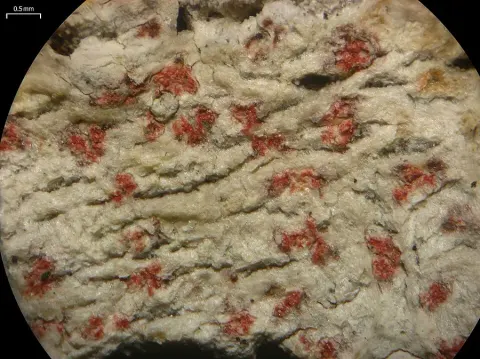
The lichen body (thallus) is a thin, whitish crust with a faint greenish tinge that develops in the upper bark layers. It is spreading and typically bordered by dark reddish-brown boundary lines ( lines); the surface looks slightly powdery. The algal partner () is from the filamentous green algal genus Trentepohlia, with oval (ellipsoid) cells arranged in short chains. The fruiting bodies (ascomata) are scattered and usually irregularly spot-like rather than distinctly elongated, mostly 0.24–1.4 mm across but occasionally reaching 1.8 mm. They lie more or less level with the thallus, becoming slightly convex, and are densely frosted with crimson pigment (). Under the microscope, the outer wall () is poorly defined. The uppermost tissue layer () contains abundant crimson crystals (with a smaller amount of colorless crystals) and is described as water-repellent (hydrophobic), while the spore-bearing layer (hymenium) below has fewer crystals. The asci are widely dispersed and may contain 4, 6, or 8 spores. The ascospores are colorless (hyaline), oval to pear-shaped (ellipsoid to ), and 4-celled (3-septate), often surrounded by a gelatinous sheath that swells in KOH (potassium hydroxide solution). The reddish pigments dissolve in K (KOH solution) and give a purplish-orange reaction, and Grube reported several pigment fractions (Pyr1–Pyr3 and Hae2) detected by thin-layer chromatography, plus an additional trace pigment.

Sebagian uraian ditampilkan dalam bahasa sumber; terjemahannya belum tersedia atau belum lolos pemeriksaan.

Rujukan: [1]

Pengukuran mengikuti objek, spesimen atau kultur, dan metode yang disebutkan sumber. Baca uraian asli untuk konteks lengkap.

02 / Kehidupan

Habitat dan peran ekologis

Coniarthonia wilmsiana is an epiphytic, lichen-forming species on smooth bark. It has been reported from Martinique, Central America, South America, southern Africa, and Australia, indicating a broadly tropical to southern-hemispheric distribution. Based on documented collections and Grube's remarks, it can occur in relatively open sites and may tolerate drier conditions, and it appears to be more common than the sparse literature might suggest (similar in that respect to the type species of the genus, C. pyrrhula).

Sebagian uraian ditampilkan dalam bahasa sumber; terjemahannya belum tersedia atau belum lolos pemeriksaan.

Rujukan: [1]

Habitat atau konteks temuan
Informasi belum tersedia pada sumber rilis ini.
Substrat
Informasi belum tersedia pada sumber rilis ini.
Peran atau konteks
Pembentuk liken
Temukan hubungan serupa
03 / Siklus hidup

Reproduksi

The fruiting bodies (ascomata) are scattered and usually irregularly spot-like rather than distinctly elongated, mostly 0.24–1.4 mm across but occasionally reaching 1.8 mm. They lie more or less level with the thallus, becoming slightly convex, and are densely frosted with crimson pigment (). Under the microscope, the outer wall () is poorly defined. The uppermost tissue layer () contains abundant crimson crystals (with a smaller amount of colorless crystals) and is described as water-repellent (hydrophobic), while the spore-bearing layer (hymenium) below has fewer crystals. The asci are widely dispersed and may contain 4, 6, or 8 spores. The ascospores are colorless (hyaline), oval to pear-shaped (ellipsoid to ), and 4-celled (3-septate), often surrounded by a gelatinous sheath that swells in KOH (potassium hydroxide solution).

Sebagian uraian ditampilkan dalam bahasa sumber; terjemahannya belum tersedia atau belum lolos pemeriksaan.

Rujukan: [1]

Sinonim menurut acuan taksonomi rilis: Arthonia wilmsiana
04 / Batas informasi

Catatan identitas dan cakupan

  • Nama diterima mengikuti Catalogue of Life Base2026-09-11; uraian mempertahankan konsep dan nama sumber aslinya.
  • Original geographic, specimen and life-cycle scope retained; source import awaits individual editorial review.
  • Impor dan terjemahan otomatis belum diperiksa editorial per profil. Struktur reproduktif yang disebutkan tidak membuktikan seluruh siklus hidup diketahui.
  • Pengukuran pada uraian mengikuti spesimen, kultur, dan metode sumber; angka tidak diperluas ke semua populasi.

Catatan distribusi dalam narasi mengikuti sumbernya. Dokumentasi spesimen atau foto mengikuti catatan sumber. Bukti wilayah Indonesia dan penilaian konservasi tidak disimpulkan dari gambar.

05 / Dokumentasi

Melihat dengan konteks

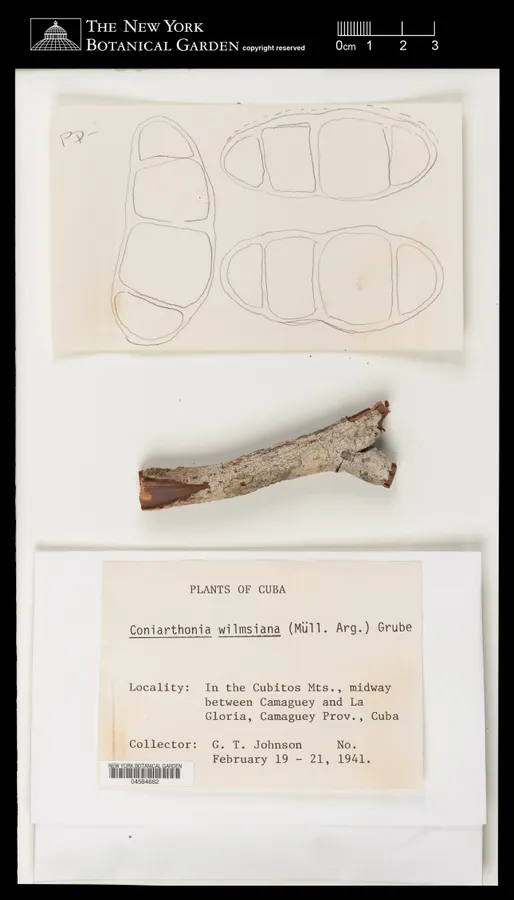
Voucher herbarium Coniarthonia wilmsiana (04584682), The New York Botanical Garden. Identifikasi mengikuti record spesimen sumber. Foto bahan, kemasan, atau label herbarium sebagaimana tersedia pada record institusi; bukan foto lapangan atau penentuan spesimen independen.

Jenis
Voucher herbarium
Kredit
The New York Botanical Garden
Lisensi
CC BY 4.0
Sumber media
Buka entri sumber

Gambar menunjukkan objek menurut identifikasi sumber, bukan verifikasi independen spesimen oleh Fungi. Tidak ada skala baru yang ditambahkan.

06 / Rujukan

Sumber profil

  1. [1] Coniarthonia wilmsiana — Wikipedia (en)Bagian sumber: Frozen revision 1345320854
    Tanggal penghimpunan sumber: 2026-10-12
    Teks sumber: CC BY-SA4.0 · Wikipedia contributors
  2. [2] Catalogue of Life Base2026-09-11 — Coniarthonia wilmsianaBagian sumber: ColDP NameUsage.tsv ID XLRN; accepted species; source 2073
    Tanggal penghimpunan sumber: 2026-10-12
  3. [3] Dokumentasi visual — Coniarthonia wilmsianaBagian sumber: Individual media record; identification follows the source, not independent determination
    Tanggal penghimpunan sumber: 2026-10-12
    Media sumber: CC BY 4.0 · The New York Botanical Garden

Adaptasi teks: CC BY-SA 4.0. Wikipedia contributors — Coniarthonia wilmsiana — Wikipedia (en)

Uraian asli dan riwayat sumber

Riwayat atau halaman sumber

Ringkasan sumber

Coniarthonia wilmsiana is a species of crustose lichen-forming fungus in the family Arthoniaceae. It is a bark-dwelling lichen with a thin, whitish crust and bright crimson, spot-like fruiting bodies, found across the tropics and into the southern hemisphere. The species was originally described from South Africa in 1886 and transferred to Coniarthonia in 2001.

Revisi sumber

Morfologi sumber

The lichen body (thallus) is a thin, whitish crust with a faint greenish tinge that develops in the upper bark layers. It is spreading and typically bordered by dark reddish-brown boundary lines ( lines); the surface looks slightly powdery. The algal partner () is from the filamentous green algal genus Trentepohlia, with oval (ellipsoid) cells arranged in short chains. The fruiting bodies (ascomata) are scattered and usually irregularly spot-like rather than distinctly elongated, mostly 0.24–1.4 mm across but occasionally reaching 1.8 mm. They lie more or less level with the thallus, becoming slightly convex, and are densely frosted with crimson pigment (). Under the microscope, the outer wall () is poorly defined. The uppermost tissue layer () contains abundant crimson crystals (with a smaller amount of colorless crystals) and is described as water-repellent (hydrophobic), while the spore-bearing layer (hymenium) below has fewer crystals. The asci are widely dispersed and may contain 4, 6, or 8 spores. The ascospores are colorless (hyaline), oval to pear-shaped (ellipsoid to ), and 4-celled (3-septate), often surrounded by a gelatinous sheath that swells in KOH (potassium hydroxide solution). The reddish pigments dissolve in K (KOH solution) and give a purplish-orange reaction, and Grube reported several pigment fractions (Pyr1–Pyr3 and Hae2) detected by thin-layer chromatography, plus an additional trace pigment.

Revisi sumber

Ekologi sumber

Coniarthonia wilmsiana is an epiphytic, lichen-forming species on smooth bark. It has been reported from Martinique, Central America, South America, southern Africa, and Australia, indicating a broadly tropical to southern-hemispheric distribution. Based on documented collections and Grube's remarks, it can occur in relatively open sites and may tolerate drier conditions, and it appears to be more common than the sparse literature might suggest (similar in that respect to the type species of the genus, C. pyrrhula).

Revisi sumber

Struktur reproduksi sumber

The fruiting bodies (ascomata) are scattered and usually irregularly spot-like rather than distinctly elongated, mostly 0.24–1.4 mm across but occasionally reaching 1.8 mm. They lie more or less level with the thallus, becoming slightly convex, and are densely frosted with crimson pigment (). Under the microscope, the outer wall () is poorly defined. The uppermost tissue layer () contains abundant crimson crystals (with a smaller amount of colorless crystals) and is described as water-repellent (hydrophobic), while the spore-bearing layer (hymenium) below has fewer crystals. The asci are widely dispersed and may contain 4, 6, or 8 spores. The ascospores are colorless (hyaline), oval to pear-shaped (ellipsoid to ), and 4-celled (3-septate), often surrounded by a gelatinous sheath that swells in KOH (potassium hydroxide solution).

Revisi sumber

Rujukan halaman ini

Fungi. Coniarthonia wilmsiana. Rilis data fungi-2026-10-12-expansion-2. https://fungi-atlas.mgadib.chatgpt.site/jamur/coniarthonia-wilmsiana/.

Status: impor sumber; pemeriksaan editorial per profil belum selesai. Untuk klaim biologis, gunakan rujukan pada bagian terkait dan periksa konteks sumber aslinya.