01 / Morfologi

Ciri dan struktur

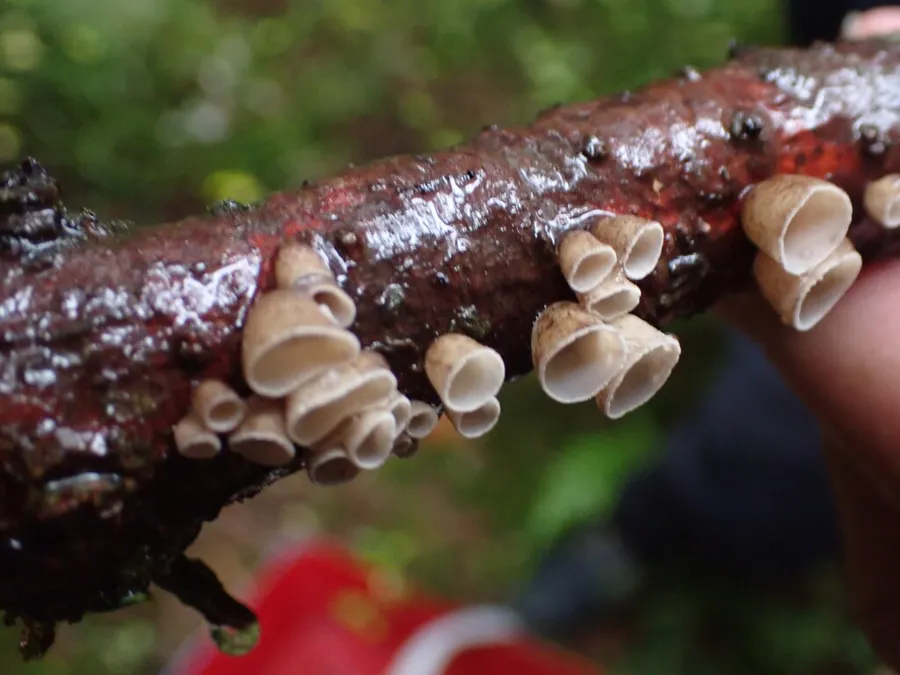
This species is identified with small, tube like basidiomata in circular to oval shaping. It has a cream, beige, or darker brown coloration, sometimes with tree bark like patterns and streaking on the outside of the structures. They appear to be hygrophanous, turning a darker shade in the presence of water. The inside of the body is typically a lighter cream to whitened color. Appears as a thin tube clumped closely together in clusters, with each individual cup growing up to 10-15 mm in diameter. They have no visible stipe and are typically rooted by either the base of the cup or one side, then hanging free from that rooted area. Cyphella digitalis has a distinct lack of gills and has a somewhat flexible membrane.

Sebagian uraian ditampilkan dalam bahasa sumber; terjemahannya belum tersedia atau belum lolos pemeriksaan.

Rujukan: [1]

Pengukuran mengikuti objek, spesimen atau kultur, dan metode yang disebutkan sumber. Baca uraian asli untuk konteks lengkap.

02 / Kehidupan

Habitat dan peran ekologis

Found mostly through Germany, Austria, Switzerland, Denmark, the Czech Republic, and Slovakia, Cyphella digitalis can be located dominantly on silver fir trees. It is almost exclusive found on these silver fir trees, due to a reliant symbiotic relationship, however has been observed in rare cases to be seen in Denmark without the Silver fir trees present. This observation has not be confirmed since initially being described.

Sebagian uraian ditampilkan dalam bahasa sumber; terjemahannya belum tersedia atau belum lolos pemeriksaan.

Rujukan: [1]

Habitat atau konteks temuan
Informasi belum tersedia pada sumber rilis ini.
Substrat
Informasi belum tersedia pada sumber rilis ini.
Peran atau konteks
Belum dikategorikan pada rilis ini.
Temukan hubungan serupa
03 / Siklus hidup

Reproduksi

This species is identified with small, tube like basidiomata in circular to oval shaping. It has a cream, beige, or darker brown coloration, sometimes with tree bark like patterns and streaking on the outside of the structures. They appear to be hygrophanous, turning a darker shade in the presence of water. The inside of the body is typically a lighter cream to whitened color. Appears as a thin tube clumped closely together in clusters, with each individual cup growing up to 10-15 mm in diameter. They have no visible stipe and are typically rooted by either the base of the cup or one side, then hanging free from that rooted area. Cyphella digitalis has a distinct lack of gills and has a somewhat flexible membrane.

Sebagian uraian ditampilkan dalam bahasa sumber; terjemahannya belum tersedia atau belum lolos pemeriksaan.

Rujukan: [1]

Sinonim menurut acuan taksonomi rilis: Aleurodiscus digitalis; Chaetocypha digitalis; Chaetocypha pendula; Enslinia pendula; Peziza pendula; Solenia digitalis
04 / Batas informasi

Catatan identitas dan cakupan

  • Nama diterima mengikuti Catalogue of Life Base2026-09-11; uraian mempertahankan konsep dan nama sumber aslinya.
  • Original geographic, specimen and life-cycle scope retained; source import awaits individual editorial review.
  • Impor dan terjemahan otomatis belum diperiksa editorial per profil. Struktur reproduktif yang disebutkan tidak membuktikan seluruh siklus hidup diketahui.
  • Pengukuran pada uraian mengikuti spesimen, kultur, dan metode sumber; angka tidak diperluas ke semua populasi.

Catatan distribusi dalam narasi mengikuti sumbernya. Dokumentasi spesimen atau foto mengikuti catatan sumber. Bukti wilayah Indonesia dan penilaian konservasi tidak disimpulkan dari gambar.

05 / Dokumentasi

Melihat dengan konteks

Dokumentasi Cyphella digitalis menurut asosiasi foto pada record takson iNaturalist. Kredit: Fotografer tidak dicantumkan. Sumber observasi iNaturalist; pengunggah: T. Pedro Hafermann. Identitas mengikuti sumber; bukan penentuan spesimen independen.

Jenis
Fotografi
Kredit
Fotografer tidak dicantumkan. Sumber observasi iNaturalist; pengunggah: T. Pedro Hafermann
Lisensi
CC0 1.0
Sumber media
Buka entri sumber

Gambar menunjukkan objek menurut identifikasi sumber, bukan verifikasi independen spesimen oleh Fungi. Tidak ada skala baru yang ditambahkan.

06 / Rujukan

Sumber profil

  1. [1] Cyphella digitalis — Wikipedia (en)Bagian sumber: Frozen revision 1319954888
    Tanggal penghimpunan sumber: 2026-10-12
    Teks sumber: CC BY-SA4.0 · Wikipedia contributors
  2. [2] Catalogue of Life Base2026-09-11 — Cyphella digitalisBagian sumber: ColDP NameUsage.tsv ID 6BVJR; accepted species; source 2073
    Tanggal penghimpunan sumber: 2026-10-12
  3. [3] Dokumentasi visual — Cyphella digitalisBagian sumber: Individual media record; identification follows the source, not independent determination
    Tanggal penghimpunan sumber: 2026-10-12
    Media sumber: CC0 1.0 · Fotografer tidak dicantumkan. Sumber observasi iNaturalist; pengunggah: T. Pedro Hafermann

Adaptasi teks: CC BY-SA 4.0. Wikipedia contributors — Cyphella digitalis — Wikipedia (en)

Uraian asli dan riwayat sumber

Riwayat atau halaman sumber

Ringkasan sumber

This species is identified with small, tube like basidiomata in circular to oval shaping. It has a cream, beige, or darker brown coloration, sometimes with tree bark like patterns and streaking on the outside of the structures. They appear to be hygrophanous, turning a darker shade in the presence of water. The inside of the body is typically a lighter cream to whitened color. Appears as a thin tube clumped closely together in clusters, with each individual cup growing up to 10-15 mm in diameter.

Revisi sumber

Morfologi sumber

This species is identified with small, tube like basidiomata in circular to oval shaping. It has a cream, beige, or darker brown coloration, sometimes with tree bark like patterns and streaking on the outside of the structures. They appear to be hygrophanous, turning a darker shade in the presence of water. The inside of the body is typically a lighter cream to whitened color. Appears as a thin tube clumped closely together in clusters, with each individual cup growing up to 10-15 mm in diameter. They have no visible stipe and are typically rooted by either the base of the cup or one side, then hanging free from that rooted area. Cyphella digitalis has a distinct lack of gills and has a somewhat flexible membrane.

Revisi sumber

Ekologi sumber

Found mostly through Germany, Austria, Switzerland, Denmark, the Czech Republic, and Slovakia, Cyphella digitalis can be located dominantly on silver fir trees. It is almost exclusive found on these silver fir trees, due to a reliant symbiotic relationship, however has been observed in rare cases to be seen in Denmark without the Silver fir trees present. This observation has not be confirmed since initially being described.

Revisi sumber

Struktur reproduksi sumber

This species is identified with small, tube like basidiomata in circular to oval shaping. It has a cream, beige, or darker brown coloration, sometimes with tree bark like patterns and streaking on the outside of the structures. They appear to be hygrophanous, turning a darker shade in the presence of water. The inside of the body is typically a lighter cream to whitened color. Appears as a thin tube clumped closely together in clusters, with each individual cup growing up to 10-15 mm in diameter. They have no visible stipe and are typically rooted by either the base of the cup or one side, then hanging free from that rooted area. Cyphella digitalis has a distinct lack of gills and has a somewhat flexible membrane.

Revisi sumber

Rujukan halaman ini

Fungi. Cyphella digitalis. Rilis data fungi-2026-10-12-expansion-2. https://fungi-atlas.mgadib.chatgpt.site/jamur/cyphella-digitalis/.

Status: impor sumber; pemeriksaan editorial per profil belum selesai. Untuk klaim biologis, gunakan rujukan pada bagian terkait dan periksa konteks sumber aslinya.