Ciri dan struktur
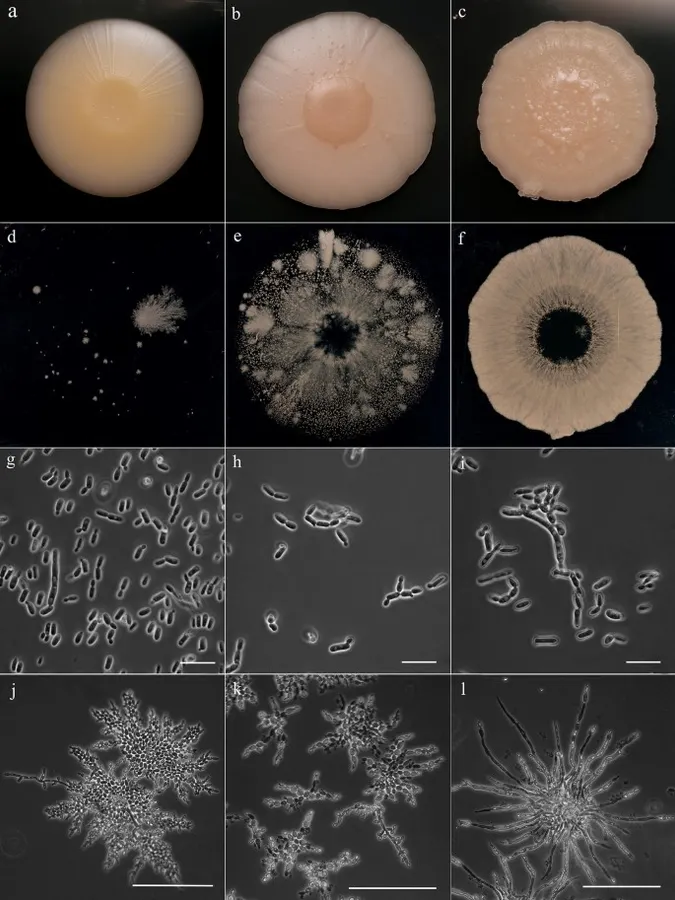
Isolated from the gut of Canthon angustatus scarab beetle from Panama. Colonies are pastel pink, flat, rough (NCAIM Y.02232 T = DEBM181 T) or smooth (paratype: NCAIM Y.02231 = DEBM180) with pseudohyphal margin on YPGA agar after 1 month of growth at 25 °C (Fig. 156 b–c). Cells are elongated, 7–15 µm × 3–3.5 µm, occur singly, in pairs or and propagate by multi-polar budding (Fig. 156 h–i) in exponential phase cultures in YPGL at 25 °C. In exponential-phase YPGL cultures, pseudo-hyphae-like branched groups or unbranched chains of unseparated yeast cells are frequently formed (Fig. 156 h–i). Transition to hyphal or pseudohyphal growth is prominent in thin films of YPGA sandwiched between glass slides, with long pseudohyphae, with up to 90 µm (NCAIM Y.02232 T) cells or short pseudohyphae with up to 15 µm long (NCAIM Y.02231), predominantly round cells in the pseudohyphae (Fig. 156 k–l). No sporulation on YPGA, potassium-acetate agar or V8 agar at 25 °C, neither in pure, nor in mixed cultures of the holotype and paratype cultures. No growth at 37 °C. The physiological characteristics (Table 4) show that the strain differs in numerous properties from other species of the genus, which allows their differentiation by conventional taxonomic tests, except for the closely related and physiologically indistinguishable Diutina bernali sp. nov. Karyotype: two bands (probably representing three chromosomes) of similar size, plus one band of smaller size (Fig. 155 b). Barro Colorado Island, the collecting location for the two newly described Diutina species, has been investigated for arthropod-associated yeasts prior to our work.
Habitat dan peran ekologis
Isolated from the gut of Canthon angustatus scarab beetle from Panama. Colonies are pastel pink, flat, rough (NCAIM Y.02232 T = DEBM181 T) or smooth (paratype: NCAIM Y.02231 = DEBM180) with pseudohyphal margin on YPGA agar after 1 month of growth at 25 °C (Fig. 156 b–c). Cells are elongated, 7–15 µm × 3–3.5 µm, occur singly, in pairs or and propagate by multi-polar budding (Fig. 156 h–i) in exponential phase cultures in YPGL at 25 °C. In exponential-phase YPGL cultures, pseudo-hyphae-like branched groups or unbranched chains of unseparated yeast cells are frequently formed (Fig. 156 h–i). Transition to hyphal or pseudohyphal growth is prominent in thin films of YPGA sandwiched between glass slides, with long pseudohyphae, with up to 90 µm (NCAIM Y.02232 T) cells or short pseudohyphae with up to 15 µm long (NCAIM Y.02231), predominantly round cells in the pseudohyphae (Fig. 156 k–l). No sporulation on YPGA, potassium-acetate agar or V8 agar at 25 °C, neither in pure, nor in mixed cultures of the holotype and paratype cultures. No growth at 37 °C. The physiological characteristics (Table 4) show that the strain differs in numerous properties from other species of the genus, which allows their differentiation by conventional taxonomic tests, except for the closely related and physiologically indistinguishable Diutina bernali sp. nov.
- Habitat atau konteks temuan
- kultur yang didokumentasikan
- Substrat
- Informasi belum tersedia pada sumber rilis ini.
- Peran atau konteks
- Belum dikategorikan pada rilis ini.
Reproduksi
Isolated from the gut of Canthon angustatus scarab beetle from Panama. Colonies are pastel pink, flat, rough (NCAIM Y.02232 T = DEBM181 T) or smooth (paratype: NCAIM Y.02231 = DEBM180) with pseudohyphal margin on YPGA agar after 1 month of growth at 25 °C (Fig. 156 b–c). Cells are elongated, 7–15 µm × 3–3.5 µm, occur singly, in pairs or and propagate by multi-polar budding (Fig. 156 h–i) in exponential phase cultures in YPGL at 25 °C. In exponential-phase YPGL cultures, pseudo-hyphae-like branched groups or unbranched chains of unseparated yeast cells are frequently formed (Fig. 156 h–i). Transition to hyphal or pseudohyphal growth is prominent in thin films of YPGA sandwiched between glass slides, with long pseudohyphae, with up to 90 µm (NCAIM Y.02232 T) cells or short pseudohyphae with up to 15 µm long (NCAIM Y.02231), predominantly round cells in the pseudohyphae (Fig. 156 k–l).
Catatan identitas dan cakupan
- Nama diterima mengikuti Catalogue of Life Base2026-09-11; uraian mempertahankan konsep dan nama sumber aslinya.
- Preserve original monograph treatment localities, hosts and specimen/substrate scope. Materials examined document specimens, not the full global range.
- Impor dan terjemahan otomatis belum diperiksa editorial per profil. Struktur reproduktif yang disebutkan tidak membuktikan seluruh siklus hidup diketahui.
- Pengukuran pada uraian mengikuti spesimen, kultur, dan metode sumber; angka tidak diperluas ke semua populasi.
Catatan distribusi dalam narasi mengikuti sumbernya. Dokumentasi spesimen atau foto mengikuti catatan sumber. Bukti wilayah Indonesia dan penilaian konservasi tidak disimpulkan dari gambar.
Melihat dengan konteks
Microphotographs of new species of Diutina. a, d, g, j Diutina bernali sp.nov., NCAIM Y.02230 T. b, e, h, k D. sipiczkii sp. nov. NCAIM Y.02231. c, f, h, l and D. sipiczkii NCAIM Y.02232 T. a – c 10-day-old colonies on YPD agar. d – f Invasivity on YPD agar after washing off 10-day-old colonies. g – i Exponential phase cellular morphology in YPD liquid medium, bars = 20 µm. j – l Exponential phase pseudohyphal morphology on YPD sandwich plates, bars = 100 µm
- Jenis
- Pelat ilmiah
- Kredit
- Penulis dan sumber artikel: Hyde, Kevin D.; Dong, Yang; Phookamsak, Rungtiwa; Jeewon, Rajesh; Bhat, D. Jayarama; Jones, E. B. Gareth; Liu, Ning-Guo; Abeywickrama, Pranami D.; Mapook, Ausana; Wei, Deping; Perera, Rekhani H.; Manawasinghe, Ishara S.; Pem, Dhandevi; Bundhun, Digvijayini; Karunarathna, Anuruddha; Ekanayaka, Anusha H.; Bao, Dan-Feng; Li, Junfu; Samarakoon, Milan C.; Chaiwan, Napalai; Lin, Chuan-Gen; Phutthacharoen, Kunthida; Zhang, Sheng-Nan; Senanayake, Indunil C.; Goonasekara, Ishani D.; Thambugala, Kasun M.; Phukhamsakda, Chayanard; Tennakoon, Danushka S.; Jiang, Hong-Bo; Yang, Jing; Zeng, Ming; Huanraluek, Naruemon; Liu, Jian-Kui (Jack); Wijesinghe, Subodini N.; Tian, Qing; Tibpromma, Saowaluck; Brahmanage, Rashika S.; Boonmee, Saranyaphat; Huang, Shi-Ke; Thiyagaraja, Vinodhini; Lu, Yong-Zhong; Jayawardena, Ruvishika S.; Dong, Wei; Yang, Er-Fu; Singh, Sanjay K.; Singh, Shiv Mohan; Rana, Shiwali; Lad, Sneha S.; Anand, Garima; Devadatha, Bandarupalli; Niranjan, M.; Sarma, V. Venkateswara; Liimatainen, Kare; Aguirre-Hudson, Begoña; Niskanen, Tuula; Overall, Andy; Alvarenga, Renato Lúcio Mendes; Gibertoni, Tatiana Baptista; Pfliegler, Walter P.; Horváth, Enikő; Imre, Alexandra; Alves, Amanda Lucia; da Silva Santos, Ana Carla; Tiago, Patricia Vieira; Bulgakov, Timur S.; Wanasinghe, Dhanushaka N.; Bahkali, Ali H.; Doilom, Mingkwan; Elgorban, Abdallah M.; Maharachchikumbura, Sajeewa S. N.; Rajeshkumar, Kunhiraman C.; Haelewaters, Danny; Mortimer, Peter E.; Zhao, Qi; Lumyong, Saisamorn; Xu, Jianchu; Sheng, Jun
- Lisensi
- CC BY 4.0
- Sumber media
- Buka entri sumber
Sumber profil
- [1] Fungal diversity notes 1151–1276: taxonomic and phylogenetic contributions on genera and species of fungal taxa — Diutina sipiczkii
- [2] Catalogue of Life Base2026-09-11 — Diutina sipiczkii
- [3] Dokumentasi visual — Diutina sipiczkii
Rujukan halaman ini
Fungi. Diutina sipiczkii. Rilis data fungi-2026-10-12-expansion-2. https://fungi-atlas.mgadib.chatgpt.site/jamur/diutina-sipiczkii/.
Status: impor sumber; pemeriksaan editorial per profil belum selesai. Untuk klaim biologis, gunakan rujukan pada bagian terkait dan periksa konteks sumber aslinya.