Ciri dan struktur
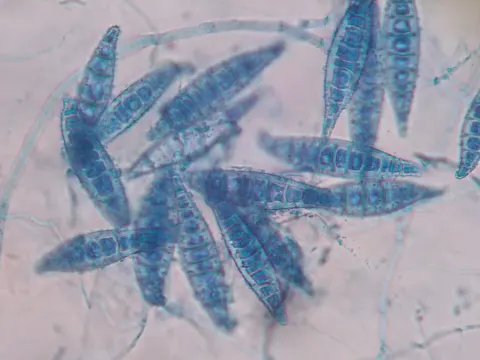
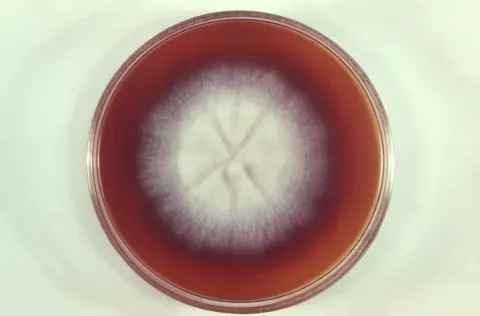
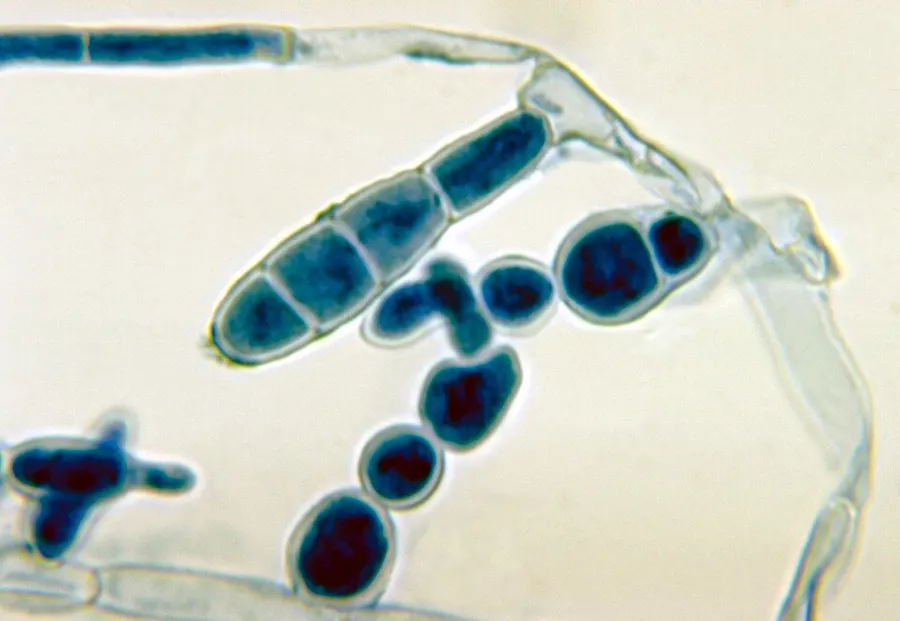
The filamentous non-soil associated fungus does not require any specific growth condition in culture. E. floccosum does not grow on urease culture, has low osmotolerance, and is unable to form perforating organs. The colonies have khaki suede-like flat surfaces and grow moderately rapidly, reaching maturity within 10 days. The reverse is reddish-brown. Colonies are initially flat, but the centre of which later becomes raised and folded, with the periphery submerged. On rich media like Sabouraud agar, colonies usually degenerate into white pleomorphic tufts within several weeks, and sometimes exude a red-brown pigment into its agar. E. floccosum has septate, hyaline hyphae. Its key features are the smooth, thin-walled, club-shaped macroconidia and the absence of microconidia. The macroconidia are borne singly or in clusters of 2 or 3; they are 20–40 μm in length and 7–12 μm in width, consisting of 1 to 9 septa. The narrow base and broad, club-shaped apex of the macroconidium have been compared in shape to a beaver tail. The fungus reproduces asexually through chlamydoconidia, which are resting spores that are abundant in culture. Arthroconidia are also abundant in the culture, emerging as swollen cells alongside macroconidia formation; these thick-walled spores are resistant to heat and drying conditions. When causing the same disease, clinical demonstrations of E. floccosum are generally indistinguishable from other dermatophytes, except for tinea pedis: infections involving E. floccosum can demonstrate marked scaling in patient's toe and sole and produce punctate lesions nearby.
Habitat dan peran ekologis
E. floccosum has a worldwide distribution but is more commonly found in tropical and subtropical areas. Historical fungal infections have been reported in US military in Vietnam and British Army in Southeast Asia. E. floccosum was considered the fourth most common cause of dermatophytosis in North America. Accounting for around 20 percent of US cases and 44 percent of Asian cases, it is also the third most common cause of tinea pedis worldwide, following Trichophyton mentagrophytes and Trichophyton rubrum.
- Habitat atau konteks temuan
- Informasi belum tersedia pada sumber rilis ini.
- Substrat
- Informasi belum tersedia pada sumber rilis ini.
- Peran atau konteks
- Belum dikategorikan pada rilis ini.
Reproduksi
The fungus reproduces asexually through chlamydoconidia, which are resting spores that are abundant in culture. Arthroconidia are also abundant in the culture, emerging as swollen cells alongside macroconidia formation; these thick-walled spores are resistant to heat and drying conditions.
Catatan identitas dan cakupan
- Nama diterima mengikuti Catalogue of Life Base2026-09-11; uraian mempertahankan konsep dan nama sumber aslinya.
- Original geographic, specimen and life-cycle scope retained; source import awaits individual editorial review.
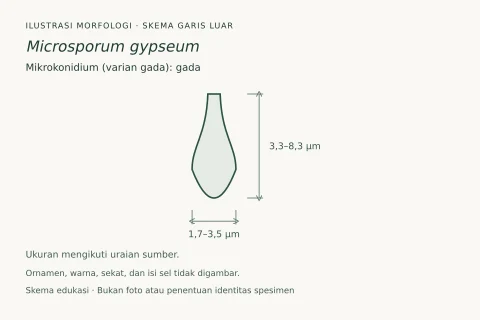
- Impor dan terjemahan otomatis belum diperiksa editorial per profil. Struktur reproduktif yang disebutkan tidak membuktikan seluruh siklus hidup diketahui.
- Pengukuran pada uraian mengikuti spesimen, kultur, dan metode sumber; angka tidak diperluas ke semua populasi.
Catatan distribusi dalam narasi mengikuti sumbernya. Dokumentasi spesimen atau foto mengikuti catatan sumber. Bukti wilayah Indonesia dan penilaian konservasi tidak disimpulkan dari gambar.
Melihat dengan konteks
Dokumentasi Epidermophyton floccosum dari Wikimedia Commons. Macroconidia of the dermatophytic fungus en:Epidermophyton floccosum . Obtained from the CDC Public Health Image Library . Image credit: CDC/Dr. Libero Ajello (PHIL #4207), 1972. Identifikasi mengikuti record berkas sumber.
- Jenis
- Fotografi
- Kredit
- CDC/Dr. Libero Ajello
- Lisensi
- Public domain
- Sumber media
- Buka entri sumber
Sumber profil
- [1] Epidermophyton floccosum — Wikipedia (en)
- [2] Catalogue of Life Base2026-09-11 — Epidermophyton floccosum
- [3] Dokumentasi visual — Epidermophyton floccosum
Rujukan halaman ini
Fungi. Epidermophyton floccosum. Rilis data fungi-2026-10-12-expansion-2. https://fungi-atlas.mgadib.chatgpt.site/jamur/epidermophyton-floccosum/.
Status: impor sumber; pemeriksaan editorial per profil belum selesai. Untuk klaim biologis, gunakan rujukan pada bagian terkait dan periksa konteks sumber aslinya.