Ciri dan struktur
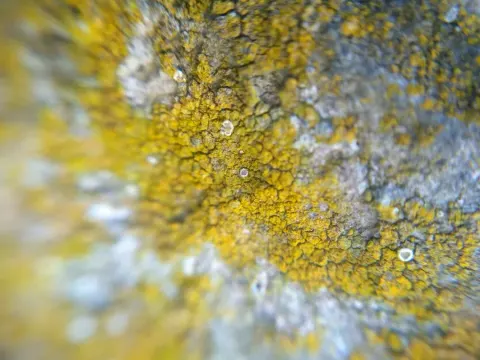
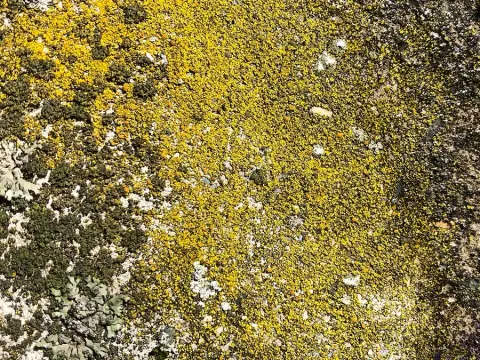
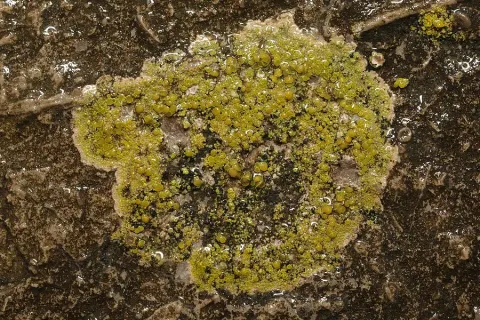
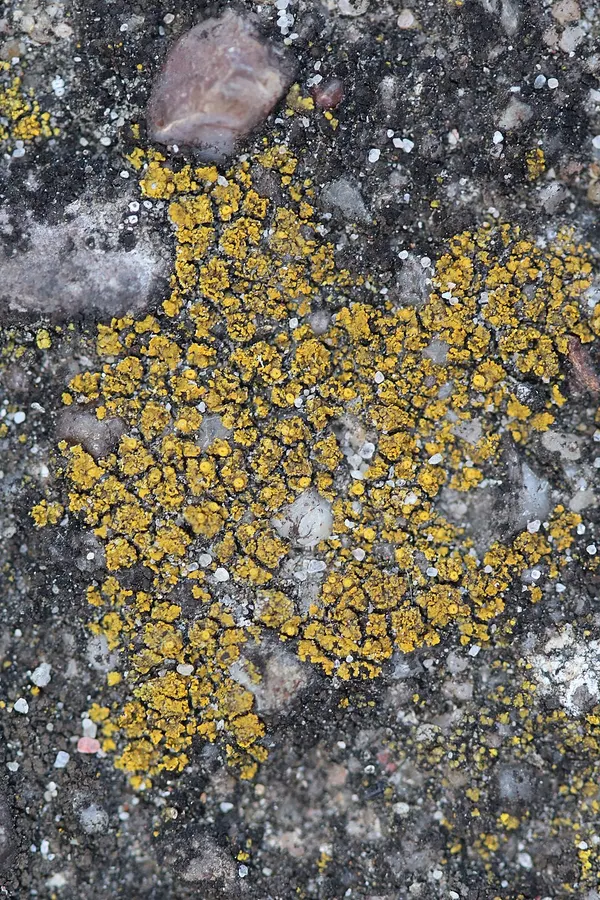
Flavoplaca arcis features a crustose to slightly (scale-like) thallus with a bright yellow colour. The thallus is made up of wavy (small, discrete areas), sometimes arranged in a rosette-shaped, that can be wavy with minute around their periphery. These areoles are rather thick, ranging in diameter from 0.4 to 2 mm, and some are adorned with coarse, spherical reproductive structures known as , which match the colour of the thallus. These blastidia are distributed across the surface and edges of the areoles, with a particularly heavy concentration at the centres of the thalli. Reproductive structures known as are in form (with a that is surrounded by a pale , which has both algal and fungal cells), (attached flatly) to , yellow, and between 0.3 and 1.5 mm in width. When tested with a solution of potassium hydroxide (the K spot test), the thallus shows a purple reaction, which is a diagnostic feature for identification.
Habitat dan peran ekologis
Flavoplaca arcis is found across a wide range of localities in Europe, although it is not commonly reported. Its distribution spans Western and Central Europe, Scandinavia, the Mediterranean region, the Balkan Peninsula, and the Canary Islands. This species has an affinity for both silicate and calcareous rocks and stones. Beyond natural habitats, Flavoplaca arcis is also known to colonise man-made structures. It is typically found in locations that are relatively exposed to the elements and can be found on both vertical and horizontal surfaces.
- Habitat atau konteks temuan
- Informasi belum tersedia pada sumber rilis ini.
- Substrat
- Informasi belum tersedia pada sumber rilis ini.
- Peran atau konteks
- Pembentuk liken
Reproduksi
Flavoplaca arcis features a crustose to slightly (scale-like) thallus with a bright yellow colour. The thallus is made up of wavy (small, discrete areas), sometimes arranged in a rosette-shaped, that can be wavy with minute around their periphery. These areoles are rather thick, ranging in diameter from 0.4 to 2 mm, and some are adorned with coarse, spherical reproductive structures known as , which match the colour of the thallus. These blastidia are distributed across the surface and edges of the areoles, with a particularly heavy concentration at the centres of the thalli. Reproductive structures known as are in form (with a that is surrounded by a pale , which has both algal and fungal cells), (attached flatly) to , yellow, and between 0.3 and 1.5 mm in width.
Catatan identitas dan cakupan
- Nama diterima mengikuti Catalogue of Life Base2026-09-11; uraian mempertahankan konsep dan nama sumber aslinya.
- Original geographic, specimen and life-cycle scope retained; source import awaits individual editorial review.
- Impor dan terjemahan otomatis belum diperiksa editorial per profil. Struktur reproduktif yang disebutkan tidak membuktikan seluruh siklus hidup diketahui.
- Pengukuran pada uraian mengikuti spesimen, kultur, dan metode sumber; angka tidak diperluas ke semua populasi.
Catatan distribusi dalam narasi mengikuti sumbernya. Dokumentasi spesimen atau foto mengikuti catatan sumber. Bukti wilayah Indonesia dan penilaian konservasi tidak disimpulkan dari gambar.
Melihat dengan konteks
Dokumentasi Flavoplaca arcis dari Wikimedia Commons. Noordwijkerhout - Bedrijventerrein - Schubbige citroenkorst (Flavoplaca arcis) Identifikasi mengikuti record berkas sumber.
- Jenis
- Fotografi
- Kredit
- Rudolphous
- Lisensi
- CC BY-SA 4.0
- Sumber media
- Buka entri sumber
Sumber profil
- [1] Flavoplaca arcis — Wikipedia (en)
- [2] Catalogue of Life Base2026-09-11 — Flavoplaca arcis
- [3] Dokumentasi visual — Flavoplaca arcis
Rujukan halaman ini
Fungi. Flavoplaca arcis. Rilis data fungi-2026-10-12-expansion-2. https://fungi-atlas.mgadib.chatgpt.site/jamur/flavoplaca-arcis/.
Status: impor sumber; pemeriksaan editorial per profil belum selesai. Untuk klaim biologis, gunakan rujukan pada bagian terkait dan periksa konteks sumber aslinya.