Ciri dan struktur
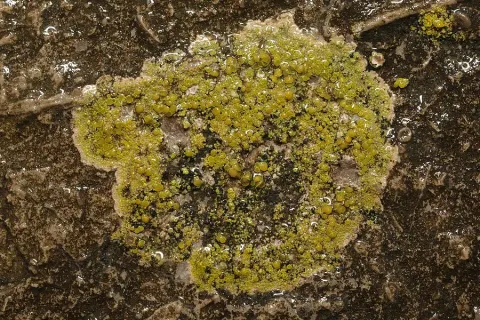
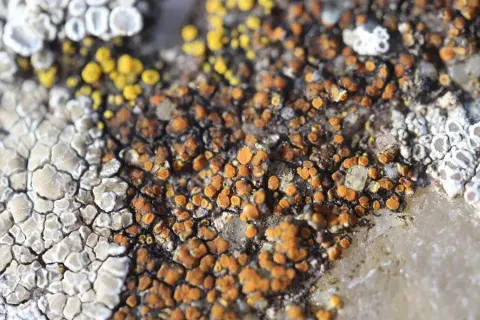
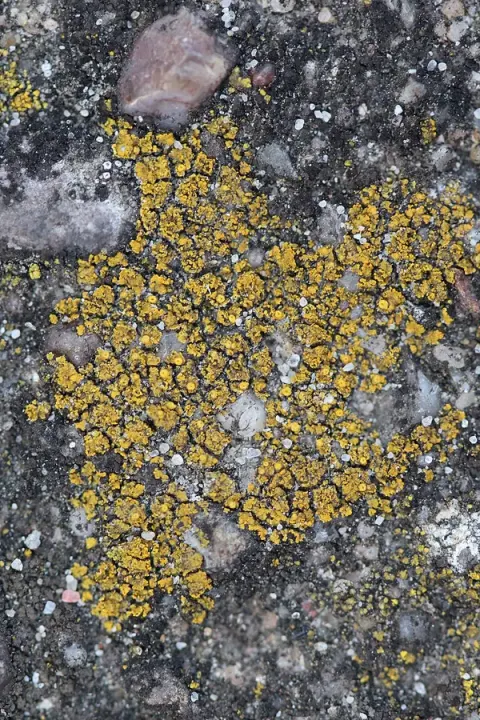
Flavoplaca citrina is a crustose (crust-like) lichen with a yellow-green thallus (the main body of the lichen). The thallus is (powdery) and entirely covered with granular soredia (tiny, powdery reproductive propagules). It can vary from thin to moderately thick and is usually soft. Thicker thalli often break into irregular, coarse (small, discrete areas), typically appearing green-yellow or green in shaded conditions. Very thick thalli, which lack soredia, have convex (rounded) areoles. The soredia, measuring between 0.02 and 0.07 mm in diameter, form at the margins of these areoles and are the same colour as the thallus. There is no (the initial growth stage of the lichen) or, if present, it is white. Apothecia (the fruiting bodies) are frequent, ranging from 0.3 to 1.5 mm in diameter. They start immersed in the thallus but become sessile (sitting on the surface) as they mature. These apothecia are flat and can swell slightly. The edges of the apothecia (s) are persistent, granular, and sorediate, sometimes appearing frosty (). The is yellow-orange with a green-yellow margin. Paraphyses (sterile filamentous structures in the apothecia) often have narrow tips or are club-shaped () up to 3 μm wide. The asci (spore-producing cells) are typically long and narrow, containing broadly ellipsoid ascospores that measure 10.5–14.8 μm in length and 5–7.5 μm in width, with a central septum (dividing partition) 3–5 μm wide, making up about one-third of the spore's length. Conidia (asexual spores) are mostly (rod-shaped). All parts of the lichen react with potassium hydroxide solution (K) solution to turn purple.
Habitat dan peran ekologis
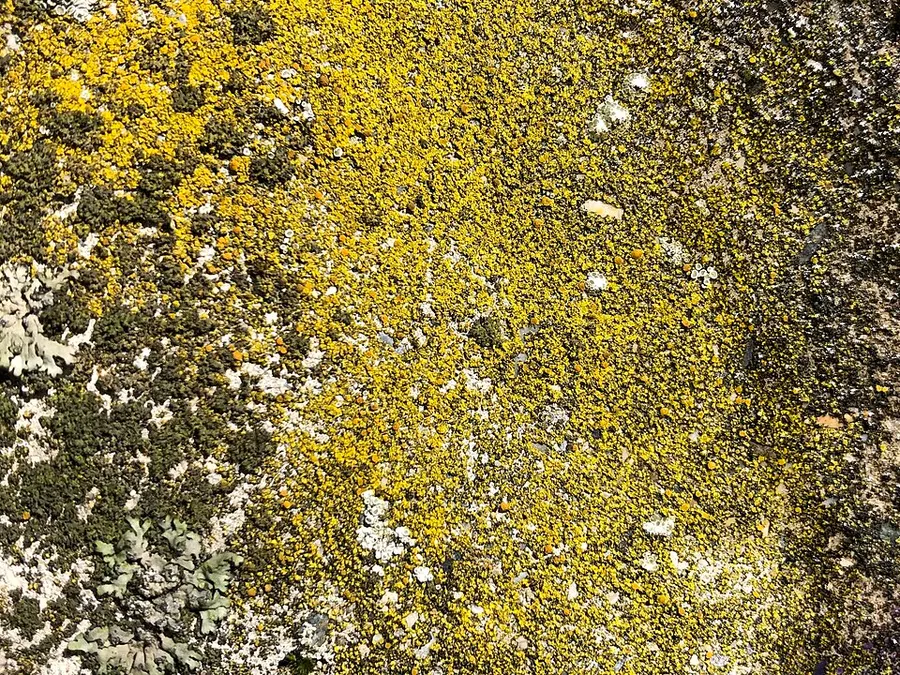
Flavoplaca citrina is commonly found on calcareous (chalky) or nutrient-rich substrates, including limestone, concrete, mortar, bone, and asbestos cement, especially on walls in sunny locations. It is less common on naturally calcareous or nutrient-enriched siliceous rocks and metalwork, and rarely occurs on wood or bark (corticolous). The species is cosmopolitan in distribution. Flavoplaca citrina is nitrophilic (adapted to nitrogen-rich environments) and is frequently found on cliffs below birds' nests, where it benefits from nitrogen enrichment by bird excrement. Research has identified F. citrina as an indicator species for bird-influenced habitats, particularly on cliff faces where peregrine falcons and ravens nest, where it thrives in localised nutrient-rich zones within otherwise nutrient-poor ecosystems. In North and Central America, Flavoplaca citrina is common in temperate regions and more occasional in the Arctic and at higher elevations in Mexico and the Caribbean. Clifford Wetmore described it as growing in exposed situations on both calcareous and non-calcareous rock, though it has also been recorded from bark, wood, and sometimes bryophytes.
- Habitat atau konteks temuan
- Informasi belum tersedia pada sumber rilis ini.
- Substrat
- kayu
- Peran atau konteks
- Pembentuk liken
Reproduksi
Flavoplaca citrina is a crustose (crust-like) lichen with a yellow-green thallus (the main body of the lichen). The thallus is (powdery) and entirely covered with granular soredia (tiny, powdery reproductive propagules). It can vary from thin to moderately thick and is usually soft. Thicker thalli often break into irregular, coarse (small, discrete areas), typically appearing green-yellow or green in shaded conditions. Very thick thalli, which lack soredia, have convex (rounded) areoles. The soredia, measuring between 0.02 and 0.07 mm in diameter, form at the margins of these areoles and are the same colour as the thallus. There is no (the initial growth stage of the lichen) or, if present, it is white.
Catatan identitas dan cakupan
- Nama diterima mengikuti Catalogue of Life Base2026-09-11; uraian mempertahankan konsep dan nama sumber aslinya.
- Original geographic, specimen and life-cycle scope retained; source import awaits individual editorial review.
- Impor dan terjemahan otomatis belum diperiksa editorial per profil. Struktur reproduktif yang disebutkan tidak membuktikan seluruh siklus hidup diketahui.
- Pengukuran pada uraian mengikuti spesimen, kultur, dan metode sumber; angka tidak diperluas ke semua populasi.
Catatan distribusi dalam narasi mengikuti sumbernya. Dokumentasi spesimen atau foto mengikuti catatan sumber. Bukti wilayah Indonesia dan penilaian konservasi tidak disimpulkan dari gambar.
Melihat dengan konteks
Dokumentasi Flavoplaca citrina dari Wikimedia Commons. Mealy Firedot Lichen ( Flavoplaca citrina ) Identifikasi mengikuti record berkas sumber.
- Jenis
- Fotografi
- Kredit
- Jason Grant
- Lisensi
- CC BY 4.0
- Sumber media
- Buka entri sumber
Sumber profil
- [1] Flavoplaca citrina — Wikipedia (en)
- [2] Catalogue of Life Base2026-09-11 — Flavoplaca citrina
- [3] Dokumentasi visual — Flavoplaca citrina
Rujukan halaman ini
Fungi. Flavoplaca citrina. Rilis data fungi-2026-10-12-expansion-2. https://fungi-atlas.mgadib.chatgpt.site/jamur/flavoplaca-citrina/.
Status: impor sumber; pemeriksaan editorial per profil belum selesai. Untuk klaim biologis, gunakan rujukan pada bagian terkait dan periksa konteks sumber aslinya.