Ciri dan struktur
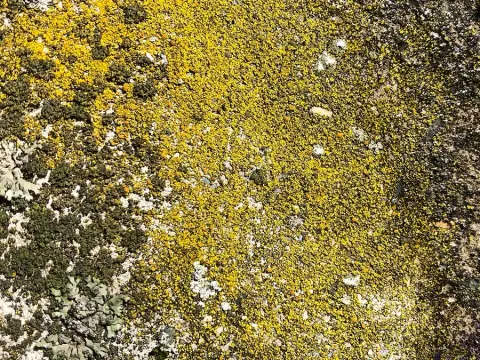
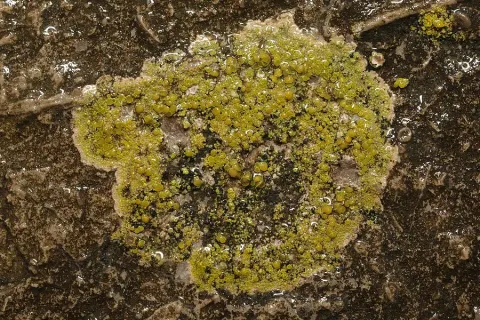
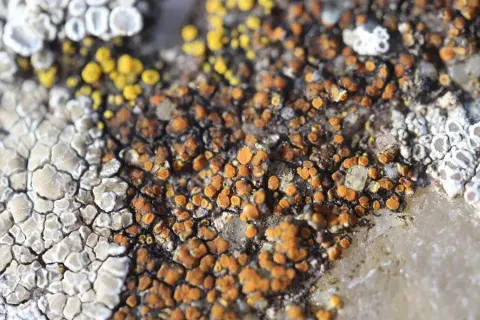
Caloplaca austrocitrina is characterised by a thallus that predominantly shows a yellow hue, though in some cases it can appear orange. The thallus is either or composed of closely packed . These squamules or areoles are typically thick, ranging from 80 to 380 μm, and they have a width that varies between 0.25 and 1.7 mm. The squamules themselves are flat and smooth, with marginal soralia of the flavocitrina type. In older thalli, the soralia may expand to cover the entire surface. The soredia of Caloplaca austrocitrina are sized approximately 22 to 61 μm in diameter and can cluster into . The cortex or (honeybombed) cortex of the lichen is well-developed, with a thickness spanning from 6 to 40 μm. About half of the specimens of this species bear apothecia, which are about 0.32 to 0.65 mm in diameter. The disc of the mature apothecia can range from flat to convex. The , which surrounds the apothecia, measures between 50 and 130 μm in thickness and has a structure. In younger apothecia, the tends to be concealed beneath the true margin, while in older specimens, it is well-developed and persists. The hymenium of Caloplaca austrocitrina has a thickness of 60 to 80 μm. The tips of the paraphyses are widened, measuring between 3.0 and 6.0 μm. The of the species are approximately 8.5 to 14.0 μm long and 4.5 to 6.5 μm wide. The septa of these spores are around 3.0 to 5.5 μm thick, accounting for nearly 0.4 of the total ascospore length. The of Caloplaca austrocitrina are small, typically measuring between 2.0 and 4.0 μm in length and 1.0 to 1.5 μm in width, contributing to the distinctive microscopic features of this lichen species.
Habitat dan peran ekologis
Flavoplaca austrocitrina, initially described from specimens collected in Ukraine, has an ecology in the Buenos Aires region of Argentina that is quite similar to its European counterparts. Predominantly, this lichen is found growing on cement mortar and concrete within urban and village settings. Cement mortar – a hardened mixture of cement, sand, and water – serves as a common for this species, distinguishing it from other types of mortars like lime mortar. Flavoplaca austrocitrina often establishes itself in proximity to aquatic environments, including rivers, lakes, and coastal areas. Flavoplaca austrocitrina has been identified in various European countries, including Austria, Bulgaria, Germany, Greece, the Czech Republic, Romania, Russia, and Slovakia. The discovery of this species in South America, coupled with its established presence in Europe, suggests a potential for a wider global distribution. The Argentine specimens have nearly identical internal transcribed spacer (ITS) sequences to their European counterparts, despite the geographical distance. This low variation in the ITS locus is noteworthy within the genus, especially considering the separation between the South American and European populations.
- Habitat atau konteks temuan
- Informasi belum tersedia pada sumber rilis ini.
- Substrat
- Informasi belum tersedia pada sumber rilis ini.
- Peran atau konteks
- Pembentuk liken
Reproduksi
The soredia of Caloplaca austrocitrina are sized approximately 22 to 61 μm in diameter and can cluster into . The cortex or (honeybombed) cortex of the lichen is well-developed, with a thickness spanning from 6 to 40 μm. The of the species are approximately 8.5 to 14.0 μm long and 4.5 to 6.5 μm wide. The septa of these spores are around 3.0 to 5.5 μm thick, accounting for nearly 0.4 of the total ascospore length. The of Caloplaca austrocitrina are small, typically measuring between 2.0 and 4.0 μm in length and 1.0 to 1.5 μm in width, contributing to the distinctive microscopic features of this lichen species.
Catatan identitas dan cakupan
- Nama diterima mengikuti Catalogue of Life Base2026-09-11; uraian mempertahankan konsep dan nama sumber aslinya.
- Original geographic, specimen and life-cycle scope retained; source import awaits individual editorial review.
- Impor dan terjemahan otomatis belum diperiksa editorial per profil. Struktur reproduktif yang disebutkan tidak membuktikan seluruh siklus hidup diketahui.
- Pengukuran pada uraian mengikuti spesimen, kultur, dan metode sumber; angka tidak diperluas ke semua populasi.
Catatan distribusi dalam narasi mengikuti sumbernya. Dokumentasi spesimen atau foto mengikuti catatan sumber. Bukti wilayah Indonesia dan penilaian konservasi tidak disimpulkan dari gambar.
Melihat dengan konteks
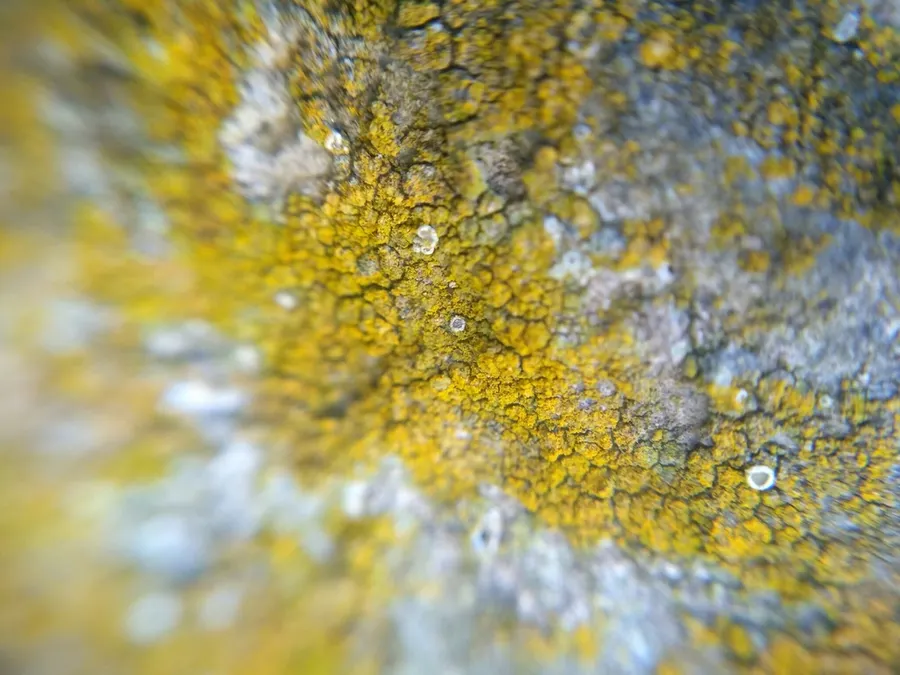
Dokumentasi Flavoplaca austrocitrina menurut asosiasi foto pada record takson iNaturalist. Kredit: Igor Balashov. Identitas mengikuti sumber; bukan penentuan spesimen independen.
- Jenis
- Fotografi
- Kredit
- (c) Igor Balashov, some rights reserved (CC BY), uploaded by Igor Balashov
- Lisensi
- CC BY 4.0
- Sumber media
- Buka entri sumber
Sumber profil
- [1] Flavoplaca austrocitrina — Wikipedia (en)
- [2] Catalogue of Life Base2026-09-11 — Flavoplaca austrocitrina
- [3] Dokumentasi visual — Flavoplaca austrocitrina
Rujukan halaman ini
Fungi. Flavoplaca austrocitrina. Rilis data fungi-2026-10-12-expansion-2. https://fungi-atlas.mgadib.chatgpt.site/jamur/flavoplaca-austrocitrina/.
Status: impor sumber; pemeriksaan editorial per profil belum selesai. Untuk klaim biologis, gunakan rujukan pada bagian terkait dan periksa konteks sumber aslinya.