01 / Morfologi

Ciri dan struktur

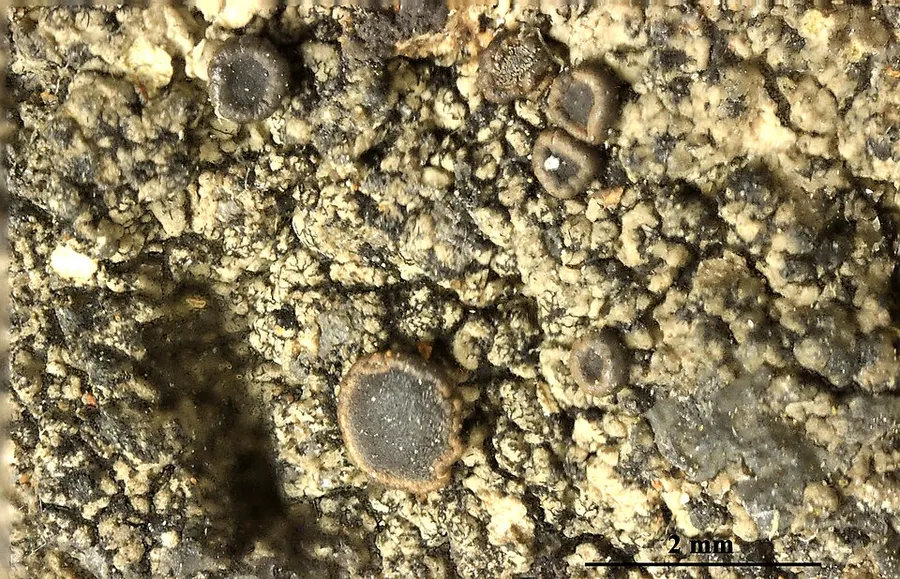
The thallus of Fuscidea austera is pale grey to chocolate-brown and broken into a cracked surface of small, closely adjoining about 0.2–0.5 mm in diameter. These areoles are thin and fairly even to somewhat irregular in shape, and may be slightly convex or somewhat warty in appearance. A black is usually present at the margin, helping to define the edge of the thallus. The apothecia (fruiting bodies) are and 0.5–2 mm wide, with rounded to irregular outlines; they may occur singly or in clusters. Their is dull blackish brown, turning reddish brown when wet, and is usually flat, sometimes with a light dusting of . The apothecial margin (the ), is brown, often paler than the disc and sometimes patchy in colour, and remains persistent as it becomes strongly uneven or lobed. The ascospores are broadly ellipsoid, single-celled (aseptate), and usually 9–11 by 6.5–8 μm. Pycnidia are about 0.15 mm in diameter and are blackish brown around the ostiole. In standard chemical spot tests the thallus is negative for C, K, KC, and Pd, but it fluoresces bluish white under ultraviolet light; divaricatic acid is confined to the apothecia.

Sebagian uraian ditampilkan dalam bahasa sumber; terjemahannya belum tersedia atau belum lolos pemeriksaan.

Rujukan: [1]

Pengukuran mengikuti objek, spesimen atau kultur, dan metode yang disebutkan sumber. Baca uraian asli untuk konteks lengkap.

02 / Kehidupan

Habitat dan peran ekologis

Fuscidea austera grows on sheltered, vertical siliceous rock faces, where it can form extensive mosaic-like patches. In the British Isles, it is a local species known from the Highlands of northern Scotland and from Snowdonia in Wales. It is rare in England, where it occurs especially on the coarse-grained sandstone known as Millstone Grit. Outside the British Isles, Fuscidea austera has also been reported from Austria, Czech Republic, Hungary, and Switzerland. In 2014, it was recorded from the Polonyna Bukovs'ka ridge in Uzh National Nature Park, and that publication treated it as a new record for the lichen biota of Ukraine. It has also been documented in northern Europe, in the subalpine and alpine belts of Central European mountains, and in Korea.

Sebagian uraian ditampilkan dalam bahasa sumber; terjemahannya belum tersedia atau belum lolos pemeriksaan.

Rujukan: [1]

Habitat atau konteks temuan
Informasi belum tersedia pada sumber rilis ini.
Substrat
Informasi belum tersedia pada sumber rilis ini.
Peran atau konteks
Pembentuk liken
Temukan hubungan serupa
03 / Siklus hidup

Reproduksi

The thallus of Fuscidea austera is pale grey to chocolate-brown and broken into a cracked surface of small, closely adjoining about 0.2–0.5 mm in diameter. These areoles are thin and fairly even to somewhat irregular in shape, and may be slightly convex or somewhat warty in appearance. A black is usually present at the margin, helping to define the edge of the thallus. The apothecia (fruiting bodies) are and 0.5–2 mm wide, with rounded to irregular outlines; they may occur singly or in clusters. Their is dull blackish brown, turning reddish brown when wet, and is usually flat, sometimes with a light dusting of . The apothecial margin (the ), is brown, often paler than the disc and sometimes patchy in colour, and remains persistent as it becomes strongly uneven or lobed.

Sebagian uraian ditampilkan dalam bahasa sumber; terjemahannya belum tersedia atau belum lolos pemeriksaan.

Rujukan: [1]

Sinonim menurut acuan taksonomi rilis: Fuscidea aggregata; Fuscidea aggregatilis; Fuscidea taeniarum; Lecanora austera; Lecidea aggregata; Lecidea aggregatilis; Lecidea contigua aggregata; Lecidea taeniarum
04 / Batas informasi

Catatan identitas dan cakupan

  • Nama diterima mengikuti Catalogue of Life Base2026-09-11; uraian mempertahankan konsep dan nama sumber aslinya.
  • Original geographic, specimen and life-cycle scope retained; source import awaits individual editorial review.
  • Impor dan terjemahan otomatis belum diperiksa editorial per profil. Struktur reproduktif yang disebutkan tidak membuktikan seluruh siklus hidup diketahui.
  • Pengukuran pada uraian mengikuti spesimen, kultur, dan metode sumber; angka tidak diperluas ke semua populasi.

Catatan distribusi dalam narasi mengikuti sumbernya. Dokumentasi spesimen atau foto mengikuti catatan sumber. Bukti wilayah Indonesia dan penilaian konservasi tidak disimpulkan dari gambar.

05 / Dokumentasi

Melihat dengan konteks

Dokumentasi Fuscidea austera dari Wikimedia Commons. Closeup of the crustose lichen species Fuscidea austera . Hungary. Mátra Mountains, in the region of Mount Kékes, at a place called Disznókő, 700 m. On trachytic rocks in a windy site. Identifikasi mengikuti record berkas sumber.

Jenis
Fotografi
Kredit
Felis Schumm
Sumber media
Buka entri sumber

Gambar menunjukkan objek menurut identifikasi sumber, bukan verifikasi independen spesimen oleh Fungi. Tidak ada skala baru yang ditambahkan.

06 / Rujukan

Sumber profil

  1. [1] Fuscidea austera — Wikipedia (en)Bagian sumber: Frozen revision 1345422168
    Tanggal penghimpunan sumber: 2026-10-12
    Teks sumber: CC BY-SA4.0 · Wikipedia contributors
  2. [2] Catalogue of Life Base2026-09-11 — Fuscidea austeraBagian sumber: ColDP NameUsage.tsv ID 6JSHG; accepted species; source 2073
    Tanggal penghimpunan sumber: 2026-10-12
  3. [3] Dokumentasi visual — Fuscidea austeraBagian sumber: Individual media record; identification follows the source, not independent determination
    Tanggal penghimpunan sumber: 2026-10-12
    Media sumber: CC BY-SA 4.0 · Felis Schumm

Adaptasi teks: CC BY-SA 4.0. Wikipedia contributors — Fuscidea austera — Wikipedia (en)

Uraian asli dan riwayat sumber

Riwayat atau halaman sumber

Ringkasan sumber

Fuscidea austera is a species of lichen-forming fungus in the family Fuscideaceae. Originally described in 1874 from specimens collected in Scotland and placed in genus Lecanora, it was reclassified in Fuscidea in 1980. The thallus is pale grey to chocolate-brown and cracked into small patches (), with blackish-brown apothecia (fruiting bodies) up to 2 mm wide. The species grows on sheltered siliceous rock faces in the British Isles and has also been recorded from several countries in continental Europe and from Korea.

Revisi sumber

Morfologi sumber

The thallus of Fuscidea austera is pale grey to chocolate-brown and broken into a cracked surface of small, closely adjoining about 0.2–0.5 mm in diameter. These areoles are thin and fairly even to somewhat irregular in shape, and may be slightly convex or somewhat warty in appearance. A black is usually present at the margin, helping to define the edge of the thallus. The apothecia (fruiting bodies) are and 0.5–2 mm wide, with rounded to irregular outlines; they may occur singly or in clusters. Their is dull blackish brown, turning reddish brown when wet, and is usually flat, sometimes with a light dusting of . The apothecial margin (the ), is brown, often paler than the disc and sometimes patchy in colour, and remains persistent as it becomes strongly uneven or lobed. The ascospores are broadly ellipsoid, single-celled (aseptate), and usually 9–11 by 6.5–8 μm. Pycnidia are about 0.15 mm in diameter and are blackish brown around the ostiole. In standard chemical spot tests the thallus is negative for C, K, KC, and Pd, but it fluoresces bluish white under ultraviolet light; divaricatic acid is confined to the apothecia.

Revisi sumber

Ekologi sumber

Fuscidea austera grows on sheltered, vertical siliceous rock faces, where it can form extensive mosaic-like patches. In the British Isles, it is a local species known from the Highlands of northern Scotland and from Snowdonia in Wales. It is rare in England, where it occurs especially on the coarse-grained sandstone known as Millstone Grit. Outside the British Isles, Fuscidea austera has also been reported from Austria, Czech Republic, Hungary, and Switzerland. In 2014, it was recorded from the Polonyna Bukovs'ka ridge in Uzh National Nature Park, and that publication treated it as a new record for the lichen biota of Ukraine. It has also been documented in northern Europe, in the subalpine and alpine belts of Central European mountains, and in Korea.

Revisi sumber

Struktur reproduksi sumber

The thallus of Fuscidea austera is pale grey to chocolate-brown and broken into a cracked surface of small, closely adjoining about 0.2–0.5 mm in diameter. These areoles are thin and fairly even to somewhat irregular in shape, and may be slightly convex or somewhat warty in appearance. A black is usually present at the margin, helping to define the edge of the thallus. The apothecia (fruiting bodies) are and 0.5–2 mm wide, with rounded to irregular outlines; they may occur singly or in clusters. Their is dull blackish brown, turning reddish brown when wet, and is usually flat, sometimes with a light dusting of . The apothecial margin (the ), is brown, often paler than the disc and sometimes patchy in colour, and remains persistent as it becomes strongly uneven or lobed.

Revisi sumber

Rujukan halaman ini

Fungi. Fuscidea austera. Rilis data fungi-2026-10-12-expansion-2. https://fungi-atlas.mgadib.chatgpt.site/jamur/fuscidea-austera/.

Status: impor sumber; pemeriksaan editorial per profil belum selesai. Untuk klaim biologis, gunakan rujukan pada bagian terkait dan periksa konteks sumber aslinya.