Ciri dan struktur
Ganoderma casuarinicola is characterised by its strongly laccate reddish-brown pileal surface, white pore surface, luminous yellow to yellowish-brown cutis. Basidiomes annual, stipitate to substipitate, pileus sectorial to shell-shaped, projecting up to 10 cm, 7 cm wide and 2 cm thick at base, corky, without odour when fresh, becoming hard corky to woody hard when dry. Pileal surface strongly laccate, reddish-brown, with a thin crust; margin obtuse, cream to reddish-brown. Stipe flattened or subcylindrical, lateral, reddish-brown, up to 6 cm long and 1.7 cm in diam. Pore surface white when fresh, turning cream when dry; pores round to angular, 4–6 per mm; dissepiments thin to slightly thick, entire. Context corky, heterogeneous, the upper layer generally light yellow up to 0.1 cm thick and the lower layer generally dark brown close to the tubes up to 1 cm thick, showing distinct concentric growth zones, black melanoid band absent. Tubes woody hard, greyish-brown, up to 0.9 cm long. Hyphal system trimitic; generative hyphae bearing clamp connections, occasionally with simple septa; all the hyphae IKI–, CB+; tissues darkening in KOH. Pellis: Pellis cells regularly arranged into a palisade; terminal cells clavate, luminous yellow to yellowish-brown, thick-walled, occasionally expanded at the apex, moderately amyloid at maturity, 40–70 × 5–13 μm. Context generative hyphae colourless, thin-walled, with clamp connections, occasionally branched, 2–4 µm in diam; skeletal hyphae dominant, pale yellowish-brown, thick-walled to subsolid, frequently branched, interwoven, 3–5.5 µm in diam; binding hyphae abundant, pale yellowish-brown, thick-walled with a narrow lumen to subsolid, frequently branched, tortuous, interwoven, 1–3 µm in diam.
Habitat dan peran ekologis
CHINA. Guangdong Prov. Zhanjiang, Dianbai, on living tree of Casuarina equisetifolia, 4 October 2015, Dai 16336 (BJFC !). CHINA. Guangdong Prov., Zhanjiang, Dianbai, on living trees of Casuarina equisetifolia, 4 October 2015, Dai 16337, Dai 16338, Dai 16339, Dai 17892, Cui 16370, Cui 16376 and Cui 16377 (BJFC !).
- Habitat atau konteks temuan
- Informasi belum tersedia pada sumber rilis ini.
- Substrat
- Informasi belum tersedia pada sumber rilis ini.
- Peran atau konteks
- Belum dikategorikan pada rilis ini.
Reproduksi
Basidiomes annual, stipitate to substipitate, pileus sectorial to shell-shaped, projecting up to 10 cm, 7 cm wide and 2 cm thick at base, corky, without odour when fresh, becoming hard corky to woody hard when dry. Pileal surface strongly laccate, reddish-brown, with a thin crust; margin obtuse, cream to reddish-brown. Stipe flattened or subcylindrical, lateral, reddish-brown, up to 6 cm long and 1.7 cm in diam. Pore surface white when fresh, turning cream when dry; pores round to angular, 4–6 per mm; dissepiments thin to slightly thick, entire. Context corky, heterogeneous, the upper layer generally light yellow up to 0.1 cm thick and the lower layer generally dark brown close to the tubes up to 1 cm thick, showing distinct concentric growth zones, black melanoid band absent.
Catatan identitas dan cakupan
- Nama diterima mengikuti Catalogue of Life Base2026-09-11; uraian mempertahankan konsep dan nama sumber aslinya.
- Preserve original treatment localities, hosts and substrate scope. Materials examined describe documented specimens, not the full global range.
- Impor dan terjemahan otomatis belum diperiksa editorial per profil. Struktur reproduktif yang disebutkan tidak membuktikan seluruh siklus hidup diketahui.
- Pengukuran pada uraian mengikuti spesimen, kultur, dan metode sumber; angka tidak diperluas ke semua populasi.
Catatan distribusi dalam narasi mengikuti sumbernya. Dokumentasi spesimen atau foto mengikuti catatan sumber. Bukti wilayah Indonesia dan penilaian konservasi tidak disimpulkan dari gambar.
Melihat dengan konteks
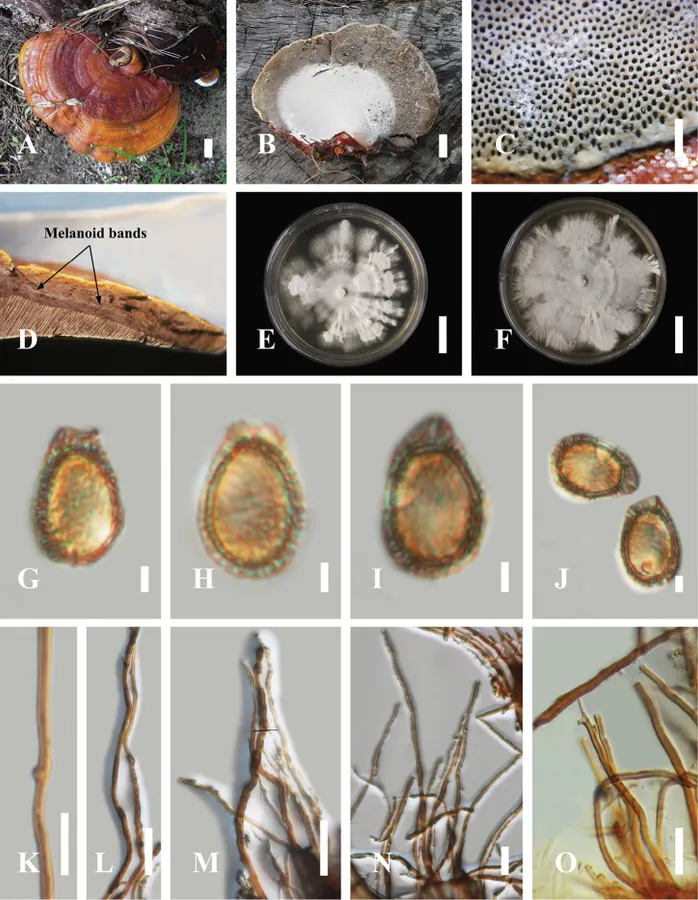
Morphology of Ganoderma casuarinicola (HKAS 104639) A The upper surface of mature basidiocarp B the lower surface of mature basidiocarp C pore characteristics D melanoid bands in the context tissue E, F culture after incubation at 25 °C for 10–14 days on Potato Dextrose Agar (PDA) G–J basidiospores in KOH K clamp connections L thick walled unbranched generative hyphae of context in KOH M, N thin-thick-walled unbranched generative and flexuous skeletal hyphae O thick-walled generative and skeletal hyphae of the tube layers. Scale bars: 2 cm (A, B); 500 µm (C); 2 cm (E, F); 2 µm (G–J); 5 µm (K); 3 µm (L–O).
- Jenis
- Pelat ilmiah
- Kredit
- Thatsanee Luangharn, Samantha C. Karunarathna, Peter E. Mortimer, Kevin D. Hyde, Jianchu Xu
- Lisensi
- CC BY 4.0
- Sumber media
- Buka entri sumber
Dokumentasi tambahan
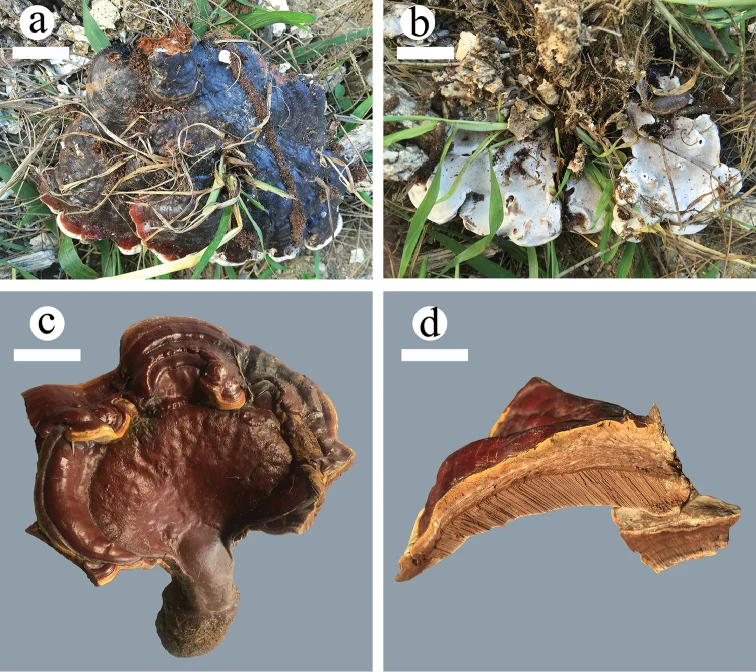
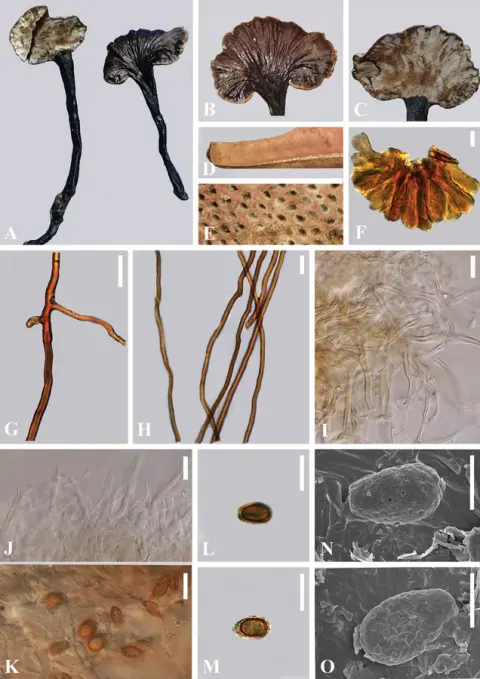
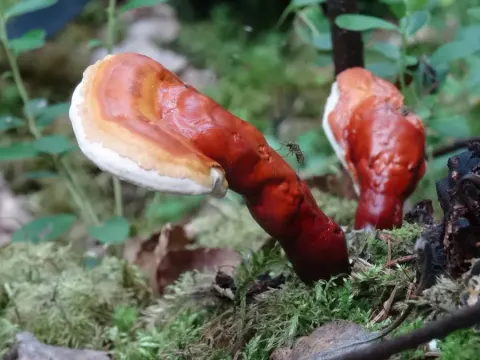
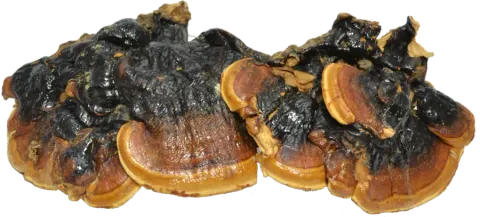
Pelat perbandingan tubuh buah. Ganoderma casuarinicola ditampilkan pada panel c–d; panel lainnya memuat spesies pembanding. Pembagian panel mengikuti keterangan sumber.
Kredit dan penggunaan
Jia-Hui Xing, Yi-Fei Sun, Yu-Li Han, Bao-Kai Cui, Yu-Cheng Dai
Ukuran dan format gambar disesuaikan tanpa pemotongan, retus, atau penambahan skala. Lisensi sumber dipertahankan.
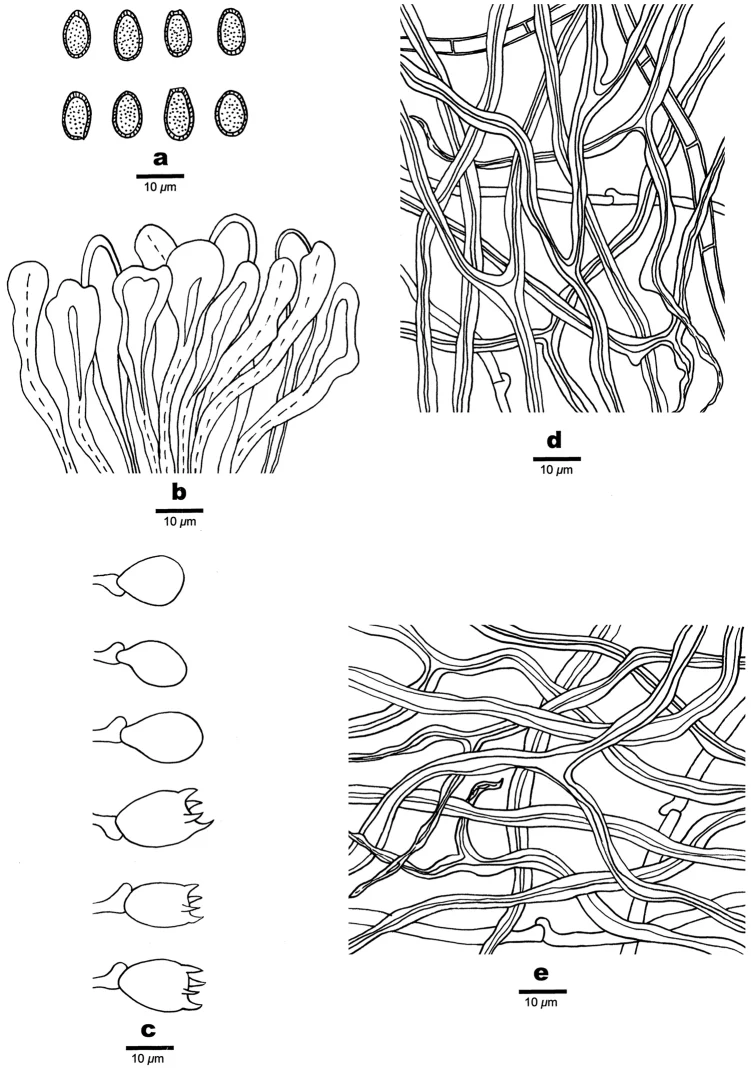
Microscopic structures of Ganoderma casuarinicola (drawn from the holotype). a Basidiospores b Apical cells from the cuticle c Basidia and basidioles d Hyphae from context e Hyphae from trama. Scale bars: 10 µm.
Kredit dan penggunaan
Jia-Hui Xing, Yi-Fei Sun, Yu-Li Han, Bao-Kai Cui, Yu-Cheng Dai
Ukuran dan format gambar disesuaikan tanpa pemotongan, retus, atau penambahan skala. Lisensi sumber dipertahankan.
Sumber profil
- [1] Morphological and molecular identification of two new Ganoderma species on Casuarina equisetifolia from China — Ganoderma casuarinicola
- [2] Catalogue of Life Base2026-09-11 — Ganoderma casuarinicola
- [3] Dokumentasi visual — Ganoderma casuarinicola
- [4] Dokumentasi visual — Ganoderma casuarinicola
- [5] Dokumentasi visual — Ganoderma casuarinicola
Rujukan halaman ini
Fungi. Ganoderma casuarinicola. Rilis data fungi-2026-10-12-expansion-2. https://fungi-atlas.mgadib.chatgpt.site/jamur/ganoderma-casuarinicola/.
Status: impor sumber; pemeriksaan editorial per profil belum selesai. Untuk klaim biologis, gunakan rujukan pada bagian terkait dan periksa konteks sumber aslinya.