01 / Morfologi

Ciri dan struktur

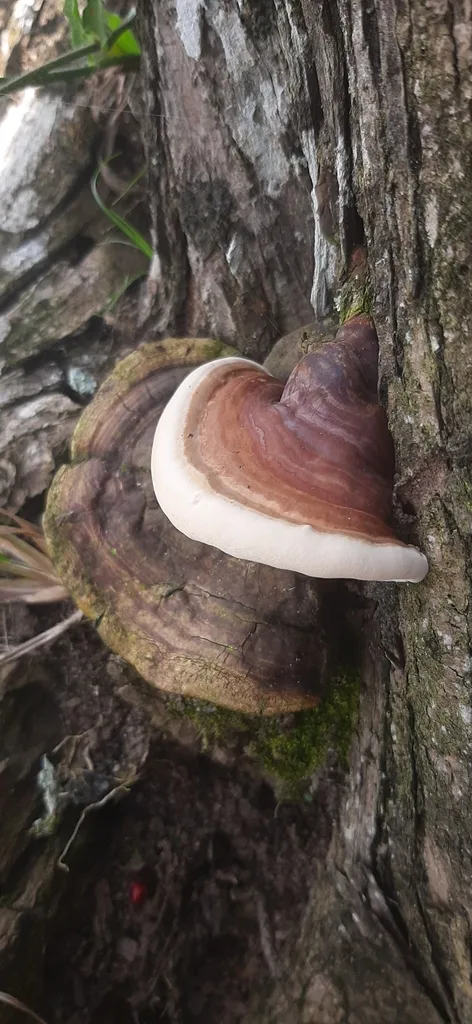
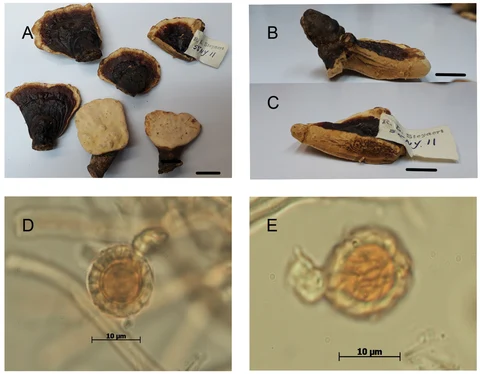
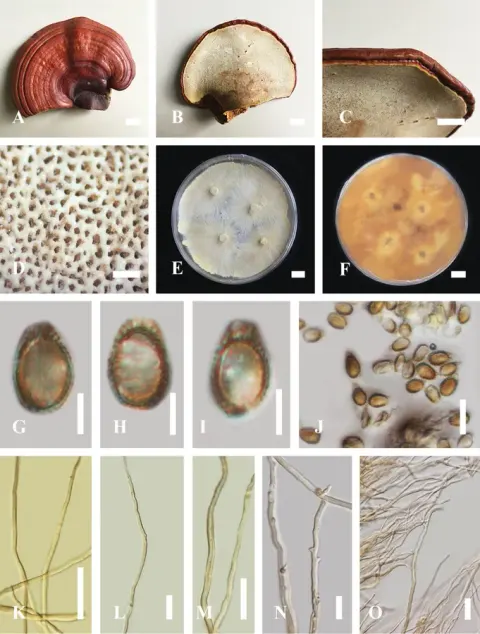
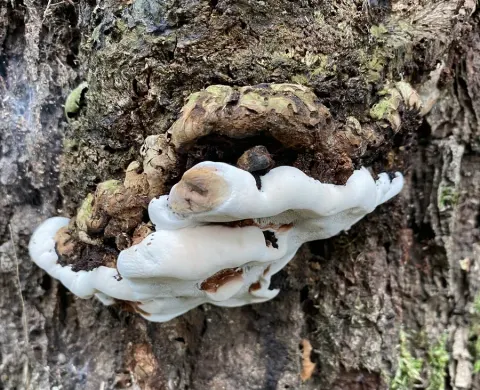
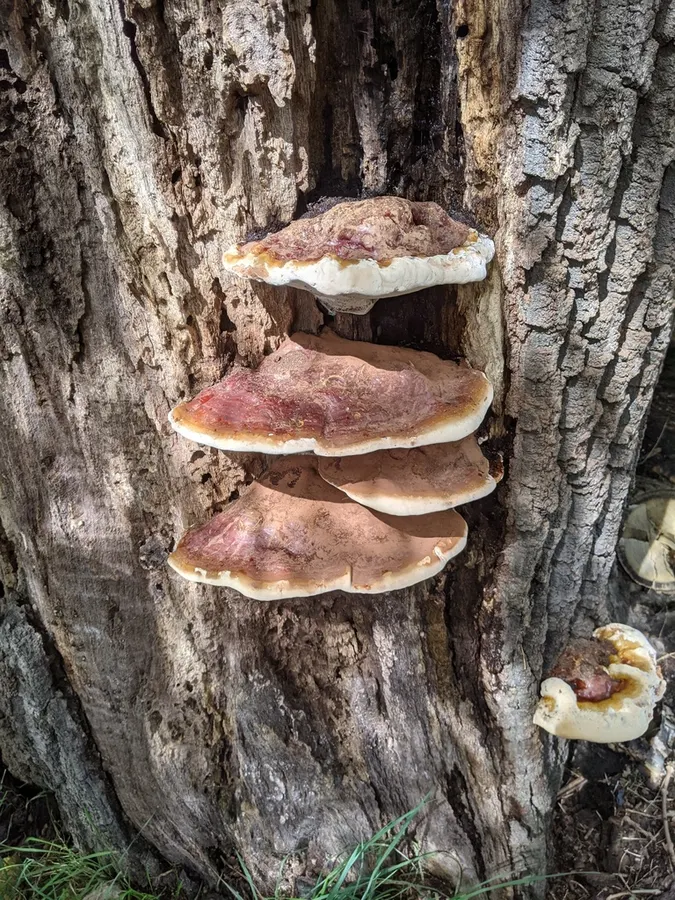
Fruiting bodies annual and sessile (without a stipe) or pseudostipitate (very small stipe). Fruiting bodies found growing on trunks or root flares of living or dead hardwood trees. Mature fruiting bodies are laccate and reddish-brown, often with a wrinkled margin if dry. Fruiting bodies are shelf-like if on stumps or overlapping clusters of fan-shaped (flabelliform) fruiting bodies if growing from underground roots, and range in size of 3-20 cm in diameter. Hymenium white, bruising brown, and poroid with irregular pores that can range in shape from circular to angular. The context tissue is cream colored and can be thin to thick and on average the same length as the tubes. Black resinous deposits are never found embedded in the context tissue, but concentric zones are often found. Spores appear smooth, or nearly so, due to the fine (thin) echinulations from the endosporium. The spores can be used to differentiate the species from other common Eastern North American species such as Ganoderma curtisii (Berk.) Murrill. Elliptical to obovate to obpyriform chlamydospores formed in vegetative mycelium, and are abundant in cultures.

Sebagian uraian ditampilkan dalam bahasa sumber; terjemahannya belum tersedia atau belum lolos pemeriksaan.

Rujukan: [1]

Pengukuran mengikuti objek, spesimen atau kultur, dan metode yang disebutkan sumber. Baca uraian asli untuk konteks lengkap.

02 / Kehidupan

Habitat dan peran ekologis

Very common taxon, being found in practically every state East of the Rocky Mountains within the United States.

Sebagian uraian ditampilkan dalam bahasa sumber; terjemahannya belum tersedia atau belum lolos pemeriksaan.

Rujukan: [1]

Habitat atau konteks temuan
Informasi belum tersedia pada sumber rilis ini.
Substrat
Informasi belum tersedia pada sumber rilis ini.
Peran atau konteks
Belum dikategorikan pada rilis ini.
Temukan hubungan serupa
03 / Siklus hidup

Reproduksi

Hymenium white, bruising brown, and poroid with irregular pores that can range in shape from circular to angular. The context tissue is cream colored and can be thin to thick and on average the same length as the tubes. Black resinous deposits are never found embedded in the context tissue, but concentric zones are often found. Spores appear smooth, or nearly so, due to the fine (thin) echinulations from the endosporium. The spores can be used to differentiate the species from other common Eastern North American species such as Ganoderma curtisii (Berk.) Murrill. Elliptical to obovate to obpyriform chlamydospores formed in vegetative mycelium, and are abundant in cultures.

Sebagian uraian ditampilkan dalam bahasa sumber; terjemahannya belum tersedia atau belum lolos pemeriksaan.

Rujukan: [1]

Sinonim menurut acuan taksonomi rilis: Fomes areolatus; Fomes chaffangeonii; Fomes resinaceus; Fomes sessilis; Fomes subperforatus; Friesia resinacea; Ganoderma areolatum; Ganoderma argillaceum; Ganoderma chaffangeonii; Ganoderma lucidum subsp. resinaceum; Ganoderma perturbatum; Ganoderma praelongum; Ganoderma pulverulentum; Ganoderma resinaceum f. quercinum; Ganoderma resinaceum var. alneum; Ganoderma sessile; Ganoderma subfornicatum; Ganoderma subincrustatum; Ganoderma subperforatum; Ganoderma subtuberculosum; Polyporus chaffangeonii; Polyporus perturbatus; Polyporus pulverulentus; Polyporus resinaceus; Polyporus sessilis; Polyporus subincrustatus; Scindalma chaffangeonii; Scindalma resinaceum
04 / Batas informasi

Catatan identitas dan cakupan

  • Nama diterima mengikuti Catalogue of Life Base2026-09-11; uraian mempertahankan konsep dan nama sumber aslinya.
  • Original geographic, specimen and life-cycle scope retained; source import awaits individual editorial review.
  • Impor dan terjemahan otomatis belum diperiksa editorial per profil. Struktur reproduktif yang disebutkan tidak membuktikan seluruh siklus hidup diketahui.
  • Pengukuran pada uraian mengikuti spesimen, kultur, dan metode sumber; angka tidak diperluas ke semua populasi.

Catatan distribusi dalam narasi mengikuti sumbernya. Dokumentasi spesimen atau foto mengikuti catatan sumber. Bukti wilayah Indonesia dan penilaian konservasi tidak disimpulkan dari gambar.

05 / Dokumentasi

Melihat dengan konteks

Dokumentasi Ganoderma resinaceum menurut asosiasi foto pada record takson iNaturalist. Kredit: Piermario Maculan. Identitas mengikuti sumber; bukan penentuan spesimen independen.

Jenis
Fotografi
Kredit
teisės nesaugomos, uploaded by Piermario Maculan
Lisensi
CC0 1.0
Sumber media
Buka entri sumber

Gambar menunjukkan objek menurut identifikasi sumber, bukan verifikasi independen spesimen oleh Fungi. Tidak ada skala baru yang ditambahkan.

Dokumentasi tambahan

06 / Rujukan

Sumber profil

  1. [1] Ganoderma sessile — Wikipedia (en)Bagian sumber: Frozen revision 1341256107
    Tanggal penghimpunan sumber: 2026-10-12
    Teks sumber: CC BY-SA4.0 · Wikipedia contributors
  2. [2] Catalogue of Life Base2026-09-11 — Ganoderma resinaceumBagian sumber: ColDP NameUsage.tsv ID 3F9DW; accepted species; source 2073
    Tanggal penghimpunan sumber: 2026-10-12
  3. [3] Dokumentasi visual — Ganoderma resinaceumBagian sumber: Identitas mengikuti sumber dokumentasi; bukan penentuan spesimen independen.
    Tanggal penghimpunan sumber: 2026-10-17
    Media sumber: CC0 1.0 · teisės nesaugomos, uploaded by Piermario Maculan
  4. [4] Dokumentasi visual — Ganoderma resinaceumBagian sumber: Identitas mengikuti sumber dokumentasi; bukan penentuan spesimen independen.
    Tanggal penghimpunan sumber: 2026-10-17
    Teks sumber: CC BY 4.0 · (c) Yoannis Domínguez, some rights reserved (CC BY), uploaded by Yoannis Domínguez

Adaptasi teks: CC BY-SA 4.0. Wikipedia contributors — Ganoderma sessile — Wikipedia (en)

Uraian asli dan riwayat sumber

Riwayat atau halaman sumber

Ringkasan sumber

Fruiting bodies annual and sessile (without a stipe) or pseudostipitate (very small stipe). Fruiting bodies found growing on trunks or root flares of living or dead hardwood trees. Mature fruiting bodies are laccate and reddish-brown, often with a wrinkled margin if dry. Fruiting bodies are shelf-like if on stumps or overlapping clusters of fan-shaped (flabelliform) fruiting bodies if growing from underground roots, and range in size of 3-20 cm in diameter. Hymenium white, bruising brown, and poroid with irregular pores that can range in shape from circular to angular.

Revisi sumber

Morfologi sumber

Fruiting bodies annual and sessile (without a stipe) or pseudostipitate (very small stipe). Fruiting bodies found growing on trunks or root flares of living or dead hardwood trees. Mature fruiting bodies are laccate and reddish-brown, often with a wrinkled margin if dry. Fruiting bodies are shelf-like if on stumps or overlapping clusters of fan-shaped (flabelliform) fruiting bodies if growing from underground roots, and range in size of 3-20 cm in diameter. Hymenium white, bruising brown, and poroid with irregular pores that can range in shape from circular to angular. The context tissue is cream colored and can be thin to thick and on average the same length as the tubes. Black resinous deposits are never found embedded in the context tissue, but concentric zones are often found. Spores appear smooth, or nearly so, due to the fine (thin) echinulations from the endosporium. The spores can be used to differentiate the species from other common Eastern North American species such as Ganoderma curtisii (Berk.) Murrill. Elliptical to obovate to obpyriform chlamydospores formed in vegetative mycelium, and are abundant in cultures.

Revisi sumber

Ekologi sumber

Very common taxon, being found in practically every state East of the Rocky Mountains within the United States.

Revisi sumber

Struktur reproduksi sumber

Hymenium white, bruising brown, and poroid with irregular pores that can range in shape from circular to angular. The context tissue is cream colored and can be thin to thick and on average the same length as the tubes. Black resinous deposits are never found embedded in the context tissue, but concentric zones are often found. Spores appear smooth, or nearly so, due to the fine (thin) echinulations from the endosporium. The spores can be used to differentiate the species from other common Eastern North American species such as Ganoderma curtisii (Berk.) Murrill. Elliptical to obovate to obpyriform chlamydospores formed in vegetative mycelium, and are abundant in cultures.

Revisi sumber

Rujukan halaman ini

Fungi. Ganoderma resinaceum. Rilis data fungi-2026-10-12-expansion-2. https://fungi-atlas.mgadib.chatgpt.site/jamur/ganoderma-resinaceum/.

Status: impor sumber; pemeriksaan editorial per profil belum selesai. Untuk klaim biologis, gunakan rujukan pada bagian terkait dan periksa konteks sumber aslinya.