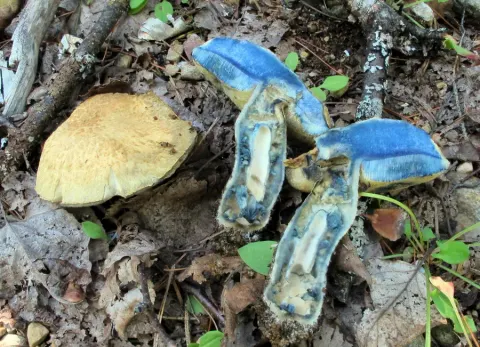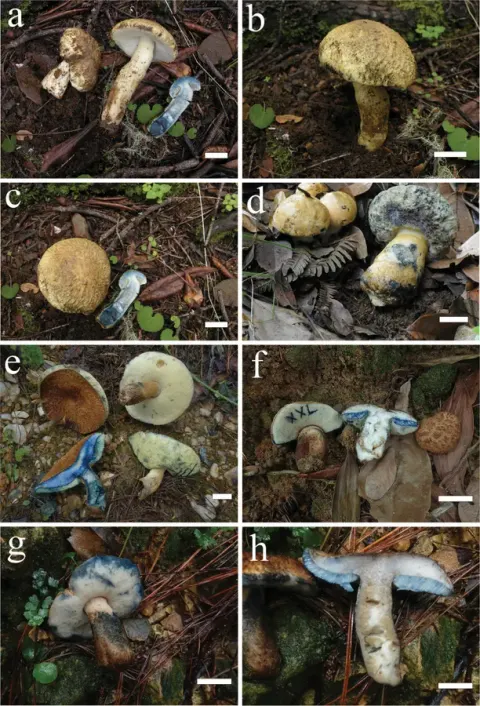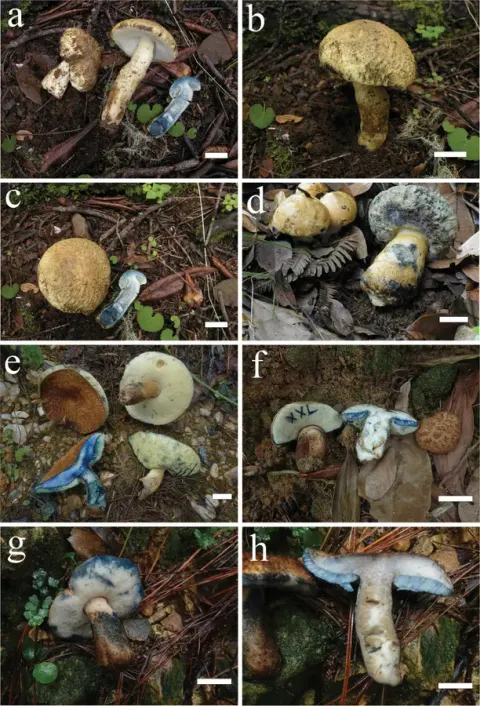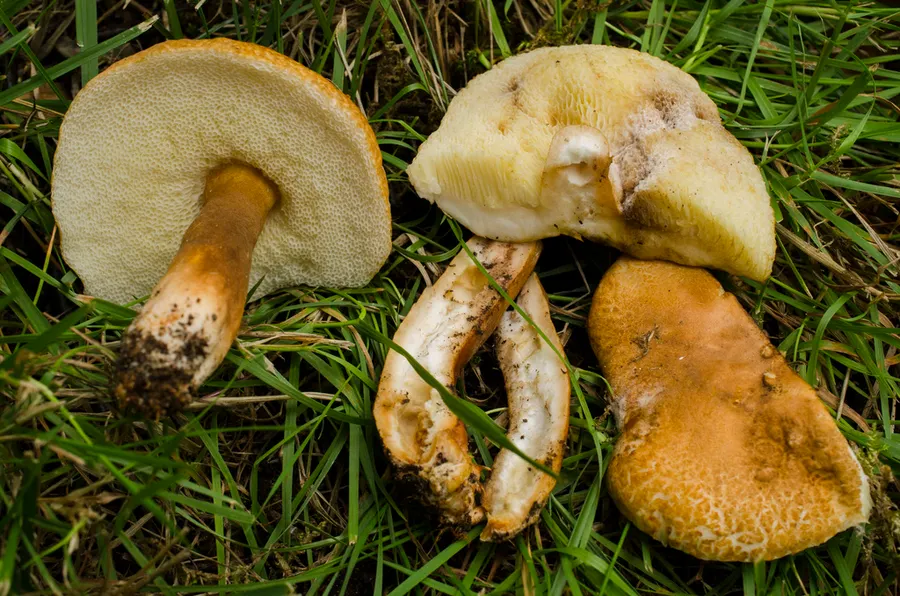
Ciri dan struktur
PILEUS: convex to plano-convex, 3.5-5.5 cm diam., dry, finely tomentose to velutinate, cocoa brown, chestnut brown, or cinnamon brown; cuticle composed of short-celled, filamentous hyphae 8-15 µm diam., usually with conspicuous clamp connections and brown contents, terminal cells resembling dermatocystidia, often projecting at right angles to surface; margin entire. HYMENOPHORE: tubes to 7 mm long, excavated around apex of stipe, white when young, pallid yellow at maturity; pores concolorous with tubes, subregular, 0.5-1 mm diam. STIPE: 4-5 cm long, tapering apically, occasionally subcylindrical, 1-2 cm diam., solid at first, becoming stuffed, finally hollow, dry, tomentose to velutinate, concolorous with pileus or paler apically; flesh white to sordid white; annulus absent. SPORES: spore print not obtained, reported to be between Amber Yellow and Citron Yellow; spores pallid stramineous, short-elliptical, often ovate and flattened on one side, 7.4-11.7-(13) X 5.2-6.5-(7.2) µm., smooth. HYMENIUM: basidia hyaline, clavate, 27-35 X 9-12 µm, 4-spored; cystidia sparse on tube walls, crowded at tube mouths, hyaline, thin-walled, subulate with rounded apices to ventricose-rostrate, 35-52 X 5.2-9.8 µm.. HYMENOPHORAL TRAMA: bilateral, of the Boletus subtype; clamp connections present. CONTEXT OF PILEUS: white to sordid white, unchanging on exposure to air. TASTE: mild. SMELL: not distinctive. CHEMICAL REACTIONS: KOH and NH4OH on pileus and context of pileus—no reaction.
Habitat dan peran ekologis
Gyroporus castaneus is widely distributed throughout temperate regions of the northern hemisphere, where it occurs in association with both coniferous and broad leaved trees. The fact that both the above collections were found in relatively undisturbed native forest suggests that it is indigenous to New Zealand. Singer (1945b) noted an unconfirmed report of its occurrence in Australia, but did not state whether it was indigenous or introduced. G. castaneus is reported to be an edible fungus by European mycologists. The species is readily recognisable by the chestnut brown fruit bodies, hollow stipe, pallid stramineous spores, and presence of clamp connections. It has not previously been recorded from New Zealand.
- Habitat atau konteks temuan
- hutan
- Substrat
- Informasi belum tersedia pada sumber rilis ini.
- Peran atau konteks
- Belum dikategorikan pada rilis ini.
Reproduksi
PILEUS: convex to plano-convex, 3.5-5.5 cm diam., dry, finely tomentose to velutinate, cocoa brown, chestnut brown, or cinnamon brown; cuticle composed of short-celled, filamentous hyphae 8-15 µm diam., usually with conspicuous clamp connections and brown contents, terminal cells resembling dermatocystidia, often projecting at right angles to surface; margin entire. HYMENOPHORE: tubes to 7 mm long, excavated around apex of stipe, white when young, pallid yellow at maturity; pores concolorous with tubes, subregular, 0.5-1 mm diam. STIPE: 4-5 cm long, tapering apically, occasionally subcylindrical, 1-2 cm diam., solid at first, becoming stuffed, finally hollow, dry, tomentose to velutinate, concolorous with pileus or paler apically; flesh white to sordid white; annulus absent.
Catatan identitas dan cakupan
- Nama diterima mengikuti Catalogue of Life Base2026-09-11; uraian mempertahankan konsep dan nama sumber aslinya.
- Historical description as cited by BiotaNZ. Preserve explicit New Zealand/locality, host and specimen qualifiers. Distribution is the cited source scope, not a current global range.
- Impor dan terjemahan otomatis belum diperiksa editorial per profil. Struktur reproduktif yang disebutkan tidak membuktikan seluruh siklus hidup diketahui.
- Pengukuran pada uraian mengikuti spesimen, kultur, dan metode sumber; angka tidak diperluas ke semua populasi.
Catatan distribusi dalam narasi mengikuti sumbernya. Dokumentasi spesimen atau foto mengikuti catatan sumber. Bukti wilayah Indonesia dan penilaian konservasi tidak disimpulkan dari gambar.
Melihat dengan konteks
Dokumentasi Gyroporus castaneus menurut asosiasi foto pada record takson iNaturalist. Kredit: Tim Sage. Identitas mengikuti sumber; bukan penentuan spesimen independen.
- Jenis
- Fotografi
- Kredit
- (c) Tim Sage, some rights reserved (CC BY-SA), uploaded by Tim Sage
- Lisensi
- CC BY-SA 4.0
- Sumber media
- Buka entri sumber
Sumber profil
- [1] McNabb, R.F.R. 1968: The Boletaceae of New Zealand. New Zealand Journal of Botany 6(2): 137-176. — Gyroporus castaneus
- [2] Catalogue of Life Base2026-09-11 — Gyroporus castaneus
- [3] Dokumentasi visual — Gyroporus castaneus
Rujukan halaman ini
Fungi. Gyroporus castaneus. Rilis data fungi-2026-10-12-expansion-2. https://fungi-atlas.mgadib.chatgpt.site/jamur/gyroporus-castaneus/.
Status: impor sumber; pemeriksaan editorial per profil belum selesai. Untuk klaim biologis, gunakan rujukan pada bagian terkait dan periksa konteks sumber aslinya.