01 / Morfologi

Ciri dan struktur

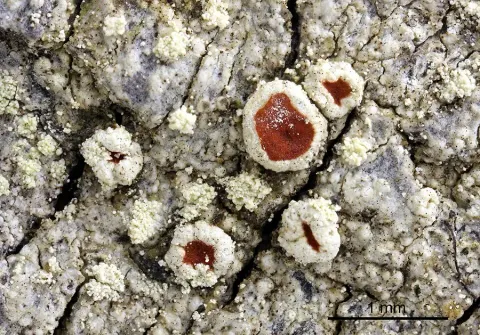
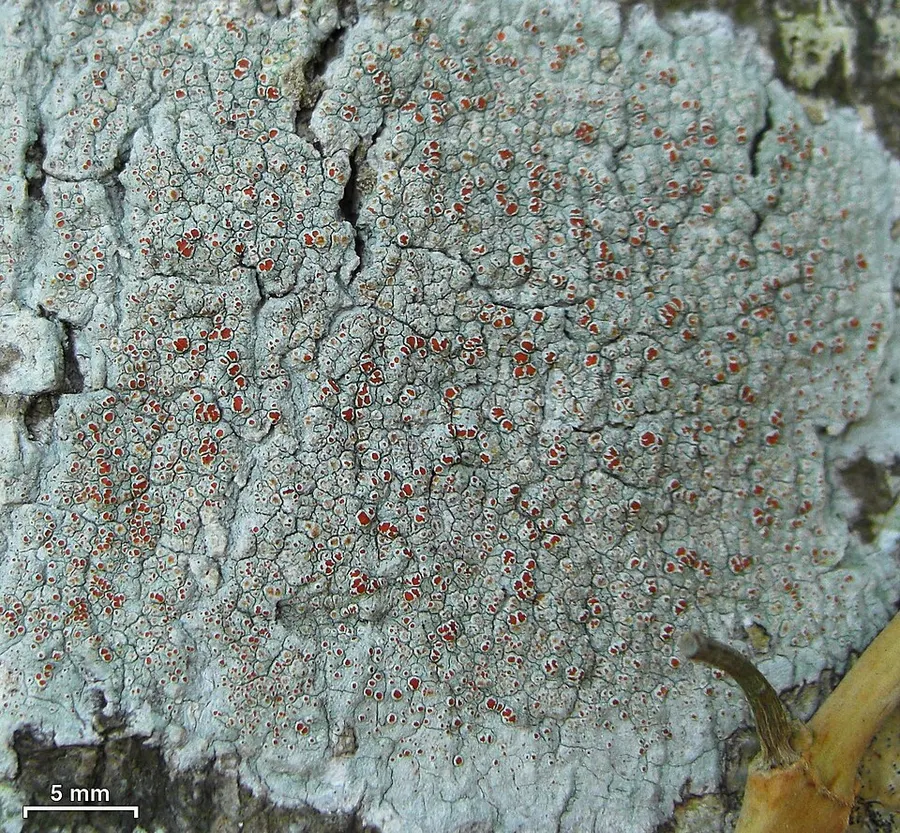
The crustose thallus of Haematomma accolens ranges from thin to moderately thick, with a texture varying from smooth to slightly roughened or cracked. The thallus appears yellowish white to greenish-grey, occasionally showing darker tones. It lacks specialised reproductive structures like soredia or isidia. Occasionally, a white, fibrous Prothallus can be seen at the edges of the lichen. The apothecia, or spore-producing structures, are vivid red to deep reddish-orange and measure 0.6–1.5 mm in diameter. They are typically flat with smooth or slightly roughened margins that remain well-defined, sometimes becoming with age. The apothecial is smooth and never (dusty-looking). The hymenium (spore-bearing layer) is colourless, while the (uppermost layer of the apothecium) is orange, reacting purple in potassium hydroxide (K) before fading. The (layer beneath the hymenium) is pale yellow or colourless. Spores are long and spindle-shaped, measuring 36–68 μm in length and 3–5 μm in width, with 6–8 septa dividing them into sections. They are typically straight or slightly curved and align parallel in the ascus. Conidia (asexual spores), though rarely observed, are short and rod-shaped, measuring 5–7 μm long.

Sebagian uraian ditampilkan dalam bahasa sumber; terjemahannya belum tersedia atau belum lolos pemeriksaan.

Rujukan: [1]

Pengukuran mengikuti objek, spesimen atau kultur, dan metode yang disebutkan sumber. Baca uraian asli untuk konteks lengkap.

02 / Kehidupan

Habitat dan peran ekologis

Haematomma accolens grows on the deciduous tree bark in warm-temperate and subtropical regions. It commonly occurs on smooth-barked trees, including Quercus (oak), Acer rubrum (red maple), and Carya (hickory), but it is also found on other genera including Fagus (beech), Ilex (holly), Liquidambar (sweetgum), Magnolia, Nyssa (tupelo), Persea (bay trees), and Michelia. The species grows in shaded to semi-shaded forest environments. Haematomma accolens occurs mainly in the southeastern United States. It has been recorded from North Carolina to northern Florida, with scattered occurrences extending westward to eastern Texas. Beyond North America, the species is also known from the West Indies, Costa Rica, Guatemala, Brazil, parts of Africa, India, and northeastern Australia. Reports from Malaysia are tentative and require further verification. In Asia, it is known from Sri Lanka, and it was recollected in India after a gap of almost 136 years since its original type collection from the state of Assam. The lichen was recorded as new to China in 2019, at elevations ranging from 400 to 1230 m. Ecologically, H. accolens is part of lichen communities on tree bark, where it contributes to nutrient cycling and provides microhabitats for small invertebrates.

Sebagian uraian ditampilkan dalam bahasa sumber; terjemahannya belum tersedia atau belum lolos pemeriksaan.

Rujukan: [1]

Habitat atau konteks temuan
hutan
Substrat
Informasi belum tersedia pada sumber rilis ini.
Peran atau konteks
Pembentuk liken
Temukan hubungan serupa
03 / Siklus hidup

Reproduksi

The crustose thallus of Haematomma accolens ranges from thin to moderately thick, with a texture varying from smooth to slightly roughened or cracked. The thallus appears yellowish white to greenish-grey, occasionally showing darker tones. It lacks specialised reproductive structures like soredia or isidia. Occasionally, a white, fibrous Prothallus can be seen at the edges of the lichen. The apothecia, or spore-producing structures, are vivid red to deep reddish-orange and measure 0.6–1.5 mm in diameter. They are typically flat with smooth or slightly roughened margins that remain well-defined, sometimes becoming with age. The apothecial is smooth and never (dusty-looking). The hymenium (spore-bearing layer) is colourless, while the (uppermost layer of the apothecium) is orange, reacting purple in potassium hydroxide (K) before fading.

Sebagian uraian ditampilkan dalam bahasa sumber; terjemahannya belum tersedia atau belum lolos pemeriksaan.

Rujukan: [1]

Sinonim menurut acuan taksonomi rilis: Haematomma puniceum var. accolens; Lecania punicea var. accolens; Lecanora punicea var. accolens
04 / Batas informasi

Catatan identitas dan cakupan

  • Nama diterima mengikuti Catalogue of Life Base2026-09-11; uraian mempertahankan konsep dan nama sumber aslinya.
  • Original geographic, specimen and life-cycle scope retained; source import awaits individual editorial review.
  • Impor dan terjemahan otomatis belum diperiksa editorial per profil. Struktur reproduktif yang disebutkan tidak membuktikan seluruh siklus hidup diketahui.
  • Pengukuran pada uraian mengikuti spesimen, kultur, dan metode sumber; angka tidak diperluas ke semua populasi.

Catatan distribusi dalam narasi mengikuti sumbernya. Dokumentasi spesimen atau foto mengikuti catatan sumber. Bukti wilayah Indonesia dan penilaian konservasi tidak disimpulkan dari gambar.

05 / Dokumentasi

Melihat dengan konteks

Dokumentasi Haematomma accolens dari Wikimedia Commons. Outer Banks, North Carolina, 20131108 Identifikasi mengikuti record berkas sumber.

Jenis
Fotografi
Kredit
Jason Hollinger
Lisensi
CC BY 2.0
Sumber media
Buka entri sumber

Gambar menunjukkan objek menurut identifikasi sumber, bukan verifikasi independen spesimen oleh Fungi. Tidak ada skala baru yang ditambahkan.

06 / Rujukan

Sumber profil

  1. [1] Haematomma accolens — Wikipedia (en)Bagian sumber: Frozen revision 1328926679
    Tanggal penghimpunan sumber: 2026-10-12
    Teks sumber: CC BY-SA4.0 · Wikipedia contributors
  2. [2] Catalogue of Life Base2026-09-11 — Haematomma accolensBagian sumber: ColDP NameUsage.tsv ID 6L8SN; accepted species; source 2073
    Tanggal penghimpunan sumber: 2026-10-12
  3. [3] Dokumentasi visual — Haematomma accolensBagian sumber: Individual media record; identification follows the source, not independent determination
    Tanggal penghimpunan sumber: 2026-10-12
    Media sumber: CC BY 2.0 · Jason Hollinger

Adaptasi teks: CC BY-SA 4.0. Wikipedia contributors — Haematomma accolens — Wikipedia (en)

Uraian asli dan riwayat sumber

Riwayat atau halaman sumber

Ringkasan sumber

Haematomma accolens, commonly known as the tree bloodspot, is a species of crustose lichen in the family Haematommataceae. It forms thin to moderately thick patches on tree bark, appearing yellowish-white to greenish-grey in colour, and features vivid red to deep reddish-orange spore-producing structures (apothecia). The lichen typically grows on the bark of deciduous trees in warm-temperate and subtropical regions, particularly favouring smooth-barked trees such as oaks and maples in shaded forest environments.

Revisi sumber

Morfologi sumber

The crustose thallus of Haematomma accolens ranges from thin to moderately thick, with a texture varying from smooth to slightly roughened or cracked. The thallus appears yellowish white to greenish-grey, occasionally showing darker tones. It lacks specialised reproductive structures like soredia or isidia. Occasionally, a white, fibrous Prothallus can be seen at the edges of the lichen. The apothecia, or spore-producing structures, are vivid red to deep reddish-orange and measure 0.6–1.5 mm in diameter. They are typically flat with smooth or slightly roughened margins that remain well-defined, sometimes becoming with age. The apothecial is smooth and never (dusty-looking). The hymenium (spore-bearing layer) is colourless, while the (uppermost layer of the apothecium) is orange, reacting purple in potassium hydroxide (K) before fading. The (layer beneath the hymenium) is pale yellow or colourless. Spores are long and spindle-shaped, measuring 36–68 μm in length and 3–5 μm in width, with 6–8 septa dividing them into sections. They are typically straight or slightly curved and align parallel in the ascus. Conidia (asexual spores), though rarely observed, are short and rod-shaped, measuring 5–7 μm long.

Revisi sumber

Ekologi sumber

Haematomma accolens grows on the deciduous tree bark in warm-temperate and subtropical regions. It commonly occurs on smooth-barked trees, including Quercus (oak), Acer rubrum (red maple), and Carya (hickory), but it is also found on other genera including Fagus (beech), Ilex (holly), Liquidambar (sweetgum), Magnolia, Nyssa (tupelo), Persea (bay trees), and Michelia. The species grows in shaded to semi-shaded forest environments. Haematomma accolens occurs mainly in the southeastern United States. It has been recorded from North Carolina to northern Florida, with scattered occurrences extending westward to eastern Texas. Beyond North America, the species is also known from the West Indies, Costa Rica, Guatemala, Brazil, parts of Africa, India, and northeastern Australia. Reports from Malaysia are tentative and require further verification. In Asia, it is known from Sri Lanka, and it was recollected in India after a gap of almost 136 years since its original type collection from the state of Assam. The lichen was recorded as new to China in 2019, at elevations ranging from 400 to 1230 m. Ecologically, H. accolens is part of lichen communities on tree bark, where it contributes to nutrient cycling and provides microhabitats for small invertebrates.

Revisi sumber

Struktur reproduksi sumber

The crustose thallus of Haematomma accolens ranges from thin to moderately thick, with a texture varying from smooth to slightly roughened or cracked. The thallus appears yellowish white to greenish-grey, occasionally showing darker tones. It lacks specialised reproductive structures like soredia or isidia. Occasionally, a white, fibrous Prothallus can be seen at the edges of the lichen. The apothecia, or spore-producing structures, are vivid red to deep reddish-orange and measure 0.6–1.5 mm in diameter. They are typically flat with smooth or slightly roughened margins that remain well-defined, sometimes becoming with age. The apothecial is smooth and never (dusty-looking). The hymenium (spore-bearing layer) is colourless, while the (uppermost layer of the apothecium) is orange, reacting purple in potassium hydroxide (K) before fading.

Revisi sumber

Rujukan halaman ini

Fungi. Haematomma accolens. Rilis data fungi-2026-10-12-expansion-2. https://fungi-atlas.mgadib.chatgpt.site/jamur/haematomma-accolens/.

Status: impor sumber; pemeriksaan editorial per profil belum selesai. Untuk klaim biologis, gunakan rujukan pada bagian terkait dan periksa konteks sumber aslinya.