01 / Morfologi

Ciri dan struktur

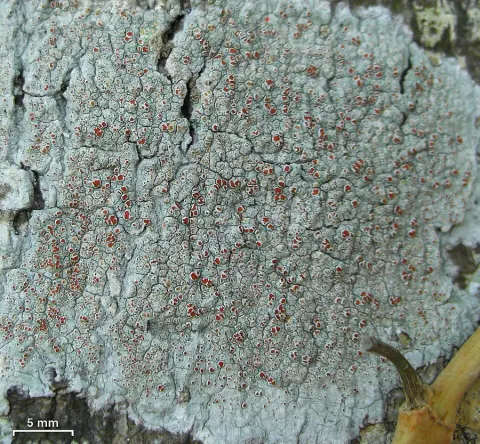
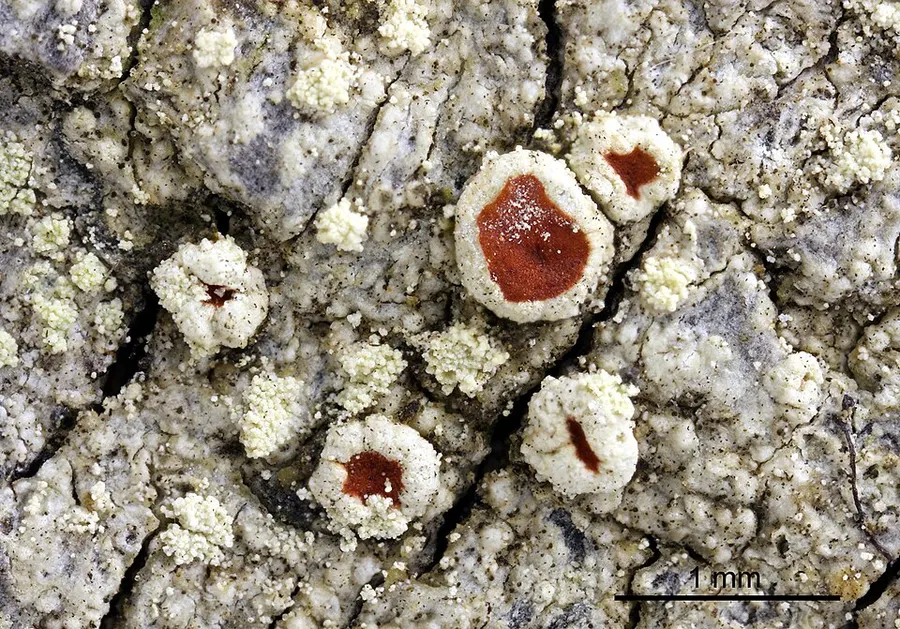
Haematomma sorediatum forms a pale white to grey (sometimes greenish-grey), crust-like thallus (the lichen body) with a granular to slightly warty () surface. It reproduces asexually by producing soredia in discrete, round soralia that are usually raised into small domes; in older thalli, neighbouring soralia may merge. A thin, white, fibrous (a border at the thallus edge) may be present. Apothecia (fruiting bodies), when present, are in form and usually about 0.6–1 mm in diameter (occasionally larger). They have a bright red to orange-red and a persistent margin that is often (scalloped) and may become partly sorediate. The disc is often (lacking a powdery coating), though some collections have been described as having a light . Asci contain eight colourless (hyaline) ascospores. Across published accounts, the spores are long and narrow (about 40–70 × 4–7 μm) and divided by about 7–14 transverse septa (cross walls). They have also been described as helically coiled within the ascus. Reported chemistry includes atranorin and placodiolic acid. In the K spot test (potassium hydroxide), the thallus typically turns yellow (K+), and the apothecial pigment briefly turns purple before fading.

Sebagian uraian ditampilkan dalam bahasa sumber; terjemahannya belum tersedia atau belum lolos pemeriksaan.

Rujukan: [1]

Pengukuran mengikuti objek, spesimen atau kultur, dan metode yang disebutkan sumber. Baca uraian asli untuk konteks lengkap.

02 / Kehidupan

Habitat dan peran ekologis

Haematomma sorediatum is a bark-dwelling species with a distribution that has been described as widely pantropical (recorded across tropical regions). In the Asia–Pacific region it is known from Australia, New Zealand, and New Guinea. In Australia it is documented from south-eastern Victoria, including the type locality, where it has been collected on Notelaea ovata and Pomaderris apetala. It was later reported from Maria Island National Park (Tasmania), based on a March 1981 collection at about 300 m altitude. The specimen grew on the trunk of P. apetala in a humid creekline forest with Eucalyptus viminalis and Acacia melanoxylon. The species may be overlooked and may occur more widely where this host is present in eucalypt forests. It was later recorded from Stony Head in northern Tasmania. In New Zealand, it has been reported as common in the northern North Island (north of about 38°S). A separate (disjunct) record is also known from near Puponga in the north-west of the South Island, on the bark of several woody hosts including Rhopalostylis, Phyllocladus, and tawa. It has also been recorded from New Guinea, in primary (old-growth) mountain forest at 2300 m elevation. In the Americas, H. sorediatum has been reported from the West Indies and has been confirmed from Jamaica.

Sebagian uraian ditampilkan dalam bahasa sumber; terjemahannya belum tersedia atau belum lolos pemeriksaan.

Rujukan: [1]

Habitat atau konteks temuan
hutan
Substrat
Informasi belum tersedia pada sumber rilis ini.
Peran atau konteks
Pembentuk liken
Temukan hubungan serupa
03 / Siklus hidup

Reproduksi

Haematomma sorediatum forms a pale white to grey (sometimes greenish-grey), crust-like thallus (the lichen body) with a granular to slightly warty () surface. It reproduces asexually by producing soredia in discrete, round soralia that are usually raised into small domes; in older thalli, neighbouring soralia may merge. A thin, white, fibrous (a border at the thallus edge) may be present. Apothecia (fruiting bodies), when present, are in form and usually about 0.6–1 mm in diameter (occasionally larger). They have a bright red to orange-red and a persistent margin that is often (scalloped) and may become partly sorediate. The disc is often (lacking a powdery coating), though some collections have been described as having a light .

Sebagian uraian ditampilkan dalam bahasa sumber; terjemahannya belum tersedia atau belum lolos pemeriksaan.

Rujukan: [1]

Sinonim menurut acuan taksonomi rilis: Haematomma neglectum
04 / Batas informasi

Catatan identitas dan cakupan

  • Nama diterima mengikuti Catalogue of Life Base2026-09-11; uraian mempertahankan konsep dan nama sumber aslinya.
  • Original geographic, specimen and life-cycle scope retained; source import awaits individual editorial review.
  • Impor dan terjemahan otomatis belum diperiksa editorial per profil. Struktur reproduktif yang disebutkan tidak membuktikan seluruh siklus hidup diketahui.
  • Pengukuran pada uraian mengikuti spesimen, kultur, dan metode sumber; angka tidak diperluas ke semua populasi.

Catatan distribusi dalam narasi mengikuti sumbernya. Dokumentasi spesimen atau foto mengikuti catatan sumber. Bukti wilayah Indonesia dan penilaian konservasi tidak disimpulkan dari gambar.

05 / Dokumentasi

Melihat dengan konteks

Dokumentasi Haematomma sorediatum dari Wikimedia Commons. Fruit bodies (apothecia) of the crustose lichen Haematomma sorediatum ; photographed in Madeira Identifikasi mengikuti record berkas sumber.

Jenis
Fotografi
Kredit
Felis Schumm
Sumber media
Buka entri sumber

Gambar menunjukkan objek menurut identifikasi sumber, bukan verifikasi independen spesimen oleh Fungi. Tidak ada skala baru yang ditambahkan.

06 / Rujukan

Sumber profil

  1. [1] Haematomma sorediatum — Wikipedia (en)Bagian sumber: Frozen revision 1341958538
    Tanggal penghimpunan sumber: 2026-10-12
    Teks sumber: CC BY-SA4.0 · Wikipedia contributors
  2. [2] Catalogue of Life Base2026-09-11 — Haematomma sorediatumBagian sumber: ColDP NameUsage.tsv ID 3J87K; accepted species; source 2073
    Tanggal penghimpunan sumber: 2026-10-12
  3. [3] Dokumentasi visual — Haematomma sorediatumBagian sumber: Individual media record; identification follows the source, not independent determination
    Tanggal penghimpunan sumber: 2026-10-12
    Media sumber: CC BY-SA 4.0 · Felis Schumm

Adaptasi teks: CC BY-SA 4.0. Wikipedia contributors — Haematomma sorediatum — Wikipedia (en)

Uraian asli dan riwayat sumber

Riwayat atau halaman sumber

Ringkasan sumber

Haematomma sorediatum is a species of corticolous (bark-dwelling) crustose lichen in the family Haematommataceae. It is distinctive among its relatives for producing (powdery asexual reproductive particles containing fungal and algal cells) in small, round ; these soredia can disperse and form new lichen bodies (thalli). It forms pale white to greyish crusts on tree bark and has been recorded in Australia and New Zealand, with scattered records in Europe and the Americas. When it produces fruiting bodies, they are bright red and stand out against the pale thallus.

Revisi sumber

Morfologi sumber

Haematomma sorediatum forms a pale white to grey (sometimes greenish-grey), crust-like thallus (the lichen body) with a granular to slightly warty () surface. It reproduces asexually by producing soredia in discrete, round soralia that are usually raised into small domes; in older thalli, neighbouring soralia may merge. A thin, white, fibrous (a border at the thallus edge) may be present. Apothecia (fruiting bodies), when present, are in form and usually about 0.6–1 mm in diameter (occasionally larger). They have a bright red to orange-red and a persistent margin that is often (scalloped) and may become partly sorediate. The disc is often (lacking a powdery coating), though some collections have been described as having a light . Asci contain eight colourless (hyaline) ascospores. Across published accounts, the spores are long and narrow (about 40–70 × 4–7 μm) and divided by about 7–14 transverse septa (cross walls). They have also been described as helically coiled within the ascus. Reported chemistry includes atranorin and placodiolic acid. In the K spot test (potassium hydroxide), the thallus typically turns yellow (K+), and the apothecial pigment briefly turns purple before fading.

Revisi sumber

Ekologi sumber

Haematomma sorediatum is a bark-dwelling species with a distribution that has been described as widely pantropical (recorded across tropical regions). In the Asia–Pacific region it is known from Australia, New Zealand, and New Guinea. In Australia it is documented from south-eastern Victoria, including the type locality, where it has been collected on Notelaea ovata and Pomaderris apetala. It was later reported from Maria Island National Park (Tasmania), based on a March 1981 collection at about 300 m altitude. The specimen grew on the trunk of P. apetala in a humid creekline forest with Eucalyptus viminalis and Acacia melanoxylon. The species may be overlooked and may occur more widely where this host is present in eucalypt forests. It was later recorded from Stony Head in northern Tasmania. In New Zealand, it has been reported as common in the northern North Island (north of about 38°S). A separate (disjunct) record is also known from near Puponga in the north-west of the South Island, on the bark of several woody hosts including Rhopalostylis, Phyllocladus, and tawa. It has also been recorded from New Guinea, in primary (old-growth) mountain forest at 2300 m elevation. In the Americas, H. sorediatum has been reported from the West Indies and has been confirmed from Jamaica.

Revisi sumber

Struktur reproduksi sumber

Haematomma sorediatum forms a pale white to grey (sometimes greenish-grey), crust-like thallus (the lichen body) with a granular to slightly warty () surface. It reproduces asexually by producing soredia in discrete, round soralia that are usually raised into small domes; in older thalli, neighbouring soralia may merge. A thin, white, fibrous (a border at the thallus edge) may be present. Apothecia (fruiting bodies), when present, are in form and usually about 0.6–1 mm in diameter (occasionally larger). They have a bright red to orange-red and a persistent margin that is often (scalloped) and may become partly sorediate. The disc is often (lacking a powdery coating), though some collections have been described as having a light .

Revisi sumber

Rujukan halaman ini

Fungi. Haematomma sorediatum. Rilis data fungi-2026-10-12-expansion-2. https://fungi-atlas.mgadib.chatgpt.site/jamur/haematomma-sorediatum/.

Status: impor sumber; pemeriksaan editorial per profil belum selesai. Untuk klaim biologis, gunakan rujukan pada bagian terkait dan periksa konteks sumber aslinya.