Ciri dan struktur
Basidiomes scattered. Pileus 35–105 mm wide, convex to broadly umbonate; surface dry, sometimes rugulose, occasionally striate at the margin, usually with veil remnants on the margin; cuticle color predominantly cinnamon brown to orange brown (6C5, 7C7) in the center with paler margin, dark beige to tan (5B3); pileus margin strongly involute when young, hygrophanous. Lamellae adnate, often with decurrent tooth, 2–3 mm broad, crowded, thin, with approx. 80–90 full length lamellae and 2–3 lamellules between the lamellae, off-white to cream or yellow-grey when young, later becoming more pinkish or grayish red to purplish and eventually vinaceous to purple-brown or brown following spore maturity; edges weakly fimbriate and white; the white edge remains when the basidiome is dried but the reddish brown color of the lamellae disappears with time. Stipe 50–120 mm long and with central width 5–12 mm, cylindrical sometimes tapering or clavate towards the base, not rooting, occasionally with mycelial cords at the base; white or alutaceous; surface dry, fibrillose, pruinose in the upper part, not discoloring with handling, becoming hollow with age. Flesh whitish, hardly discoloring where bruised. Odor indistinct to raphanoid; taste bitter. Spore vinaceous cinnamon becoming chocolate brown. Exsiccata with no particular characteristics. Basidiospores based on at least 50 spores from each of three collections, 5% to 95% percentile range 8.9–11.4 × 5.6–7.1 µm, with median 9.7–10.6 × 6.1–6.7 µm and av. 9.6–10.6 × 6.1–6.6 µm with av. S. D. length 0.47 µm and width 0.33 µm; Q value 5% to 95% percentile range 1.43–1.72, with median 1.53–1.58 and av. 1.53–1.59 with av.
Habitat dan peran ekologis
So far known only from Bukit Fraser (Fraser’s Hill), Malaysia. The recent collections were found scattered in lowland dipterocarp-oak woodland on the side of the path in tropical rain forest with Quercus.
- Habitat atau konteks temuan
- hutan
- Substrat
- Informasi belum tersedia pada sumber rilis ini.
- Peran atau konteks
- Belum dikategorikan pada rilis ini.
Reproduksi
Basidiomes scattered. Pileus 35–105 mm wide, convex to broadly umbonate; surface dry, sometimes rugulose, occasionally striate at the margin, usually with veil remnants on the margin; cuticle color predominantly cinnamon brown to orange brown (6C5, 7C7) in the center with paler margin, dark beige to tan (5B3); pileus margin strongly involute when young, hygrophanous. Lamellae adnate, often with decurrent tooth, 2–3 mm broad, crowded, thin, with approx. 80–90 full length lamellae and 2–3 lamellules between the lamellae, off-white to cream or yellow-grey when young, later becoming more pinkish or grayish red to purplish and eventually vinaceous to purple-brown or brown following spore maturity; edges weakly fimbriate and white; the white edge remains when the basidiome is dried but the reddish brown color of the lamellae disappears with time.
Catatan identitas dan cakupan
- Nama diterima mengikuti Catalogue of Life Base2026-09-11; uraian mempertahankan konsep dan nama sumber aslinya.
- Preserve original treatment localities, hosts and substrate scope. Materials examined describe documented specimens, not the full global range.
- Impor dan terjemahan otomatis belum diperiksa editorial per profil. Struktur reproduktif yang disebutkan tidak membuktikan seluruh siklus hidup diketahui.
- Pengukuran pada uraian mengikuti spesimen, kultur, dan metode sumber; angka tidak diperluas ke semua populasi.
Catatan distribusi dalam narasi mengikuti sumbernya. Dokumentasi spesimen atau foto mengikuti catatan sumber. Bukti wilayah Indonesia dan penilaian konservasi tidak disimpulkan dari gambar.
Melihat dengan konteks
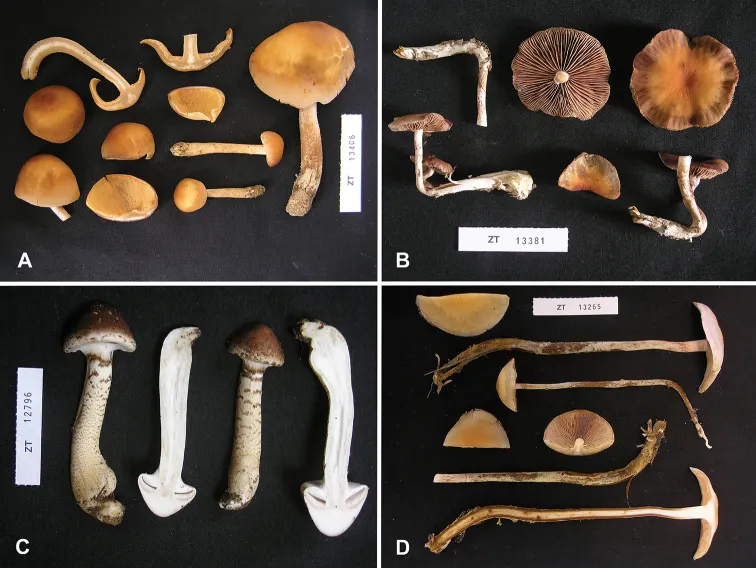
Macroscopic features A Hebeloma flavidifolium (E. Horak 13406) B H. lactariolens (E. Horak 13381) C H. parvisporum (E. Horak 12796) D H. radicans holotype (E. Horak 13265). Photographs E. Horak.
- Jenis
- Pelat ilmiah
- Kredit
- Ursula Eberhardt, Nicole Schütz, Henry J. Beker, Su See Lee, Egon Horak
- Lisensi
- CC BY 4.0
- Sumber media
- Buka entri sumber
Dokumentasi tambahan
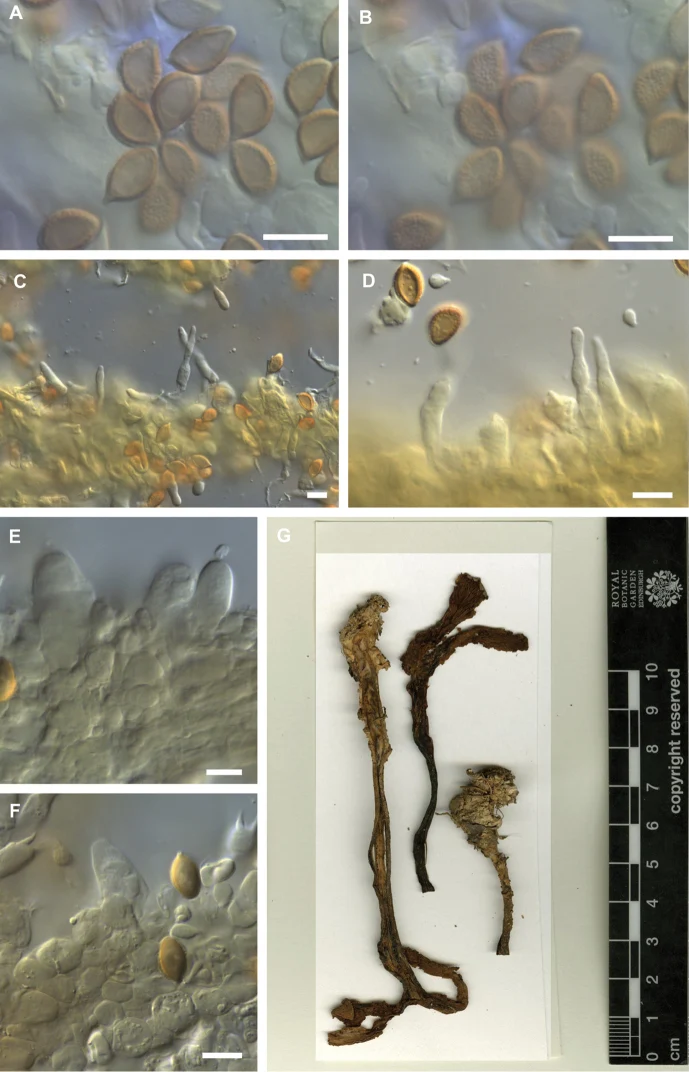
Microscopic features of Hebeloma flavidifolium holotype (E 00204812) A spores in Melzer’s reagent ×1600 B spore ornamentation in Melzer’s reagent ×1600 C cheilocystidia in Melzer’s reagent ×500 D cheilocystidia in Melzer’s reagent ×1000 E cheilocystidia in KOH ×1000 F pleurocystidia in KOH ×1000. Scale bars: 10 µm (A–F). Photographs H.J. Beker. G Exsiccata (a section of photograph from http://data.rbge.org.uk/herb/ E 00204812 provided by the Royal Botanic Garden Edinburgh).
Kredit dan penggunaan
Ursula Eberhardt, Nicole Schütz, Henry J. Beker, Su See Lee, Egon Horak
Ukuran dan format gambar disesuaikan tanpa pemotongan, retus, atau penambahan skala. Lisensi sumber dipertahankan.
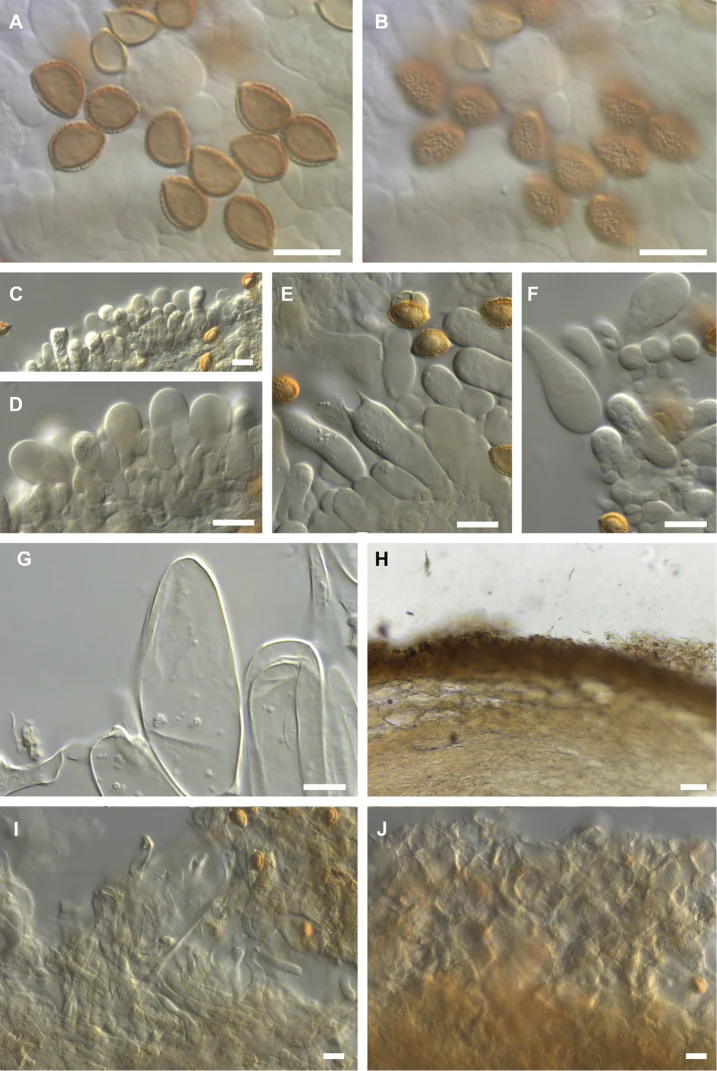
Microscopic features of Hebeloma flavidifolium (E. Horak 13406) A spores in Melzer’s reagent ×1600 B spore ornamentation in Melzer’s reagent ×1600 C cheilocystidia in KOH ×500 D cheilocystidia in KOH ×1000 E basidium in KOH ×1000 F pleurocystidia in KOH ×1000 G caulocystidium in KOH ×1000 H ixocutis section (showing thin gelatinous epicutis) in KOH ×125 I epicutis hyphae in KOH ×500 J subcutis below epicutis in KOH ×500. Scale bars: 10 µm, 100 µm (H). Photographs H.J. Beker.
Kredit dan penggunaan
Ursula Eberhardt, Nicole Schütz, Henry J. Beker, Su See Lee, Egon Horak
Ukuran dan format gambar disesuaikan tanpa pemotongan, retus, atau penambahan skala. Lisensi sumber dipertahankan.
Sumber profil
- [1] Hebeloma in the Malay Peninsula: Masquerading within Psathyrella — Hebeloma flavidifolium
- [2] Catalogue of Life Base2026-09-11 — Hebeloma flavidifolium
- [3] Dokumentasi visual — Hebeloma flavidifolium
- [4] Dokumentasi visual — Hebeloma flavidifolium
- [5] Dokumentasi visual — Hebeloma flavidifolium
Rujukan halaman ini
Fungi. Hebeloma flavidifolium. Rilis data fungi-2026-10-12-expansion-2. https://fungi-atlas.mgadib.chatgpt.site/jamur/hebeloma-flavidifolium/.
Status: impor sumber; pemeriksaan editorial per profil belum selesai. Untuk klaim biologis, gunakan rujukan pada bagian terkait dan periksa konteks sumber aslinya.