01 / Morfologi

Ciri dan struktur

The amygdaloid, non-dextrinoid, rather strongly ornamented spores with average Q value less than 1.6 and the capitate-stipitate cheilocystidia with average width at the apex greater than 9.5 µm distinguish this species from all other known Hebeloma species. Pileus 19–26 mm diameter, convex, surface dry, finely tomentose, cuticle separable, reddish yellow to brown in the center, and pale orange towards the margin. Lamellae emarginate, white, cream to orange brown as the spores mature, with a white fimbriate edge, and about 60 full-length lamellae. Stipe 10–21 mm long, 4–6 mm diameter at median, cylindrical, surface whitish but discoloring brown from the base upwards, with age or handling, fibrillose, at apex pruinose. Context in pileus white to cream, firm, in stipe stuffed, initially white to cream but becoming brown with age and handling, becoming hollow with age; taste fungal to sweet, smell raphanoid. Spore deposit not recorded. Basidiospores based on n = 44 spores of the holotype, 5% to 95% percentile range 9.7–11.6 × 6.4–7.6 µm, with median 10.5 × 7.0 µm and av. 10.5 × 7.0 µm with S.D. length 0.62 µm and width 0.42 µm; Q value 5% to 95% percentile range 1.40–1.62, with median 1.49 and av. 1.50 with S.D. 0.07; amygdaloid, often limoniform, with small apiculus and rounded apically, often subacute to acute, with a distinct thinning of the apical wall and sometimes a clearly visible papilla, not guttulate, usually rather strongly ornamented, ornamentation visible even without immersion, with perispore at most somewhat loosening in a few spores, an indistinct brownish tint in Melzer’s reagent (O3; P1; D1); yellow-brown in KOH.

Sebagian uraian ditampilkan dalam bahasa sumber; terjemahannya belum tersedia atau belum lolos pemeriksaan.

Rujukan: [1]

Pengukuran mengikuti objek, spesimen atau kultur, dan metode yang disebutkan sumber. Baca uraian asli untuk konteks lengkap.

02 / Kehidupan

Habitat dan peran ekologis

In woodland on the ground with Comarostaphylis and Quercus. Growth habit scattered. To date, with only one collection of this species, not possible to describe its distribution and ecology.

Sebagian uraian ditampilkan dalam bahasa sumber; terjemahannya belum tersedia atau belum lolos pemeriksaan.

Rujukan: [1]

Habitat atau konteks temuan
hutan
Substrat
tanah
Peran atau konteks
Belum dikategorikan pada rilis ini.
Temukan hubungan serupa
03 / Siklus hidup

Reproduksi

The amygdaloid, non-dextrinoid, rather strongly ornamented spores with average Q value less than 1.6 and the capitate-stipitate cheilocystidia with average width at the apex greater than 9.5 µm distinguish this species from all other known Hebeloma species. Pileus 19–26 mm diameter, convex, surface dry, finely tomentose, cuticle separable, reddish yellow to brown in the center, and pale orange towards the margin. Lamellae emarginate, white, cream to orange brown as the spores mature, with a white fimbriate edge, and about 60 full-length lamellae. Stipe 10–21 mm long, 4–6 mm diameter at median, cylindrical, surface whitish but discoloring brown from the base upwards, with age or handling, fibrillose, at apex pruinose.

Sebagian uraian ditampilkan dalam bahasa sumber; terjemahannya belum tersedia atau belum lolos pemeriksaan.

Rujukan: [1]

04 / Batas informasi

Catatan identitas dan cakupan

  • Nama diterima mengikuti Catalogue of Life Base2026-09-11; uraian mempertahankan konsep dan nama sumber aslinya.
  • Preserve original treatment localities, hosts and substrate scope. Materials examined describe documented specimens, not the full global range.
  • Impor dan terjemahan otomatis belum diperiksa editorial per profil. Struktur reproduktif yang disebutkan tidak membuktikan seluruh siklus hidup diketahui.
  • Pengukuran pada uraian mengikuti spesimen, kultur, dan metode sumber; angka tidak diperluas ke semua populasi.

Catatan distribusi dalam narasi mengikuti sumbernya. Dokumentasi spesimen atau foto mengikuti catatan sumber. Bukti wilayah Indonesia dan penilaian konservasi tidak disimpulkan dari gambar.

05 / Dokumentasi

Melihat dengan konteks

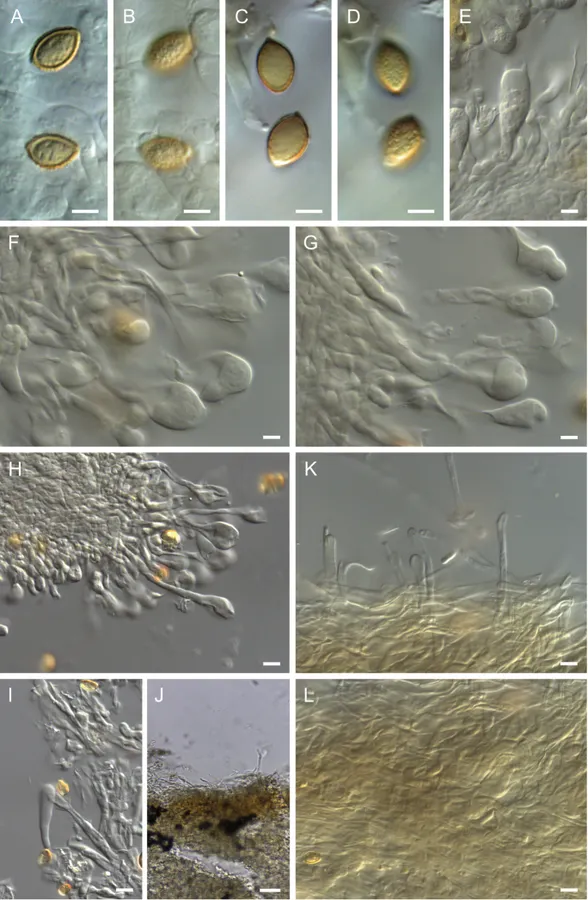
Holotype of Hebeloma magnicystidiatum TLXM 6157 (HJB16795) A Basidiospores ×1600 B spore ornamentation ×1600 C basidiospores and D spore ornamentation in Melzer’s reagent ×1600 E basidium ×1000 F–H cheilocystidia ×1000 H cheilocystidia ×500 I caulocystidia ×500 J cutis ×125 K epicutis hyphae ×500 L subcutis ×500. All in KOH, except C–D. Scale bars: 5 µm (A–G); 10 µm (H–I, K–L); 50 µm (J). Photos H. J. Beker.

Jenis
Pelat ilmiah
Kredit
Ursula Eberhardt, Alejandro Kong, Adriana Montoya, Nicole Schütz, Peter Bartlett, Henry J. Beker
Lisensi
CC BY 4.0
Sumber media
Buka entri sumber

Gambar menunjukkan objek menurut identifikasi sumber, bukan verifikasi independen spesimen oleh Fungi. Tidak ada skala baru yang ditambahkan.

06 / Rujukan

Sumber profil

  1. [1] Not (only) poison pies – Hebeloma (Agaricales, Hymenogastraceae) in Mexico — Hebeloma magnicystidiatumBagian sumber: PMC9849069_section_20
    Tanggal penghimpunan sumber: 2026-10-12
    Teks sumber: CC BY 4.0 · Eberhardt U, Kong A, Montoya A, Schütz N, Bartlett P, Beker HJ.
  2. [2] Catalogue of Life Base2026-09-11 — Hebeloma magnicystidiatumBagian sumber: ColDP NameUsage.tsv ID B2QBD; accepted species; source 2073
    Tanggal penghimpunan sumber: 2026-10-12
  3. [3] Dokumentasi visual — Hebeloma magnicystidiatumBagian sumber: Individual media record; identification follows the source, not independent determination
    Tanggal penghimpunan sumber: 2026-10-12
    Media sumber: CC BY 4.0 · Ursula Eberhardt, Alejandro Kong, Adriana Montoya, Nicole Schütz, Peter Bartlett, Henry J. Beker

Adaptasi teks: CC BY 4.0. Eberhardt U, Kong A, Montoya A, Schütz N, Bartlett P, Beker HJ. — Not (only) poison pies – Hebeloma (Agaricales, Hymenogastraceae) in Mexico — Hebeloma magnicystidiatum

Uraian asli dan riwayat sumber

Riwayat atau halaman sumber

Ringkasan sumber

The amygdaloid, non-dextrinoid, rather strongly ornamented spores with average Q value less than 1.6 and the capitate-stipitate cheilocystidia with average width at the apex greater than 9.5 µm distinguish this species from all other known Hebeloma species. Pileus 19–26 mm diameter, convex, surface dry, finely tomentose, cuticle separable, reddish yellow to brown in the center, and pale orange towards the margin. Lamellae emarginate, white, cream to orange brown as the spores mature, with a white fimbriate edge, and about 60 full-length lamellae.

Revisi sumber

Morfologi sumber

The amygdaloid, non-dextrinoid, rather strongly ornamented spores with average Q value less than 1.6 and the capitate-stipitate cheilocystidia with average width at the apex greater than 9.5 µm distinguish this species from all other known Hebeloma species. Pileus 19–26 mm diameter, convex, surface dry, finely tomentose, cuticle separable, reddish yellow to brown in the center, and pale orange towards the margin. Lamellae emarginate, white, cream to orange brown as the spores mature, with a white fimbriate edge, and about 60 full-length lamellae. Stipe 10–21 mm long, 4–6 mm diameter at median, cylindrical, surface whitish but discoloring brown from the base upwards, with age or handling, fibrillose, at apex pruinose. Context in pileus white to cream, firm, in stipe stuffed, initially white to cream but becoming brown with age and handling, becoming hollow with age; taste fungal to sweet, smell raphanoid. Spore deposit not recorded. Basidiospores based on n = 44 spores of the holotype, 5% to 95% percentile range 9.7–11.6 × 6.4–7.6 µm, with median 10.5 × 7.0 µm and av. 10.5 × 7.0 µm with S.D. length 0.62 µm and width 0.42 µm; Q value 5% to 95% percentile range 1.40–1.62, with median 1.49 and av. 1.50 with S.D. 0.07; amygdaloid, often limoniform, with small apiculus and rounded apically, often subacute to acute, with a distinct thinning of the apical wall and sometimes a clearly visible papilla, not guttulate, usually rather strongly ornamented, ornamentation visible even without immersion, with perispore at most somewhat loosening in a few spores, an indistinct brownish tint in Melzer’s reagent (O3; P1; D1); yellow-brown in KOH.

Revisi sumber

Ekologi sumber

In woodland on the ground with Comarostaphylis and Quercus. Growth habit scattered. To date, with only one collection of this species, not possible to describe its distribution and ecology.

Revisi sumber

Struktur reproduksi sumber

The amygdaloid, non-dextrinoid, rather strongly ornamented spores with average Q value less than 1.6 and the capitate-stipitate cheilocystidia with average width at the apex greater than 9.5 µm distinguish this species from all other known Hebeloma species. Pileus 19–26 mm diameter, convex, surface dry, finely tomentose, cuticle separable, reddish yellow to brown in the center, and pale orange towards the margin. Lamellae emarginate, white, cream to orange brown as the spores mature, with a white fimbriate edge, and about 60 full-length lamellae. Stipe 10–21 mm long, 4–6 mm diameter at median, cylindrical, surface whitish but discoloring brown from the base upwards, with age or handling, fibrillose, at apex pruinose.

Revisi sumber

Rujukan halaman ini

Fungi. Hebeloma magnicystidiatum. Rilis data fungi-2026-10-12-expansion-2. https://fungi-atlas.mgadib.chatgpt.site/jamur/hebeloma-magnicystidiatum/.

Status: impor sumber; pemeriksaan editorial per profil belum selesai. Untuk klaim biologis, gunakan rujukan pada bagian terkait dan periksa konteks sumber aslinya.