01 / Morfologi

Ciri dan struktur

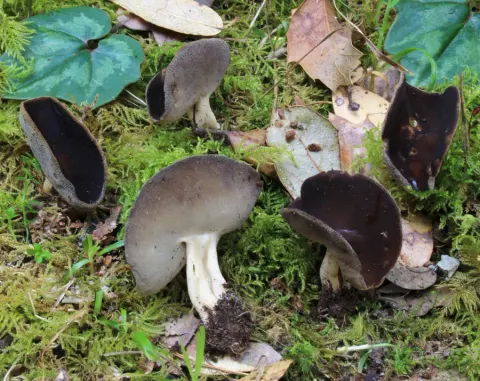
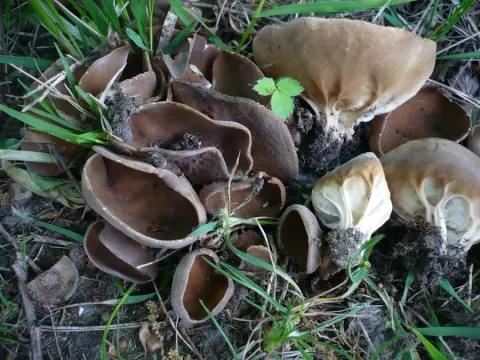
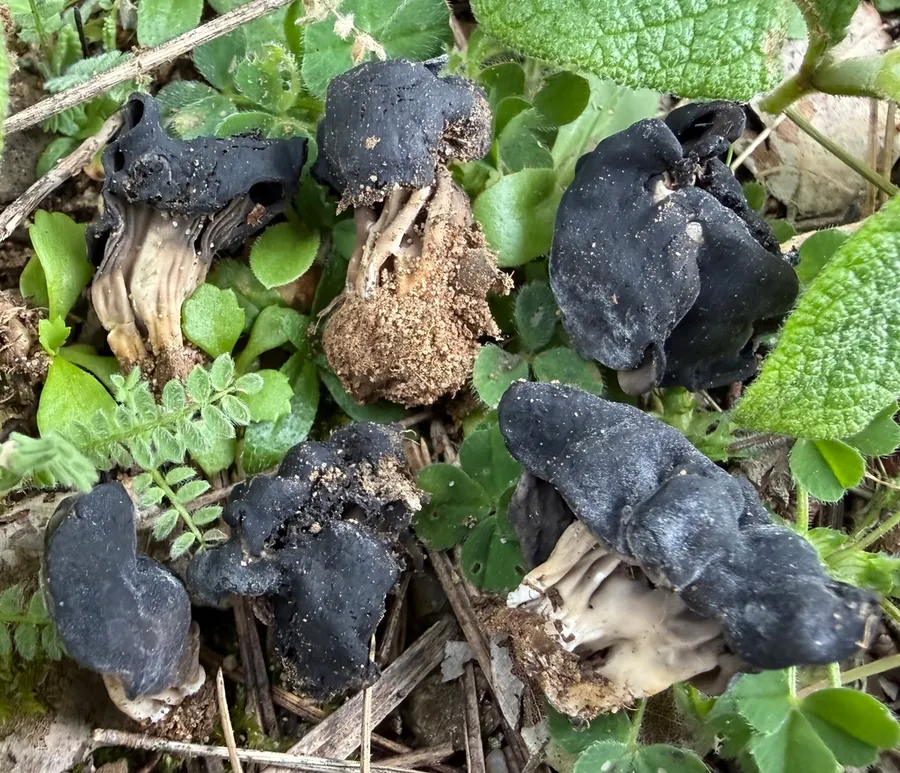
The fruit body consists of a stalked, cap‑shaped cup (an apothecium) 1.5–3 cm across. Young cups are folded and convex; as they mature they become irregularly two‑ or three‑lobed with gently wavy (undulate) margins. In fully mature specimens the lobes often fold back (deflex) and may fuse to the top of the stalk. The spore‑bearing layer (hymenium) is initially greyish white, smooth or slightly bumpy (gibbose), and darkens to black with age. The outer surface of the cup is finely scurfy (furfuraceous) at first, then develops a network of ribs and veins. The stalk (stipe) is hollow, 1.2–4 cm tall by 0.5–2 cm thick, and bears three to five blunt longitudinal ribs with matching grooves. It is generally the same colour as the cup or slightly paler above, turning whitish at the base. Under the microscope, the inner flesh is made up of densely interwoven hyphae (textura intricata) while the outer layer consists of rows of angular to prismatic brownish cells. The elongated sac‑shaped spore‑bearing cells (asci) measure about 300–370 × 14–18 μm. Spores are oblong‑ellipsoidal, roughly 19.8–24.5 by 12.2–14.8 μm, each containing one large and several smaller oil droplets (guttules). Sterile supporting filaments (paraphyses) are thin (3–4 μm) below and expand to club‑shaped tips of 6–9 μm.

Sebagian uraian ditampilkan dalam bahasa sumber; terjemahannya belum tersedia atau belum lolos pemeriksaan.

Rujukan: [1]

Pengukuran mengikuti objek, spesimen atau kultur, dan metode yang disebutkan sumber. Baca uraian asli untuk konteks lengkap.

02 / Kehidupan

Habitat dan peran ekologis

This species is characteristic of Mediterranean climates, where it grows in mycorrhizal association with shrubs of the rockrose genus Cistus, especially Cistus albidus. Fruiting bodies appear from January to March at altitudes of 500–700 m above sea level. Although predominantly recorded in southern Europe, a confirmed collection from Gotland, Sweden shows it can occur further north. It has also been collected in Greece, and Cyprus, where it grows in maquis shrubland. It often fruits alongside close relatives such as Helvella juniperi—which has a more irregular saddle‑shaped cup and deeper furrows on its stalk—and the cup‑shaped Helvella helvellula, but can be distinguished by its more regular cap morphology and fewer, less prominent ribs on the stipe.

Sebagian uraian ditampilkan dalam bahasa sumber; terjemahannya belum tersedia atau belum lolos pemeriksaan.

Rujukan: [1]

Habitat atau konteks temuan
Informasi belum tersedia pada sumber rilis ini.
Substrat
Informasi belum tersedia pada sumber rilis ini.
Peran atau konteks
Mitra tumbuhan
Temukan hubungan serupa
03 / Siklus hidup

Reproduksi

The fruit body consists of a stalked, cap‑shaped cup (an apothecium) 1.5–3 cm across. Young cups are folded and convex; as they mature they become irregularly two‑ or three‑lobed with gently wavy (undulate) margins. In fully mature specimens the lobes often fold back (deflex) and may fuse to the top of the stalk. The spore‑bearing layer (hymenium) is initially greyish white, smooth or slightly bumpy (gibbose), and darkens to black with age. The outer surface of the cup is finely scurfy (furfuraceous) at first, then develops a network of ribs and veins. The stalk (stipe) is hollow, 1.2–4 cm tall by 0.5–2 cm thick, and bears three to five blunt longitudinal ribs with matching grooves. It is generally the same colour as the cup or slightly paler above, turning whitish at the base.

Sebagian uraian ditampilkan dalam bahasa sumber; terjemahannya belum tersedia atau belum lolos pemeriksaan.

Rujukan: [1]

04 / Batas informasi

Catatan identitas dan cakupan

  • Nama diterima mengikuti Catalogue of Life Base2026-09-11; uraian mempertahankan konsep dan nama sumber aslinya.
  • Original geographic, specimen and life-cycle scope retained; source import awaits individual editorial review.
  • Impor dan terjemahan otomatis belum diperiksa editorial per profil. Struktur reproduktif yang disebutkan tidak membuktikan seluruh siklus hidup diketahui.
  • Pengukuran pada uraian mengikuti spesimen, kultur, dan metode sumber; angka tidak diperluas ke semua populasi.

Catatan distribusi dalam narasi mengikuti sumbernya. Dokumentasi spesimen atau foto mengikuti catatan sumber. Bukti wilayah Indonesia dan penilaian konservasi tidak disimpulkan dari gambar.

05 / Dokumentasi

Melihat dengan konteks

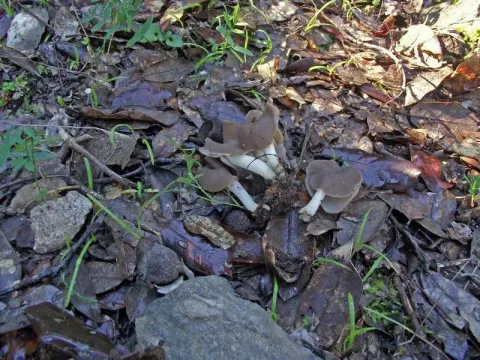
Dokumentasi Helvella semiobruta menurut asosiasi foto pada record takson iNaturalist. Kredit: Lucian Clanet. Identitas mengikuti sumber; bukan penentuan spesimen independen.

Jenis
Fotografi
Kredit
(c) Lucian Clanet, some rights reserved (CC BY)
Lisensi
CC BY 4.0
Sumber media
Buka entri sumber

Gambar menunjukkan objek menurut identifikasi sumber, bukan verifikasi independen spesimen oleh Fungi. Tidak ada skala baru yang ditambahkan.

06 / Rujukan

Sumber profil

  1. [1] Helvella semiobruta — Wikipedia (en)Bagian sumber: Frozen revision 1364137072
    Tanggal penghimpunan sumber: 2026-10-12
    Teks sumber: CC BY-SA4.0 · Wikipedia contributors
  2. [2] Catalogue of Life Base2026-09-11 — Helvella semiobrutaBagian sumber: ColDP NameUsage.tsv ID 3KK3J; accepted species; source 2073
    Tanggal penghimpunan sumber: 2026-10-12
  3. [3] Dokumentasi visual — Helvella semiobrutaBagian sumber: Individual media record; identification follows the source, not independent determination
    Tanggal penghimpunan sumber: 2026-10-12
    Media sumber: CC BY 4.0 · (c) Lucian Clanet, some rights reserved (CC BY)

Adaptasi teks: CC BY-SA 4.0. Wikipedia contributors — Helvella semiobruta — Wikipedia (en)

Uraian asli dan riwayat sumber

Riwayat atau halaman sumber

Ringkasan sumber

Helvella semiobruta is a species of mushroom-forming fungus in the family Helvellaceae, formally described in 1976. The fungus produces stalked, cap-shaped fruit bodies with lobes that start greyish white and darken to black with age, supported by a hollow stalk featuring three to five blunt longitudinal ribs. It grows in mycorrhizal association with rock rose shrubs (particularly Cistus albidus) and is primarily found in Mediterranean climates of southern Europe, though it has been recorded as far north as Sweden.

Revisi sumber

Morfologi sumber

The fruit body consists of a stalked, cap‑shaped cup (an apothecium) 1.5–3 cm across. Young cups are folded and convex; as they mature they become irregularly two‑ or three‑lobed with gently wavy (undulate) margins. In fully mature specimens the lobes often fold back (deflex) and may fuse to the top of the stalk. The spore‑bearing layer (hymenium) is initially greyish white, smooth or slightly bumpy (gibbose), and darkens to black with age. The outer surface of the cup is finely scurfy (furfuraceous) at first, then develops a network of ribs and veins. The stalk (stipe) is hollow, 1.2–4 cm tall by 0.5–2 cm thick, and bears three to five blunt longitudinal ribs with matching grooves. It is generally the same colour as the cup or slightly paler above, turning whitish at the base. Under the microscope, the inner flesh is made up of densely interwoven hyphae (textura intricata) while the outer layer consists of rows of angular to prismatic brownish cells. The elongated sac‑shaped spore‑bearing cells (asci) measure about 300–370 × 14–18 μm. Spores are oblong‑ellipsoidal, roughly 19.8–24.5 by 12.2–14.8 μm, each containing one large and several smaller oil droplets (guttules). Sterile supporting filaments (paraphyses) are thin (3–4 μm) below and expand to club‑shaped tips of 6–9 μm.

Revisi sumber

Ekologi sumber

This species is characteristic of Mediterranean climates, where it grows in mycorrhizal association with shrubs of the rockrose genus Cistus, especially Cistus albidus. Fruiting bodies appear from January to March at altitudes of 500–700 m above sea level. Although predominantly recorded in southern Europe, a confirmed collection from Gotland, Sweden shows it can occur further north. It has also been collected in Greece, and Cyprus, where it grows in maquis shrubland. It often fruits alongside close relatives such as Helvella juniperi—which has a more irregular saddle‑shaped cup and deeper furrows on its stalk—and the cup‑shaped Helvella helvellula, but can be distinguished by its more regular cap morphology and fewer, less prominent ribs on the stipe.

Revisi sumber

Struktur reproduksi sumber

The fruit body consists of a stalked, cap‑shaped cup (an apothecium) 1.5–3 cm across. Young cups are folded and convex; as they mature they become irregularly two‑ or three‑lobed with gently wavy (undulate) margins. In fully mature specimens the lobes often fold back (deflex) and may fuse to the top of the stalk. The spore‑bearing layer (hymenium) is initially greyish white, smooth or slightly bumpy (gibbose), and darkens to black with age. The outer surface of the cup is finely scurfy (furfuraceous) at first, then develops a network of ribs and veins. The stalk (stipe) is hollow, 1.2–4 cm tall by 0.5–2 cm thick, and bears three to five blunt longitudinal ribs with matching grooves. It is generally the same colour as the cup or slightly paler above, turning whitish at the base.

Revisi sumber

Rujukan halaman ini

Fungi. Helvella semiobruta. Rilis data fungi-2026-10-12-expansion-2. https://fungi-atlas.mgadib.chatgpt.site/jamur/helvella-semiobruta/.

Status: impor sumber; pemeriksaan editorial per profil belum selesai. Untuk klaim biologis, gunakan rujukan pada bagian terkait dan periksa konteks sumber aslinya.