01 / Morfologi

Ciri dan struktur

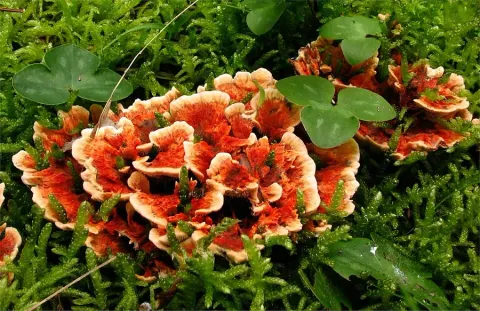
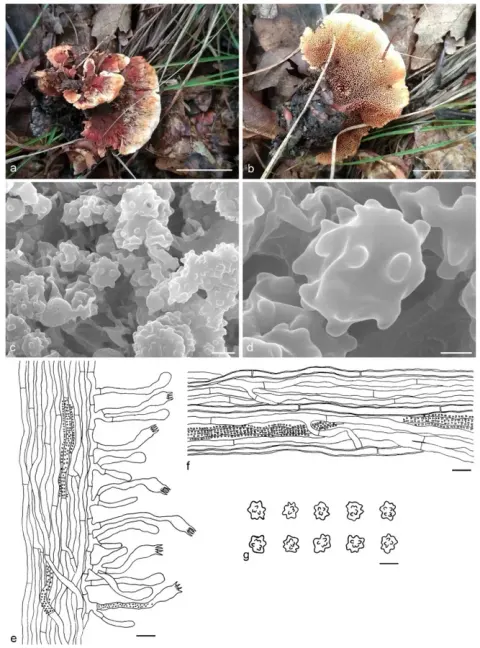
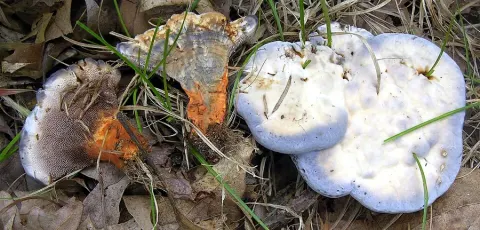
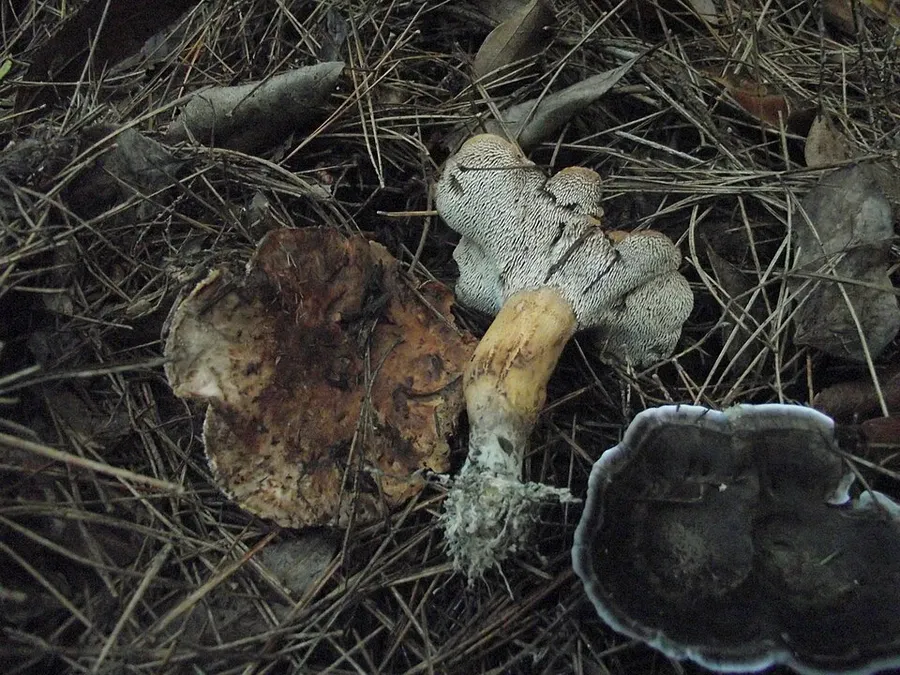
The fruit bodies are medium to large, club‑shaped basidiocarps (cap and stem fused), 75–200 mm across, often lobed or irregular in outline. The pileus (cap) surface is finely felted to smooth, cracking into shallow plates but without erect scales, and ranges from yellowish‑brown to cinnamon or beige, typically darker when wet. The edge is initially slightly inrolled and sterile. The stipe is stout (35–60 by 22–40 mm), simple or branched, with spines (aculei) up to 10 mm long that run partly down the stipe. The spines are whitish at first, becoming brownish towards the base. The flesh is thick—brittle in the cap, fibrous in the stem—and displays a vivid greenish‑blue reaction with potassium hydroxide (KOH), turning orange with time. The taste is extremely bitter and often tingling; the hymenium (spore‑bearing surface) emits a characteristic intense bitter‑almond aroma shortly after collection. Microscopically, the hyphal system is monomitic (only generative hyphae, without clamp connections). Basidia are four‑spored, more or less cylindrical to club‑shaped, 27–34 by 5–6 micrometres] (μm). Spores are somewhat spherical (globose) to ellipsoid, ornamented with nodules or warts, 5.25–6.5 by 4–5 μm (including ornamentation), each containing a single oil drop. Gloeocystidia (oil-containing cystidia) occur abundantly in the cap cuticle.

Sebagian uraian ditampilkan dalam bahasa sumber; terjemahannya belum tersedia atau belum lolos pemeriksaan.

Rujukan: [1]

Pengukuran mengikuti objek, spesimen atau kultur, dan metode yang disebutkan sumber. Baca uraian asli untuk konteks lengkap.

02 / Kehidupan

Habitat dan peran ekologis

Sarcodon amygdaliolens is known from scattered Mediterranean climate localities throughout the Iberian Peninsula, fruiting in autumn and winter (November–December). It grows terrestrially under conifers—predominantly maritime pine (Pinus pinaster), but also Scots pine (P. sylvestris) and stone pine (P. pinea)—on acidic, siliceous soils derived from quartzite, schist or granite. Recorded provinces include Guadalajara, Valencia, Cádiz, Cuenca, Salamanca, Badajoz and Almería. Its preference for acid soils and pine stands, combined with the bitter taste and almond scent, make it readily recognised in the field.

Sebagian uraian ditampilkan dalam bahasa sumber; terjemahannya belum tersedia atau belum lolos pemeriksaan.

Rujukan: [1]

Habitat atau konteks temuan
Informasi belum tersedia pada sumber rilis ini.
Substrat
Informasi belum tersedia pada sumber rilis ini.
Peran atau konteks
Belum dikategorikan pada rilis ini.
Temukan hubungan serupa
03 / Siklus hidup

Reproduksi

The fruit bodies are medium to large, club‑shaped basidiocarps (cap and stem fused), 75–200 mm across, often lobed or irregular in outline. The pileus (cap) surface is finely felted to smooth, cracking into shallow plates but without erect scales, and ranges from yellowish‑brown to cinnamon or beige, typically darker when wet. The edge is initially slightly inrolled and sterile. The stipe is stout (35–60 by 22–40 mm), simple or branched, with spines (aculei) up to 10 mm long that run partly down the stipe. The spines are whitish at first, becoming brownish towards the base. The flesh is thick—brittle in the cap, fibrous in the stem—and displays a vivid greenish‑blue reaction with potassium hydroxide (KOH), turning orange with time.

Sebagian uraian ditampilkan dalam bahasa sumber; terjemahannya belum tersedia atau belum lolos pemeriksaan.

Rujukan: [1]

Sinonim menurut acuan taksonomi rilis: Sarcodon amygdaliolens
04 / Batas informasi

Catatan identitas dan cakupan

  • Nama diterima mengikuti Catalogue of Life Base2026-09-11; uraian mempertahankan konsep dan nama sumber aslinya.
  • Original geographic, specimen and life-cycle scope retained; source import awaits individual editorial review.
  • Impor dan terjemahan otomatis belum diperiksa editorial per profil. Struktur reproduktif yang disebutkan tidak membuktikan seluruh siklus hidup diketahui.
  • Pengukuran pada uraian mengikuti spesimen, kultur, dan metode sumber; angka tidak diperluas ke semua populasi.

Catatan distribusi dalam narasi mengikuti sumbernya. Dokumentasi spesimen atau foto mengikuti catatan sumber. Bukti wilayah Indonesia dan penilaian konservasi tidak disimpulkan dari gambar.

05 / Dokumentasi

Melihat dengan konteks

Dokumentasi Hydnellum amygdaliolens dari Wikimedia Commons. Fruit bodies of the hydnoid fungus Sarcodon amygdaliolens Rubio Casas, Rubio Roldán & Català. Photographed in Monte Arci, Sardinia, Italy. Identifikasi mengikuti record berkas sumber.

Jenis
Fotografi
Kredit
Davide Puddu
Sumber media
Buka entri sumber

Gambar menunjukkan objek menurut identifikasi sumber, bukan verifikasi independen spesimen oleh Fungi. Tidak ada skala baru yang ditambahkan.

06 / Rujukan

Sumber profil

  1. [1] Hydnellum amygdaliolens — Wikipedia (en)Bagian sumber: Frozen revision 1288924573
    Tanggal penghimpunan sumber: 2026-10-12
    Teks sumber: CC BY-SA4.0 · Wikipedia contributors
  2. [2] Catalogue of Life Base2026-09-11 — Hydnellum amygdaliolensBagian sumber: ColDP NameUsage.tsv ID 3MZDH; accepted species; source 2073
    Tanggal penghimpunan sumber: 2026-10-12
  3. [3] Dokumentasi visual — Hydnellum amygdaliolensBagian sumber: Individual media record; identification follows the source, not independent determination
    Tanggal penghimpunan sumber: 2026-10-12
    Media sumber: CC BY-SA 3.0 · Davide Puddu

Adaptasi teks: CC BY-SA 4.0. Wikipedia contributors — Hydnellum amygdaliolens — Wikipedia (en)

Uraian asli dan riwayat sumber

Riwayat atau halaman sumber

Ringkasan sumber

Hydnellum amygdaliolens is a species of tooth fungus in the family Bankeraceae, found in the Iberian Peninsula. It is characterised by its yellowish-brown to cinnamon-coloured caps, which can reach 20 cm across, and its distinctive intense bitter-almond smell. The fungus grows in association with pine trees on acidic soils and was first described from Spain in 2011.

Revisi sumber

Morfologi sumber

The fruit bodies are medium to large, club‑shaped basidiocarps (cap and stem fused), 75–200 mm across, often lobed or irregular in outline. The pileus (cap) surface is finely felted to smooth, cracking into shallow plates but without erect scales, and ranges from yellowish‑brown to cinnamon or beige, typically darker when wet. The edge is initially slightly inrolled and sterile. The stipe is stout (35–60 by 22–40 mm), simple or branched, with spines (aculei) up to 10 mm long that run partly down the stipe. The spines are whitish at first, becoming brownish towards the base. The flesh is thick—brittle in the cap, fibrous in the stem—and displays a vivid greenish‑blue reaction with potassium hydroxide (KOH), turning orange with time. The taste is extremely bitter and often tingling; the hymenium (spore‑bearing surface) emits a characteristic intense bitter‑almond aroma shortly after collection. Microscopically, the hyphal system is monomitic (only generative hyphae, without clamp connections). Basidia are four‑spored, more or less cylindrical to club‑shaped, 27–34 by 5–6 micrometres] (μm). Spores are somewhat spherical (globose) to ellipsoid, ornamented with nodules or warts, 5.25–6.5 by 4–5 μm (including ornamentation), each containing a single oil drop. Gloeocystidia (oil-containing cystidia) occur abundantly in the cap cuticle.

Revisi sumber

Ekologi sumber

Sarcodon amygdaliolens is known from scattered Mediterranean climate localities throughout the Iberian Peninsula, fruiting in autumn and winter (November–December). It grows terrestrially under conifers—predominantly maritime pine (Pinus pinaster), but also Scots pine (P. sylvestris) and stone pine (P. pinea)—on acidic, siliceous soils derived from quartzite, schist or granite. Recorded provinces include Guadalajara, Valencia, Cádiz, Cuenca, Salamanca, Badajoz and Almería. Its preference for acid soils and pine stands, combined with the bitter taste and almond scent, make it readily recognised in the field.

Revisi sumber

Struktur reproduksi sumber

The fruit bodies are medium to large, club‑shaped basidiocarps (cap and stem fused), 75–200 mm across, often lobed or irregular in outline. The pileus (cap) surface is finely felted to smooth, cracking into shallow plates but without erect scales, and ranges from yellowish‑brown to cinnamon or beige, typically darker when wet. The edge is initially slightly inrolled and sterile. The stipe is stout (35–60 by 22–40 mm), simple or branched, with spines (aculei) up to 10 mm long that run partly down the stipe. The spines are whitish at first, becoming brownish towards the base. The flesh is thick—brittle in the cap, fibrous in the stem—and displays a vivid greenish‑blue reaction with potassium hydroxide (KOH), turning orange with time.

Revisi sumber

Rujukan halaman ini

Fungi. Hydnellum amygdaliolens. Rilis data fungi-2026-10-12-expansion-2. https://fungi-atlas.mgadib.chatgpt.site/jamur/hydnellum-amygdaliolens/.

Status: impor sumber; pemeriksaan editorial per profil belum selesai. Untuk klaim biologis, gunakan rujukan pada bagian terkait dan periksa konteks sumber aslinya.