Ciri dan struktur
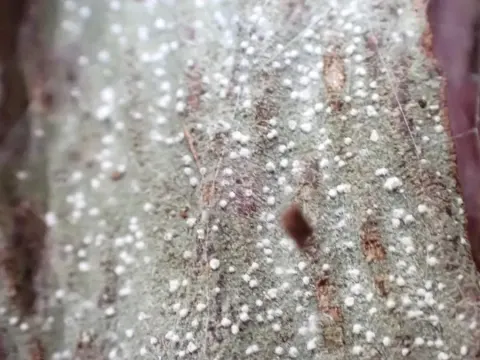
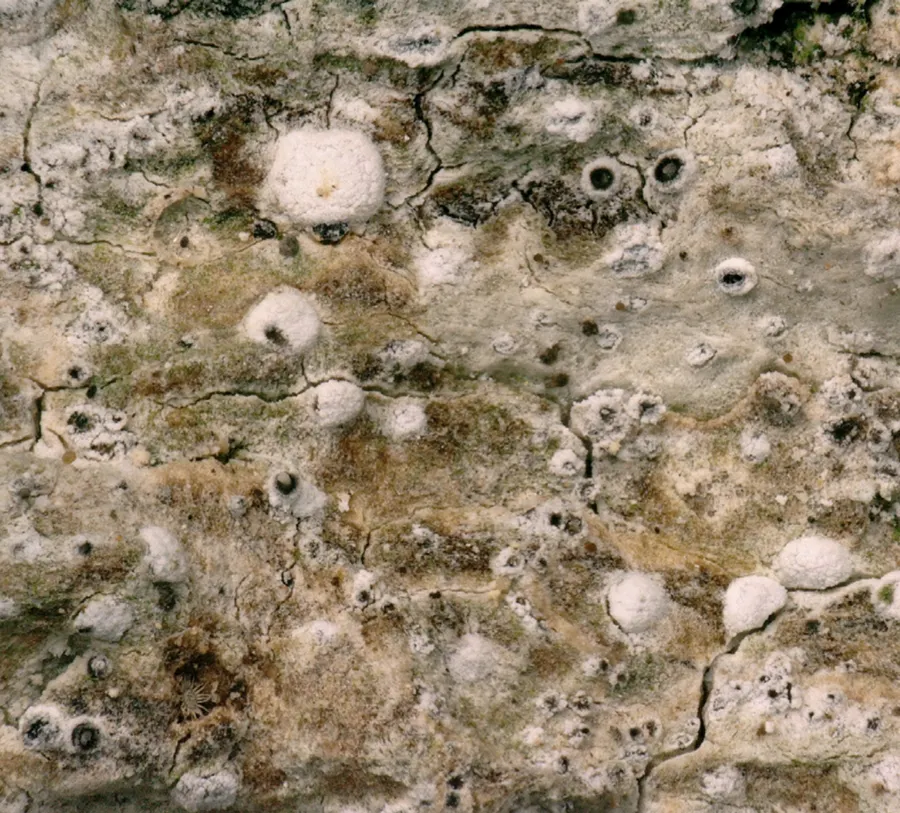
The thallus (lichen body) is whitish to pale fawn and forms continuous sheets that may crack into small plates; it lacks a true outer skin () so the surface looks , slightly felted or scurfy. In section it is thin (to about 0.05 mm) and largely buried in the outer bark. The photosynthetic partner is a green alga (cells roughly 12–25 × 5–22 μm), and no calcium oxalate crystals were seen. Sexual fruiting bodies (apothecia) are small rounded , about 0.4–1.0 mm in diameter, sitting level with to slightly raised above the thallus and dusted with a white, frost-like coating (). Inside, the spore layer is only moderately gelatinised; the tissue beneath it (the ) is dark brown and well developed. Ascospores are colourless (hyaline), narrowly , usually with 3–4 cross-walls (septa), and measure roughly 13.5–16.7 (to 19.0) × 4.5–5.5 (to 6.0) μm. Asexual fruiting bodies (pycnidia) are numerous and conspicuous: dark brown to black cups 0.15–0.40 mm across whose rims and "shoulders" are coated in a thick white pruina. The pore is entire to ragged, and the interior is bowl-shaped, often partitioned by thin septa; the wall is . The pycnidia produce bacilliform conidia about 4.5–6.0 × 1.0–1.5 μm. Chemically, the species shows the "byssaceum unknowns" on high-performance thin-layer chromatography; routine spot tests on the thallus, apothecia and pycnidial pruina are negative (K−, C−, KC−, Pd−). Iodine tests used by specialists show blue to red-blue reactions in the gels of the fruiting bodies, while the granular crystals in the apothecial rim dissolve in K and in Lactophenol cotton blue but not in sulphuric acid.
Habitat dan peran ekologis
In temperate Europe, Inoderma byssaceum is largely tied to the bark of old oaks and tends to occur in old-growth forests or on veteran trees in locally humid climates. The species has undergone a marked decline in recent decades and is listed on many national red lists. In 2023, it was recorded for the first time in Belgium, where it was found on the trunk of an old oak in a well-preserved mixed deciduous forest in the Lorraine district of southern Belgium. In this region the species is regarded as an indicator of long-continuity, well-preserved oak forests and is otherwise rare or very rare in neighbouring countries such as Germany, France, Great Britain and Luxembourg, absent from the Netherlands, and treated as threatened with extinction in France, so the Belgian locality is considered to merit specific protection measures. In north-eastern North America the lichen has been collected on a range of deciduous and coniferous hosts with deeply fissured or flaky bark, including Quercus species, Acer saccharum, Chamaecyparis thyoides and Thuja species, from habitats such as northern hardwood forest, cedar–red maple woods, and even a boggy stream margin. Records also exist from Hokkaido, Japan.
- Habitat atau konteks temuan
- hutan
- Substrat
- Informasi belum tersedia pada sumber rilis ini.
- Peran atau konteks
- Pembentuk liken
Reproduksi
Sexual fruiting bodies (apothecia) are small rounded , about 0.4–1.0 mm in diameter, sitting level with to slightly raised above the thallus and dusted with a white, frost-like coating (). Inside, the spore layer is only moderately gelatinised; the tissue beneath it (the ) is dark brown and well developed. Ascospores are colourless (hyaline), narrowly , usually with 3–4 cross-walls (septa), and measure roughly 13.5–16.7 (to 19.0) × 4.5–5.5 (to 6.0) μm. Asexual fruiting bodies (pycnidia) are numerous and conspicuous: dark brown to black cups 0.15–0.40 mm across whose rims and "shoulders" are coated in a thick white pruina. The pore is entire to ragged, and the interior is bowl-shaped, often partitioned by thin septa; the wall is .
Catatan identitas dan cakupan
- Nama diterima mengikuti Catalogue of Life Base2026-09-11; uraian mempertahankan konsep dan nama sumber aslinya.
- Original geographic, specimen and life-cycle scope retained; source import awaits individual editorial review.
- Impor dan terjemahan otomatis belum diperiksa editorial per profil. Struktur reproduktif yang disebutkan tidak membuktikan seluruh siklus hidup diketahui.
- Pengukuran pada uraian mengikuti spesimen, kultur, dan metode sumber; angka tidak diperluas ke semua populasi.
Catatan distribusi dalam narasi mengikuti sumbernya. Dokumentasi spesimen atau foto mengikuti catatan sumber. Bukti wilayah Indonesia dan penilaian konservasi tidak disimpulkan dari gambar.
Melihat dengan konteks
Dokumentasi Inoderma byssaceum dari Wikimedia Commons. Inoderma byssaceum , a lichen indicator of well-preserved forest sites, discovered in the Rabais valley near Virton Identifikasi mengikuti record berkas sumber.
- Jenis
- Fotografi
- Kredit
- Damien Ertz
- Lisensi
- CC BY-SA 4.0
- Sumber media
- Buka entri sumber
Sumber profil
- [1] Inoderma byssaceum — Wikipedia (en)
- [2] Catalogue of Life Base2026-09-11 — Inoderma byssaceum
- [3] Dokumentasi visual — Inoderma byssaceum
Rujukan halaman ini
Fungi. Inoderma byssaceum. Rilis data fungi-2026-10-12-expansion-2. https://fungi-atlas.mgadib.chatgpt.site/jamur/inoderma-byssaceum/.
Status: impor sumber; pemeriksaan editorial per profil belum selesai. Untuk klaim biologis, gunakan rujukan pada bagian terkait dan periksa konteks sumber aslinya.