Ciri dan struktur
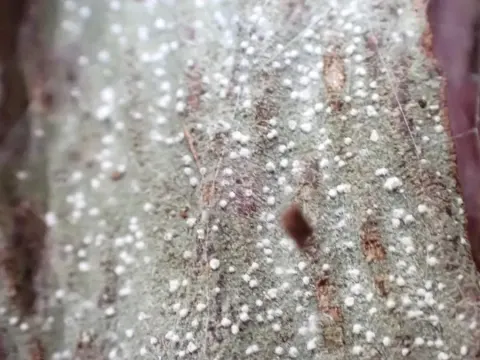
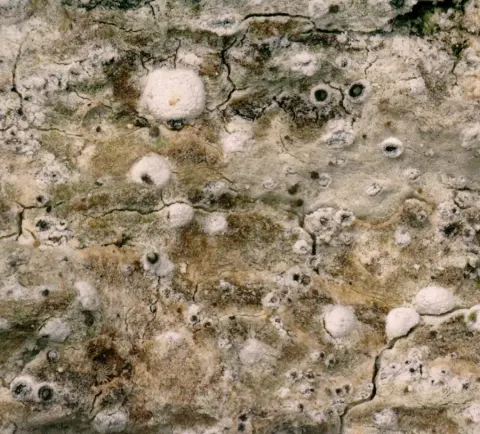
The thallus (lichen body) forms pale olive-grey patches that are fissured to fissured-areolate and lack a true outer skin (), giving a matt, faintly felty or scurfy surface; a loose, thin necrotic layer often overlies the . The is a green alga (Printzina lagenifera); cells are mostly 9–19 × 5–14 micrometres (μm), and calcium oxalate crystals were not seen in the type material. Sexual fruiting bodies (apothecia) were sparse and under-developed in the type material. When present they are small rounded , 0.4–0.6 mm in diameter, set level with the thallus and covered in a thin white (a frost-like powder). Internally the tissues and spore-bearing layer match the Arthonia-type; ascospores are hyaline, narrowly , typically 3–4-septate (rarely 2) and measure about 13–16 × 3–4 μm. Asexual fruiting bodies (pycnidia) are numerous and conspicuous: dark brown to black cups 0.25–0.50 mm across that protrude strongly or sit with a constricted base on the thallus, their rims and shoulders dusted with thick white pruina. The pore is entire to ragged, and the interior shows a bowl-shaped cavity; the wall is strongly at the sides. cells are 9–11 × 1.5–3.0 μm and produce conidia that are often slightly curved, with dimensions averaging around 4.9 × 1.3 μm. Chemically, the species contains lepraric acid. In routine spot tests the thallus and the white pruina turn K+ (lemon yellow), a diagnostic reaction for this compound, and are C−, KC−, Pd−; the thallus hyphae are I− but KI+ (pale blue).
Habitat dan peran ekologis
Inoderma nipponicum occurs below about 500 m elevation in shady to semi-shady situations. It grows mainly on deeply fissured or flaky bark of both deciduous and coniferous hosts, including Acer buergerianum, Machilus thunbergii, Picea sp., Pinus densiflora and Torreya nucifera; a small saxicolous collection was also made on rain-shadowed castle walls at Hikone. The species appears tolerant of drier conditions and of urban air, occurring in parkland as well as in old-growth forest. Confirmed records are from Japan (Hokkaidō and Honshū).
- Habitat atau konteks temuan
- hutan
- Substrat
- Informasi belum tersedia pada sumber rilis ini.
- Peran atau konteks
- Pembentuk liken
Reproduksi
Sexual fruiting bodies (apothecia) were sparse and under-developed in the type material. When present they are small rounded , 0.4–0.6 mm in diameter, set level with the thallus and covered in a thin white (a frost-like powder). Internally the tissues and spore-bearing layer match the Arthonia-type; ascospores are hyaline, narrowly , typically 3–4-septate (rarely 2) and measure about 13–16 × 3–4 μm. Asexual fruiting bodies (pycnidia) are numerous and conspicuous: dark brown to black cups 0.25–0.50 mm across that protrude strongly or sit with a constricted base on the thallus, their rims and shoulders dusted with thick white pruina. The pore is entire to ragged, and the interior shows a bowl-shaped cavity; the wall is strongly at the sides. cells are 9–11 × 1.5–3.0 μm and produce conidia that are often slightly curved, with dimensions averaging around 4.9 × 1.3 μm.
Catatan identitas dan cakupan
- Nama diterima mengikuti Catalogue of Life Base2026-09-11; uraian mempertahankan konsep dan nama sumber aslinya.
- Original geographic, specimen and life-cycle scope retained; source import awaits individual editorial review.
- Impor dan terjemahan otomatis belum diperiksa editorial per profil. Struktur reproduktif yang disebutkan tidak membuktikan seluruh siklus hidup diketahui.
- Pengukuran pada uraian mengikuti spesimen, kultur, dan metode sumber; angka tidak diperluas ke semua populasi.
Catatan distribusi dalam narasi mengikuti sumbernya. Dokumentasi spesimen atau foto mengikuti catatan sumber. Bukti wilayah Indonesia dan penilaian konservasi tidak disimpulkan dari gambar.
Melihat dengan konteks
Dokumentasi visual yang memenuhi pemeriksaan subjek dan hak penggunaan belum tersedia. Foto gejala, label, dan gambar yang meragukan tidak dihitung.
Sumber profil
Rujukan halaman ini
Fungi. Inoderma nipponicum. Rilis data fungi-2026-10-12-expansion-2. https://fungi-atlas.mgadib.chatgpt.site/jamur/inoderma-nipponicum/.
Status: impor sumber; pemeriksaan editorial per profil belum selesai. Untuk klaim biologis, gunakan rujukan pada bagian terkait dan periksa konteks sumber aslinya.