01 / Morfologi

Ciri dan struktur

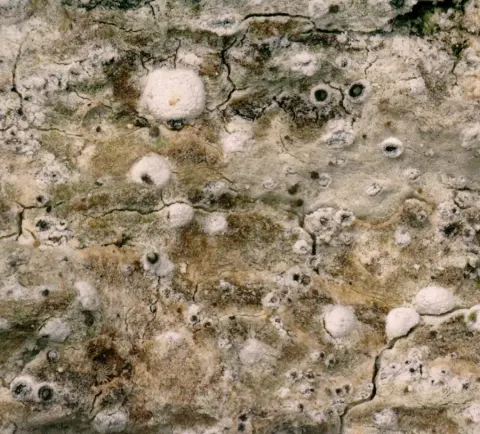
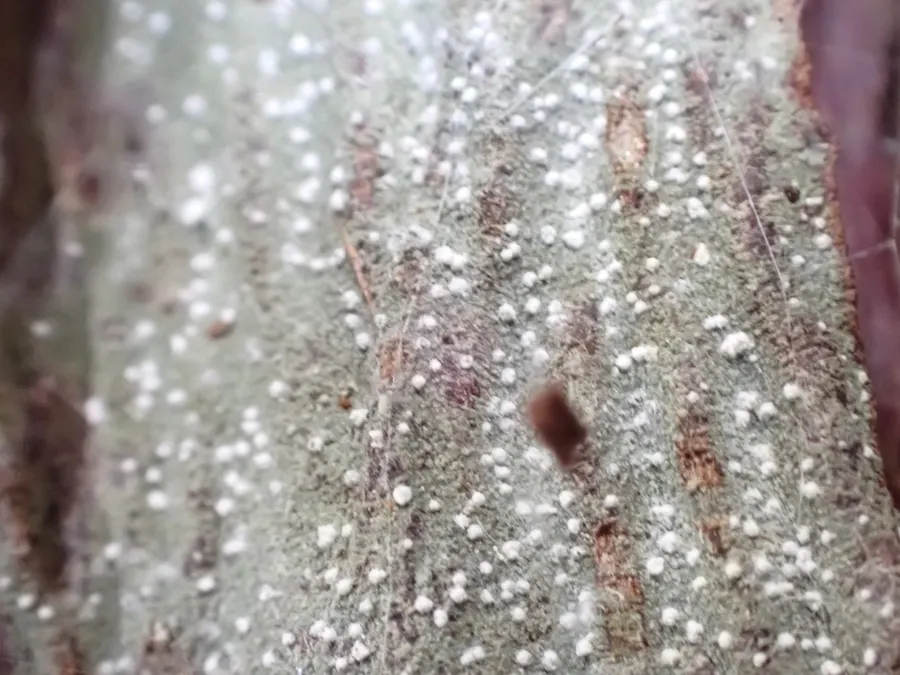
The thallus (lichen body) forms extensive, whitish to pale olivaceous-grey patches that may remain continuous or crack into small, angular plates (). It lacks a true outer cortex (it is ), giving it a , faintly scurfy, minutely appearance. In cross-section it is thin (to about 0.12 mm) and partly sunk into the outer bark. The is a Trentepohlia-type () green alga. Its cells mostly measure 7–15 × 4–13 μm. Calcium oxalate crystals were not observed. Sexual fruiting bodies (apothecia) are unknown. Asexual fruiting bodies (pycnidia) are numerous and conspicuous: dark brown to black, cup-shaped structures 0.20–0.45 mm across. Their rims and upper sides are coated in a thick, coarsely granular white (a frost-like powder). The opening ranges from narrow to widely gaping, and the rim is often strongly reflexed (curved backwards). In cross-section the cavity is bowl-shaped to wedge-shaped (about 100–300 μm wide) and may be divided by thin internal septa; the wall is . Conidia are rod-shaped (), usually 4.2–5.8 × 1.1–1.5 μm (rarely up to 7.0 × 1.7 μm; mean about 5.0 × 1.3 μm). Chemically the species contains confluentic and lepraric acids. In spot tests, the thallus and pycnidial pruina are K+ (lemon yellow), but C−, KC− and Pd−; the thallus hyphae are I+ and KI+ (pale blue). The crystal layer of the pycnidia dissolves in K (potassium hydroxide; yellowish solution) and in lactic-cotton blue, but not in sulphuric acid.

Sebagian uraian ditampilkan dalam bahasa sumber; terjemahannya belum tersedia atau belum lolos pemeriksaan.

Rujukan: [1]

Pengukuran mengikuti objek, spesimen atau kultur, dan metode yang disebutkan sumber. Baca uraian asli untuk konteks lengkap.

02 / Kehidupan

Habitat dan peran ekologis

Inoderma subabietinum is a strongly oceanic lichen (associated with Atlantic climates) of dry, acidic substrates, usually found in sheltered situations that are semi-shaded rather than deeply shaded. It is most often recorded on the bark of old oaks (Quercus), but it has also been found on Betula, Pinus and Hedera. More occasional records are from Calluna stems and decaying fern fronds in sheltered sites. It can grow alongside other oceanic bark lichens such as Arthonia impolita, Diploicia canescens, Enterographa crassa, Lepraria incana, Schismatomma decolorans and Chaenotheca hispidula. The similar Opegrapha vermicellifera tends to occur in shadier conditions and on less acidic, more nutrient-rich bark, for example on Acer pseudoplatanus and Ulmus. In Great Britain it is considered easily overlooked and has been recorded mainly from southern, oceanic areas. Confirmed records include Great Britain and Ireland, France (including Brittany), and the Atlantic island groups (archipelagos) of the Azores, Madeira and the Canary Islands.

Sebagian uraian ditampilkan dalam bahasa sumber; terjemahannya belum tersedia atau belum lolos pemeriksaan.

Rujukan: [1]

Habitat atau konteks temuan
Informasi belum tersedia pada sumber rilis ini.
Substrat
Informasi belum tersedia pada sumber rilis ini.
Peran atau konteks
Pembentuk liken
Temukan hubungan serupa
03 / Siklus hidup

Reproduksi

The thallus (lichen body) forms extensive, whitish to pale olivaceous-grey patches that may remain continuous or crack into small, angular plates (). It lacks a true outer cortex (it is ), giving it a , faintly scurfy, minutely appearance. In cross-section it is thin (to about 0.12 mm) and partly sunk into the outer bark. The is a Trentepohlia-type () green alga. Its cells mostly measure 7–15 × 4–13 μm. Calcium oxalate crystals were not observed. Sexual fruiting bodies (apothecia) are unknown. Asexual fruiting bodies (pycnidia) are numerous and conspicuous: dark brown to black, cup-shaped structures 0.20–0.45 mm across. Their rims and upper sides are coated in a thick, coarsely granular white (a frost-like powder).

Sebagian uraian ditampilkan dalam bahasa sumber; terjemahannya belum tersedia atau belum lolos pemeriksaan.

Rujukan: [1]

Sinonim menurut acuan taksonomi rilis: Lecanactis subabietina
04 / Batas informasi

Catatan identitas dan cakupan

  • Nama diterima mengikuti Catalogue of Life Base2026-09-11; uraian mempertahankan konsep dan nama sumber aslinya.
  • Original geographic, specimen and life-cycle scope retained; source import awaits individual editorial review.
  • Impor dan terjemahan otomatis belum diperiksa editorial per profil. Struktur reproduktif yang disebutkan tidak membuktikan seluruh siklus hidup diketahui.
  • Pengukuran pada uraian mengikuti spesimen, kultur, dan metode sumber; angka tidak diperluas ke semua populasi.

Catatan distribusi dalam narasi mengikuti sumbernya. Dokumentasi spesimen atau foto mengikuti catatan sumber. Bukti wilayah Indonesia dan penilaian konservasi tidak disimpulkan dari gambar.

05 / Dokumentasi

Melihat dengan konteks

Dokumentasi Inoderma subabietinum menurut asosiasi foto pada record takson iNaturalist. Kredit: Sim Elliott. Identitas mengikuti sumber; bukan penentuan spesimen independen.

Jenis
Fotografi
Kredit
no rights reserved, uploaded by Sim Elliott
Lisensi
CC0 1.0
Sumber media
Buka entri sumber

Gambar menunjukkan objek menurut identifikasi sumber, bukan verifikasi independen spesimen oleh Fungi. Tidak ada skala baru yang ditambahkan.

06 / Rujukan

Sumber profil

  1. [1] Inoderma subabietinum — Wikipedia (en)Bagian sumber: Frozen revision 1333473632
    Tanggal penghimpunan sumber: 2026-10-12
    Teks sumber: CC BY-SA4.0 · Wikipedia contributors
  2. [2] Catalogue of Life Base2026-09-11 — Inoderma subabietinumBagian sumber: ColDP NameUsage.tsv ID 3PRV7; accepted species; source 2073
    Tanggal penghimpunan sumber: 2026-10-12
  3. [3] Dokumentasi visual — Inoderma subabietinumBagian sumber: Individual media record; identification follows the source, not independent determination
    Tanggal penghimpunan sumber: 2026-10-12
    Media sumber: CC0 1.0 · no rights reserved, uploaded by Sim Elliott

Adaptasi teks: CC BY-SA 4.0. Wikipedia contributors — Inoderma subabietinum — Wikipedia (en)

Uraian asli dan riwayat sumber

Riwayat atau halaman sumber

Ringkasan sumber

Inoderma subabietinum is a species of corticolous (bark-dwelling) crustose lichen in the family Arthoniaceae. Originally described in 1979 as Lecanactis subabietina from south Devon, England, it was transferred to the genus Inoderma in 2015 on the basis of DNA evidence. The species forms whitish to pale olivaceous-grey patches on bark. It is recognized by numerous dark brown to black, cup-shaped asexual fruiting bodies (pycnidia) coated in a thick, granular, white, frost-like powder. It is a strongly oceanic lichen (associated with Atlantic climates) typically found on old oaks in sheltered, semi-shaded sites, with records from Great Britain, Ireland, France, and from Atlantic islands including the Azores, Madeira and the Canary Islands.

Revisi sumber

Morfologi sumber

The thallus (lichen body) forms extensive, whitish to pale olivaceous-grey patches that may remain continuous or crack into small, angular plates (). It lacks a true outer cortex (it is ), giving it a , faintly scurfy, minutely appearance. In cross-section it is thin (to about 0.12 mm) and partly sunk into the outer bark. The is a Trentepohlia-type () green alga. Its cells mostly measure 7–15 × 4–13 μm. Calcium oxalate crystals were not observed. Sexual fruiting bodies (apothecia) are unknown. Asexual fruiting bodies (pycnidia) are numerous and conspicuous: dark brown to black, cup-shaped structures 0.20–0.45 mm across. Their rims and upper sides are coated in a thick, coarsely granular white (a frost-like powder). The opening ranges from narrow to widely gaping, and the rim is often strongly reflexed (curved backwards). In cross-section the cavity is bowl-shaped to wedge-shaped (about 100–300 μm wide) and may be divided by thin internal septa; the wall is . Conidia are rod-shaped (), usually 4.2–5.8 × 1.1–1.5 μm (rarely up to 7.0 × 1.7 μm; mean about 5.0 × 1.3 μm). Chemically the species contains confluentic and lepraric acids. In spot tests, the thallus and pycnidial pruina are K+ (lemon yellow), but C−, KC− and Pd−; the thallus hyphae are I+ and KI+ (pale blue). The crystal layer of the pycnidia dissolves in K (potassium hydroxide; yellowish solution) and in lactic-cotton blue, but not in sulphuric acid.

Revisi sumber

Ekologi sumber

Inoderma subabietinum is a strongly oceanic lichen (associated with Atlantic climates) of dry, acidic substrates, usually found in sheltered situations that are semi-shaded rather than deeply shaded. It is most often recorded on the bark of old oaks (Quercus), but it has also been found on Betula, Pinus and Hedera. More occasional records are from Calluna stems and decaying fern fronds in sheltered sites. It can grow alongside other oceanic bark lichens such as Arthonia impolita, Diploicia canescens, Enterographa crassa, Lepraria incana, Schismatomma decolorans and Chaenotheca hispidula. The similar Opegrapha vermicellifera tends to occur in shadier conditions and on less acidic, more nutrient-rich bark, for example on Acer pseudoplatanus and Ulmus. In Great Britain it is considered easily overlooked and has been recorded mainly from southern, oceanic areas. Confirmed records include Great Britain and Ireland, France (including Brittany), and the Atlantic island groups (archipelagos) of the Azores, Madeira and the Canary Islands.

Revisi sumber

Struktur reproduksi sumber

The thallus (lichen body) forms extensive, whitish to pale olivaceous-grey patches that may remain continuous or crack into small, angular plates (). It lacks a true outer cortex (it is ), giving it a , faintly scurfy, minutely appearance. In cross-section it is thin (to about 0.12 mm) and partly sunk into the outer bark. The is a Trentepohlia-type () green alga. Its cells mostly measure 7–15 × 4–13 μm. Calcium oxalate crystals were not observed. Sexual fruiting bodies (apothecia) are unknown. Asexual fruiting bodies (pycnidia) are numerous and conspicuous: dark brown to black, cup-shaped structures 0.20–0.45 mm across. Their rims and upper sides are coated in a thick, coarsely granular white (a frost-like powder).

Revisi sumber

Rujukan halaman ini

Fungi. Inoderma subabietinum. Rilis data fungi-2026-10-12-expansion-2. https://fungi-atlas.mgadib.chatgpt.site/jamur/inoderma-subabietinum/.

Status: impor sumber; pemeriksaan editorial per profil belum selesai. Untuk klaim biologis, gunakan rujukan pada bagian terkait dan periksa konteks sumber aslinya.