01 / Morfologi

Ciri dan struktur

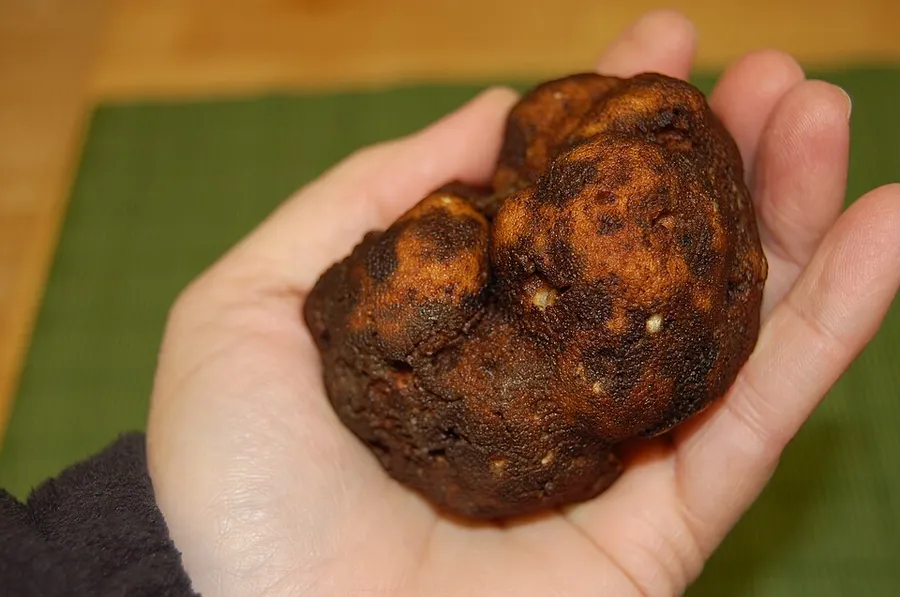
The truffle-like fruit bodies of Kalapuya are roughly spherical, with lobes and furrows, and dimensions of typically 12 – 60 mm by 10 – 45 mm. The peridium (outer "skin") is up to 2 mm thick, and ranges in color from light yellowish-brown to orange-brown to reddish-brown, usually with darker patches in maturity. The surface texture is rough, as the truffle is covered with flat to rounded warts that are 0.5–3 mm wide; larger warts often have smaller warts on them. Older specimens develop narrow cracks over the surface such that it becomes areolate or rimose. The undersurface of the peridium has an branching basal attachment that is roughly similar in texture to cartilage, and which breaks off readily when the truffle is extracted from the soil. The internal spore-bearing tissue, the gleba, is initially whitish and firm, but develops grayish-brown mottling as it matures. The spores are ellipsoid in shape, with a smooth surface, and contain a large central oil drop surrounded by smaller droplets. The spore dimensions are 32–43 by 25–38 μm, the walls measuring 1–3 μm thick. Although not reactive with Melzer's reagent, spores stain readily with Methyl blue. The asci contain 6 to 8 spores per ascus. They are variably shaped, with dimensions of 70–110 by 60–100 μm, with a stem 10–40 by 6–10 μm, and a forked base. Initially about 3 μm thick, the ascus walls thin to roughly 1 μm when mature. The gleba comprises loosely interwoven, thin-walled hyaline hyphae measuring 5–13 μm in diameter.

Sebagian uraian ditampilkan dalam bahasa sumber; terjemahannya belum tersedia atau belum lolos pemeriksaan.

Rujukan: [1]

Pengukuran mengikuti objek, spesimen atau kultur, dan metode yang disebutkan sumber. Baca uraian asli untuk konteks lengkap.

02 / Kehidupan

Habitat dan peran ekologis

The species is known only from the Pacific Northwest region of the United States, where it grows in Douglas fir forests that are up to about 50 years old; the authors suggest that it is obligately symbiotic with this tree. Usually appearing from October through March, fruit bodies grow in the top 2 – 10 cm of soil, beneath soil litter, at elevations ranging from roughly sea level to about 500 m. It occurs on the west side of Oregon's Cascade Range, as well as in the Coastal Ranges of Oregon and northern California.

Sebagian uraian ditampilkan dalam bahasa sumber; terjemahannya belum tersedia atau belum lolos pemeriksaan.

Rujukan: [1]

Habitat atau konteks temuan
hutan
Substrat
Informasi belum tersedia pada sumber rilis ini.
Peran atau konteks
Belum dikategorikan pada rilis ini.
Temukan hubungan serupa
03 / Siklus hidup

Reproduksi

The truffle-like fruit bodies of Kalapuya are roughly spherical, with lobes and furrows, and dimensions of typically 12 – 60 mm by 10 – 45 mm. The peridium (outer "skin") is up to 2 mm thick, and ranges in color from light yellowish-brown to orange-brown to reddish-brown, usually with darker patches in maturity. The surface texture is rough, as the truffle is covered with flat to rounded warts that are 0.5–3 mm wide; larger warts often have smaller warts on them. Older specimens develop narrow cracks over the surface such that it becomes areolate or rimose. The undersurface of the peridium has an branching basal attachment that is roughly similar in texture to cartilage, and which breaks off readily when the truffle is extracted from the soil.

Sebagian uraian ditampilkan dalam bahasa sumber; terjemahannya belum tersedia atau belum lolos pemeriksaan.

Rujukan: [1]

04 / Batas informasi

Catatan identitas dan cakupan

  • Nama diterima mengikuti Catalogue of Life Base2026-09-11; uraian mempertahankan konsep dan nama sumber aslinya.
  • Original geographic, specimen and life-cycle scope retained; source import awaits individual editorial review.
  • Impor dan terjemahan otomatis belum diperiksa editorial per profil. Struktur reproduktif yang disebutkan tidak membuktikan seluruh siklus hidup diketahui.
  • Pengukuran pada uraian mengikuti spesimen, kultur, dan metode sumber; angka tidak diperluas ke semua populasi.

Catatan distribusi dalam narasi mengikuti sumbernya. Dokumentasi spesimen atau foto mengikuti catatan sumber. Bukti wilayah Indonesia dan penilaian konservasi tidak disimpulkan dari gambar.

05 / Dokumentasi

Melihat dengan konteks

Dokumentasi Kalapuya brunnea dari Wikimedia Commons. The truffle-like fungus Kalapuya brunnea M.J. Trappe, Trappe & Bonito, commonly known as the "Oregon brown truffle". Found in Cedar Creek, near Foster, Oregon, USA. "Notes: These huge baseball sized Oregon brown truffles smelled like a combination of cauliflower and garlic cheese" Identifikasi mengikuti record berkas sumber.

Jenis
Fotografi
Kredit
Mary Smiley (ladyflyfsh)
Sumber media
Buka entri sumber

Gambar menunjukkan objek menurut identifikasi sumber, bukan verifikasi independen spesimen oleh Fungi. Tidak ada skala baru yang ditambahkan.

06 / Rujukan

Sumber profil

  1. [1] Kalapuya brunnea — Wikipedia (en)Bagian sumber: Frozen revision 1304472041
    Tanggal penghimpunan sumber: 2026-10-12
    Teks sumber: CC BY-SA4.0 · Wikipedia contributors
  2. [2] Catalogue of Life Base2026-09-11 — Kalapuya brunneaBagian sumber: ColDP NameUsage.tsv ID 3QYRS; accepted species; source 2073
    Tanggal penghimpunan sumber: 2026-10-12
  3. [3] Dokumentasi visual — Kalapuya brunneaBagian sumber: Individual media record; identification follows the source, not independent determination
    Tanggal penghimpunan sumber: 2026-10-12
    Media sumber: CC BY-SA 3.0 · Mary Smiley (ladyflyfsh)

Adaptasi teks: CC BY-SA 4.0. Wikipedia contributors — Kalapuya brunnea — Wikipedia (en)

Uraian asli dan riwayat sumber

Riwayat atau halaman sumber

Ringkasan sumber

Kalapuya brunnea is a species of truffle in the monotypic fungal genus Kalapuya. The truffle occurs only in the Pacific Northwest region of the United States, in western Oregon and northern California. Known locally as the Oregon brown truffle, it was formerly thought to be an undescribed species of Leucangium until molecular analysis demonstrated that it was distinct from that genus. The truffle is reddish brown with a rough and warty outer skin, while the interior spore-producing gleba is initially whitish before developing greyish-brown mottling as it matures.

Revisi sumber

Morfologi sumber

The truffle-like fruit bodies of Kalapuya are roughly spherical, with lobes and furrows, and dimensions of typically 12 – 60 mm by 10 – 45 mm. The peridium (outer "skin") is up to 2 mm thick, and ranges in color from light yellowish-brown to orange-brown to reddish-brown, usually with darker patches in maturity. The surface texture is rough, as the truffle is covered with flat to rounded warts that are 0.5–3 mm wide; larger warts often have smaller warts on them. Older specimens develop narrow cracks over the surface such that it becomes areolate or rimose. The undersurface of the peridium has an branching basal attachment that is roughly similar in texture to cartilage, and which breaks off readily when the truffle is extracted from the soil. The internal spore-bearing tissue, the gleba, is initially whitish and firm, but develops grayish-brown mottling as it matures. The spores are ellipsoid in shape, with a smooth surface, and contain a large central oil drop surrounded by smaller droplets. The spore dimensions are 32–43 by 25–38 μm, the walls measuring 1–3 μm thick. Although not reactive with Melzer's reagent, spores stain readily with Methyl blue. The asci contain 6 to 8 spores per ascus. They are variably shaped, with dimensions of 70–110 by 60–100 μm, with a stem 10–40 by 6–10 μm, and a forked base. Initially about 3 μm thick, the ascus walls thin to roughly 1 μm when mature. The gleba comprises loosely interwoven, thin-walled hyaline hyphae measuring 5–13 μm in diameter.

Revisi sumber

Ekologi sumber

The species is known only from the Pacific Northwest region of the United States, where it grows in Douglas fir forests that are up to about 50 years old; the authors suggest that it is obligately symbiotic with this tree. Usually appearing from October through March, fruit bodies grow in the top 2 – 10 cm of soil, beneath soil litter, at elevations ranging from roughly sea level to about 500 m. It occurs on the west side of Oregon's Cascade Range, as well as in the Coastal Ranges of Oregon and northern California.

Revisi sumber

Struktur reproduksi sumber

The truffle-like fruit bodies of Kalapuya are roughly spherical, with lobes and furrows, and dimensions of typically 12 – 60 mm by 10 – 45 mm. The peridium (outer "skin") is up to 2 mm thick, and ranges in color from light yellowish-brown to orange-brown to reddish-brown, usually with darker patches in maturity. The surface texture is rough, as the truffle is covered with flat to rounded warts that are 0.5–3 mm wide; larger warts often have smaller warts on them. Older specimens develop narrow cracks over the surface such that it becomes areolate or rimose. The undersurface of the peridium has an branching basal attachment that is roughly similar in texture to cartilage, and which breaks off readily when the truffle is extracted from the soil.

Revisi sumber

Rujukan halaman ini

Fungi. Kalapuya brunnea. Rilis data fungi-2026-10-12-expansion-2. https://fungi-atlas.mgadib.chatgpt.site/jamur/kalapuya-brunnea/.

Status: impor sumber; pemeriksaan editorial per profil belum selesai. Untuk klaim biologis, gunakan rujukan pada bagian terkait dan periksa konteks sumber aslinya.