Ciri dan struktur
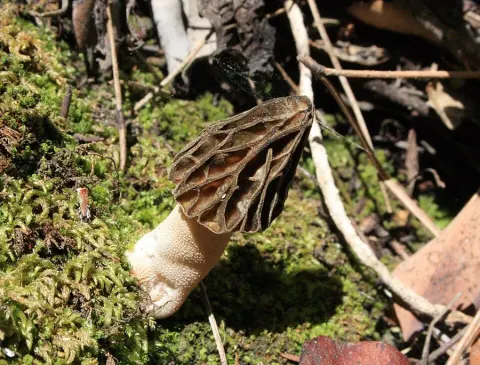
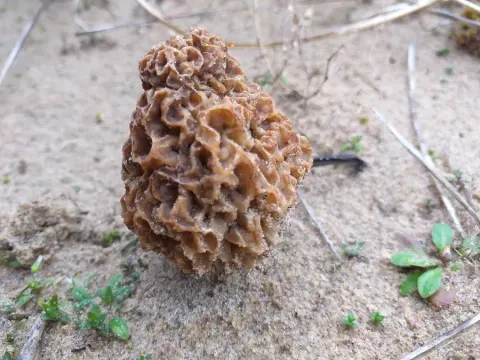
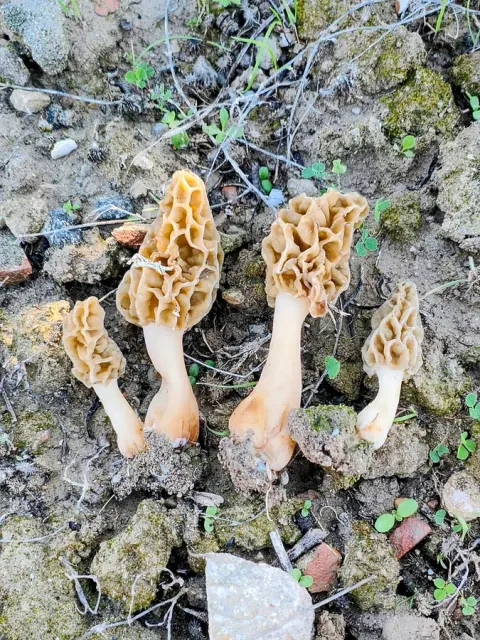
The fruit bodies are rufescent and can grow to 40 – 100 mm tall and 7 – 15 mm wide. They are conical or acutely conical, with fleshy longitudinal ribs that remain typically pale at maturity and never darken. Young specimens have dark grey pits sometimes with a faint lilac tint, and contrasting pale ribs, but typically fade to uniformly buff or greyish-brown in maturity. Pits are large and vertically elongated, often stretching uninterrupted from the base of the pileus to the apex, with no or rare transverse interconnecting ribs that are characteristic of most other Morchella species. The stipe is bulbous at the base, weakly wrinkled and initially covered in a distinct grey pruinescence that fades in mature specimens. There is no sinus at the attachment of the pileus with the stipe. The ascospores are ellipsoid to broadly ellipsoid, hyaline (translucent), and measure (22.5–)24–27(–32) by (12–)13–17(–20) μm; these dimensions are relatively large for the genus Morchella. Deep longitudinal grooves are present on the surface of mature spores when viewed under a scanning electron microscope or in the appropriate staining medium. The spores are produced in groups of eight in cylindrical to club-shaped asci, measuring 266–345 by 20–26(–35) μm. The paraphyses are hyaline, slenderly cylindrical or slightly inflated, with rounded to attenuated and sometimes enlarged apices, have 1–2(–3) septa and measure 150–250 by 8.5–18 μm. The acroparaphyses, located on the sterile ribs, are fasciculate and variable in shape, have 1–4 septa and measure 60–217 by 14–30 μm. The stipe features distinctly long, subcapitate, clavate or pyriform hyphoid hairs, which are sub-hyaline to pale gray and measure (64–)89–174(–222) by 23–40 μm.
Habitat dan peran ekologis
Morchella anatolica appears to be very rare and narrowly endemic to the Mediterranean basin. It is thought to be a climatic relict that may once have had a wider distribution that shrank during the Quaternary glaciations. In vitro cultures suggest that, like its sister-species M. rufobrunnea, M. anatolica may grow as a saprotroph. However, few collections in the wild have been found in close vicinity to Olea europaea and Fraxinus angustifolia, suggesting that the fungus may be able to form facultative associations with plants of the Oleaceae family. So far, M. anatolica is known only from Turkey, Spain, the island of Cyprus, and the Greek islands of Kefalonia, Lesvos and Zakynthos.
- Habitat atau konteks temuan
- kultur yang didokumentasikan
- Substrat
- Informasi belum tersedia pada sumber rilis ini.
- Peran atau konteks
- Belum dikategorikan pada rilis ini.
Reproduksi
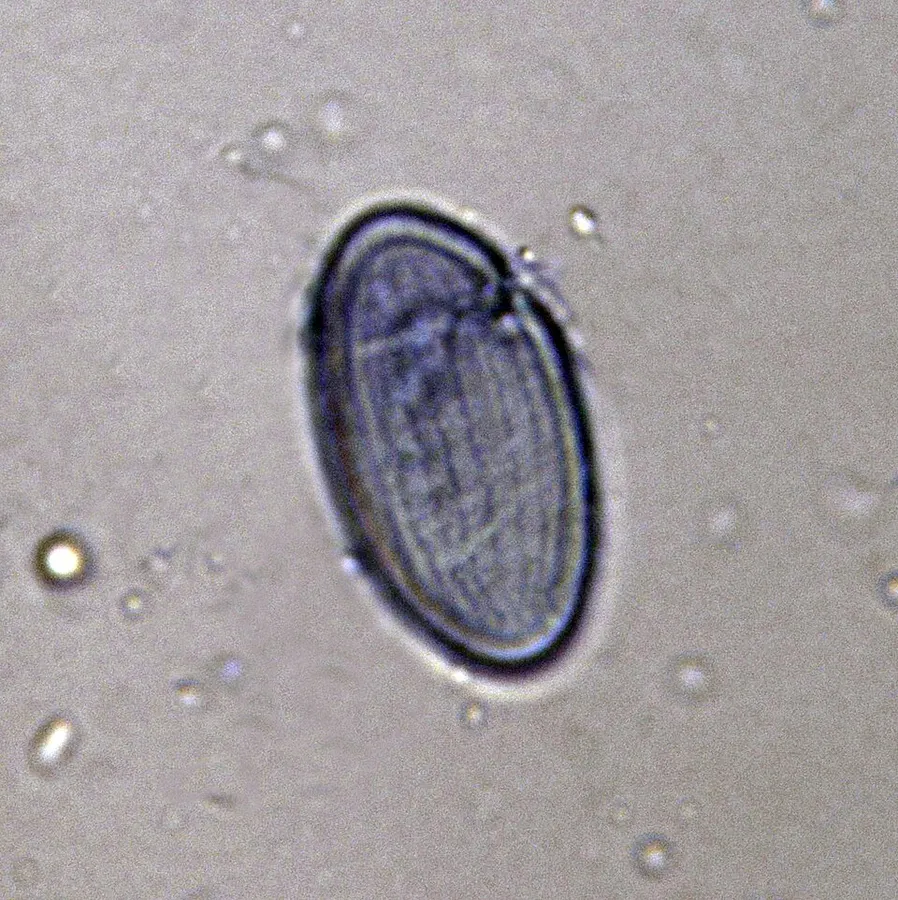
The ascospores are ellipsoid to broadly ellipsoid, hyaline (translucent), and measure (22.5–)24–27(–32) by (12–)13–17(–20) μm; these dimensions are relatively large for the genus Morchella. Deep longitudinal grooves are present on the surface of mature spores when viewed under a scanning electron microscope or in the appropriate staining medium. The spores are produced in groups of eight in cylindrical to club-shaped asci, measuring 266–345 by 20–26(–35) μm. The paraphyses are hyaline, slenderly cylindrical or slightly inflated, with rounded to attenuated and sometimes enlarged apices, have 1–2(–3) septa and measure 150–250 by 8.5–18 μm. The acroparaphyses, located on the sterile ribs, are fasciculate and variable in shape, have 1–4 septa and measure 60–217 by 14–30 μm.
Catatan identitas dan cakupan
- Nama diterima mengikuti Catalogue of Life Base2026-09-11; uraian mempertahankan konsep dan nama sumber aslinya.
- Original geographic, specimen and life-cycle scope retained; source import awaits individual editorial review.
- Impor dan terjemahan otomatis belum diperiksa editorial per profil. Struktur reproduktif yang disebutkan tidak membuktikan seluruh siklus hidup diketahui.
- Pengukuran pada uraian mengikuti spesimen, kultur, dan metode sumber; angka tidak diperluas ke semua populasi.
Catatan distribusi dalam narasi mengikuti sumbernya. Dokumentasi spesimen atau foto mengikuti catatan sumber. Bukti wilayah Indonesia dan penilaian konservasi tidak disimpulkan dari gambar.
Melihat dengan konteks
Dokumentasi Morchella anatolica dari Wikimedia Commons. Ascospore of Morchella anatolica in lactophenol cotton blue. Identifikasi mengikuti record berkas sumber.
- Jenis
- Fotografi
- Kredit
- Michloiz1968
- Lisensi
- CC BY-SA 4.0
- Sumber media
- Buka entri sumber
Sumber profil
- [1] Morchella anatolica — Wikipedia (en)
- [2] Catalogue of Life Base2026-09-11 — Morchella anatolica
- [3] Dokumentasi visual — Morchella anatolica
Rujukan halaman ini
Fungi. Morchella anatolica. Rilis data fungi-2026-10-12-expansion-2. https://fungi-atlas.mgadib.chatgpt.site/jamur/morchella-anatolica/.
Status: impor sumber; pemeriksaan editorial per profil belum selesai. Untuk klaim biologis, gunakan rujukan pada bagian terkait dan periksa konteks sumber aslinya.