01 / Morfologi

Ciri dan struktur

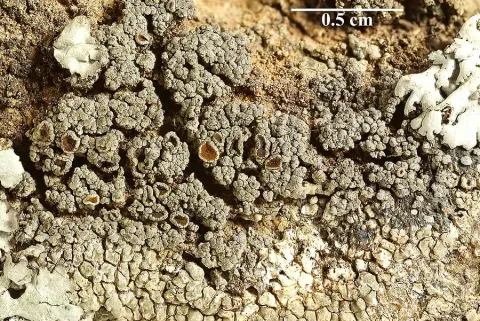
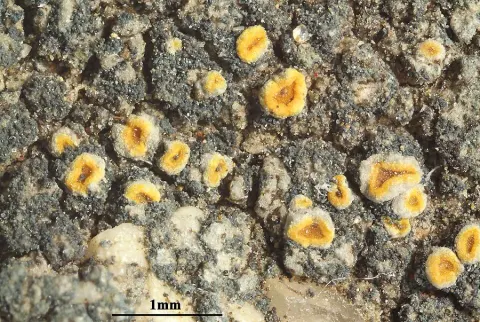
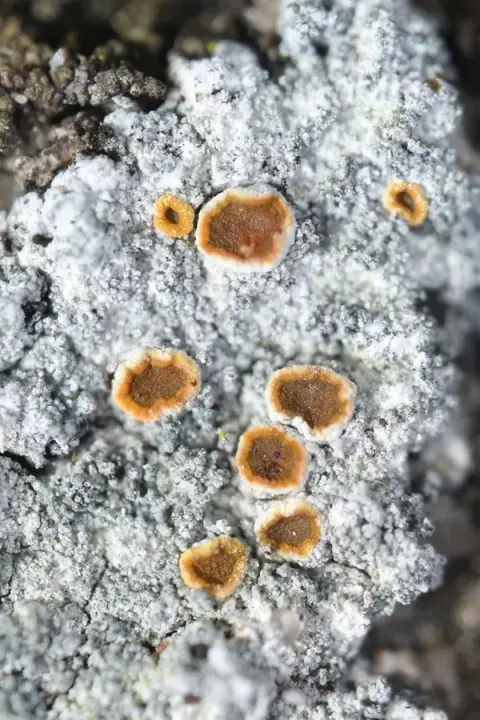
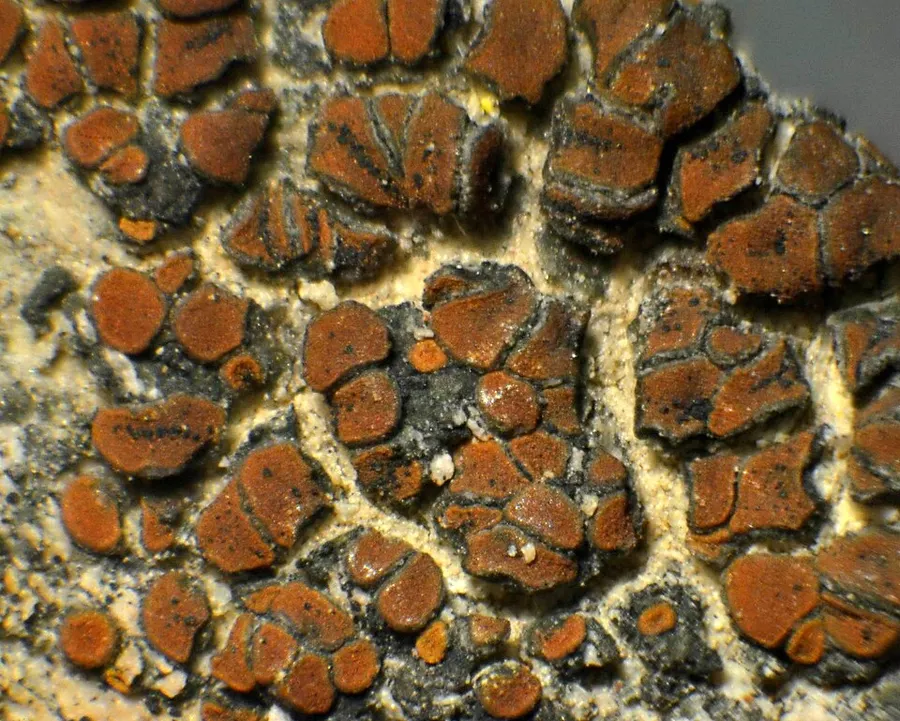
Kuettlingeria atroflava features a crustose thallus, typically measuring between 1 and 2 mm in diameter, and displays a dark grey to black hue. When fully mature, the thallus has a thin, cracked surface divided into convex , each approximately 0.5 mm in diameter, surrounded by a well-developed, black, sometimes fringe-like prothallus. The apothecia (fruiting bodies) are up to 0.5 mm in diameter and vary in frequency from scattered to densely packed. They have shapes ranging from rounded to irregularly curved, and are flat with a constricted base. These apothecia lack a , but have a distinct, even, and convex that is bright orange and glossy, while the themselves are brown-orange. The paraphyses (sterile structures within the apothecium) are slender, segmented, and curve gently, with ends that are only slightly enlarged. are broadly ellipsoid and swollen, measuring 13–16 by 9–10 μm, with a septum (internal division) that is 5–7 μm wide, constituting one-third to one-half (or occasionally more) of the spore's length. Chemical spot test reactions of the thallus with potassium hydroxide solution (K) result in faintly purple areas, while the apothecia react by turning purple.

Sebagian uraian ditampilkan dalam bahasa sumber; terjemahannya belum tersedia atau belum lolos pemeriksaan.

Rujukan: [1]

Pengukuran mengikuti objek, spesimen atau kultur, dan metode yang disebutkan sumber. Baca uraian asli untuk konteks lengkap.

02 / Kehidupan

Habitat dan peran ekologis

In North America, it has been recorded from California and Colorado in the United States, and British Columbia in Canada. It is categorised in the Estonian Regional Red List as "Regionally Extinct".

Sebagian uraian ditampilkan dalam bahasa sumber; terjemahannya belum tersedia atau belum lolos pemeriksaan.

Rujukan: [1]

Habitat atau konteks temuan
Informasi belum tersedia pada sumber rilis ini.
Substrat
Informasi belum tersedia pada sumber rilis ini.
Peran atau konteks
Pembentuk liken
Temukan hubungan serupa
03 / Siklus hidup

Reproduksi

are broadly ellipsoid and swollen, measuring 13–16 by 9–10 μm, with a septum (internal division) that is 5–7 μm wide, constituting one-third to one-half (or occasionally more) of the spore's length. Chemical spot test reactions of the thallus with potassium hydroxide solution (K) result in faintly purple areas, while the apothecia react by turning purple.

Sebagian uraian ditampilkan dalam bahasa sumber; terjemahannya belum tersedia atau belum lolos pemeriksaan.

Rujukan: [1]

Sinonim menurut acuan taksonomi rilis: Callopisma atroflavum; Caloplaca atroflava; Caloplaca atroflava var. submersa; Caloplaca ferruginea var. turneriana; Caloplaca fuscoatra var. atroflava; Caloplaca pyracea var. submersa; Caloplaca pyracea var. turneriana; Caloplaca turneriana; Lecanora atroflava; Lecanora ferruginea var. turneriana; Lecanora pyracea f. submersa; Lecanora turneriana; Lecidea atroflava; Lecidea turneriana; Lichen atroflavus; Lichen peltatus turneriana; Placodium atroflavum; Placodium ferrugineum var. turnerianum; Placodium pyraceum f. submersum; Placodium turnerianum; Pyrenodesmia atroflava
04 / Batas informasi

Catatan identitas dan cakupan

  • Nama diterima mengikuti Catalogue of Life Base2026-09-11; uraian mempertahankan konsep dan nama sumber aslinya.
  • Original geographic, specimen and life-cycle scope retained; source import awaits individual editorial review.
  • Impor dan terjemahan otomatis belum diperiksa editorial per profil. Struktur reproduktif yang disebutkan tidak membuktikan seluruh siklus hidup diketahui.
  • Pengukuran pada uraian mengikuti spesimen, kultur, dan metode sumber; angka tidak diperluas ke semua populasi.

Catatan distribusi dalam narasi mengikuti sumbernya. Dokumentasi spesimen atau foto mengikuti catatan sumber. Bukti wilayah Indonesia dan penilaian konservasi tidak disimpulkan dari gambar.

05 / Dokumentasi

Melihat dengan konteks

Dokumentasi Kuettlingeria atroflava dari Wikimedia Commons. For more information about this, see the observation page at Mushroom Observer. Identifikasi mengikuti record berkas sumber.

Jenis
Fotografi
Kredit
This image was created by user J-Dar at Mushroom Observer , a source for mycological images. You can contact this user here .
Sumber media
Buka entri sumber

Gambar menunjukkan objek menurut identifikasi sumber, bukan verifikasi independen spesimen oleh Fungi. Tidak ada skala baru yang ditambahkan.

06 / Rujukan

Sumber profil

  1. [1] Kuettlingeria atroflava — Wikipedia (en)Bagian sumber: Frozen revision 1378653467
    Tanggal penghimpunan sumber: 2026-10-12
    Teks sumber: CC BY-SA4.0 · Wikipedia contributors
  2. [2] Catalogue of Life Base2026-09-11 — Kuettlingeria atroflavaBagian sumber: ColDP NameUsage.tsv ID B2S3Z; accepted species; source 2073
    Tanggal penghimpunan sumber: 2026-10-12
  3. [3] Dokumentasi visual — Kuettlingeria atroflavaBagian sumber: Individual media record; identification follows the source, not independent determination
    Tanggal penghimpunan sumber: 2026-10-12
    Media sumber: CC BY-SA 3.0 · This image was created by user J-Dar at Mushroom Observer , a source for mycological images. You can contact this user here .

Adaptasi teks: CC BY-SA 4.0. Wikipedia contributors — Kuettlingeria atroflava — Wikipedia (en)

Uraian asli dan riwayat sumber

Riwayat atau halaman sumber

Ringkasan sumber

Kuettlingeria atroflava is a species of saxicolous (rock-dwelling), crustose lichen in the family Teloschistaceae.

Revisi sumber

Morfologi sumber

Kuettlingeria atroflava features a crustose thallus, typically measuring between 1 and 2 mm in diameter, and displays a dark grey to black hue. When fully mature, the thallus has a thin, cracked surface divided into convex , each approximately 0.5 mm in diameter, surrounded by a well-developed, black, sometimes fringe-like prothallus. The apothecia (fruiting bodies) are up to 0.5 mm in diameter and vary in frequency from scattered to densely packed. They have shapes ranging from rounded to irregularly curved, and are flat with a constricted base. These apothecia lack a , but have a distinct, even, and convex that is bright orange and glossy, while the themselves are brown-orange. The paraphyses (sterile structures within the apothecium) are slender, segmented, and curve gently, with ends that are only slightly enlarged. are broadly ellipsoid and swollen, measuring 13–16 by 9–10 μm, with a septum (internal division) that is 5–7 μm wide, constituting one-third to one-half (or occasionally more) of the spore's length. Chemical spot test reactions of the thallus with potassium hydroxide solution (K) result in faintly purple areas, while the apothecia react by turning purple.

Revisi sumber

Ekologi sumber

In North America, it has been recorded from California and Colorado in the United States, and British Columbia in Canada. It is categorised in the Estonian Regional Red List as "Regionally Extinct".

Revisi sumber

Struktur reproduksi sumber

are broadly ellipsoid and swollen, measuring 13–16 by 9–10 μm, with a septum (internal division) that is 5–7 μm wide, constituting one-third to one-half (or occasionally more) of the spore's length. Chemical spot test reactions of the thallus with potassium hydroxide solution (K) result in faintly purple areas, while the apothecia react by turning purple.

Revisi sumber

Rujukan halaman ini

Fungi. Kuettlingeria atroflava. Rilis data fungi-2026-10-12-expansion-2. https://fungi-atlas.mgadib.chatgpt.site/jamur/kuettlingeria-atroflava/.

Status: impor sumber; pemeriksaan editorial per profil belum selesai. Untuk klaim biologis, gunakan rujukan pada bagian terkait dan periksa konteks sumber aslinya.