Ciri dan struktur
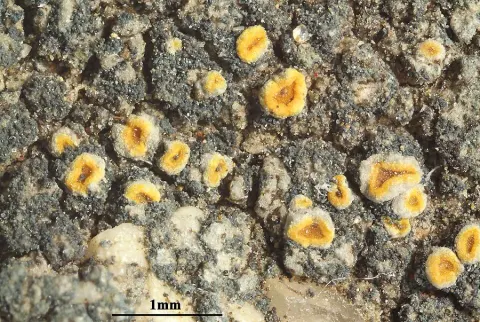
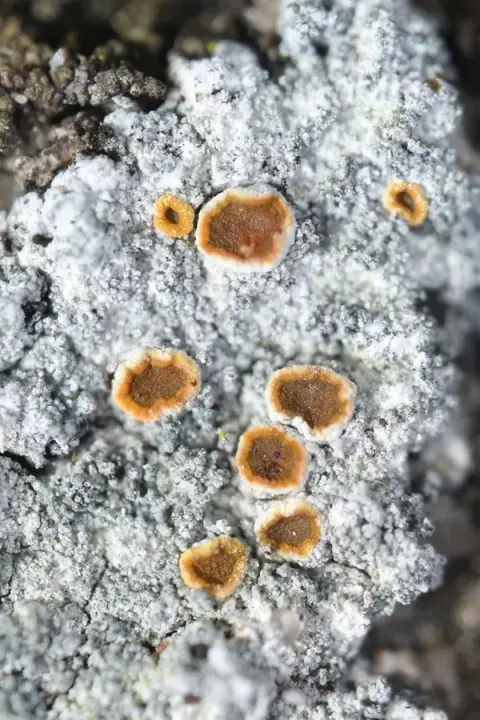
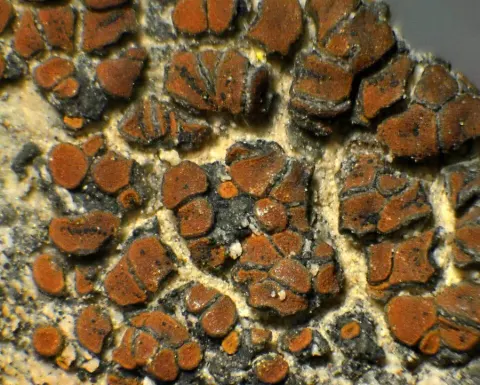
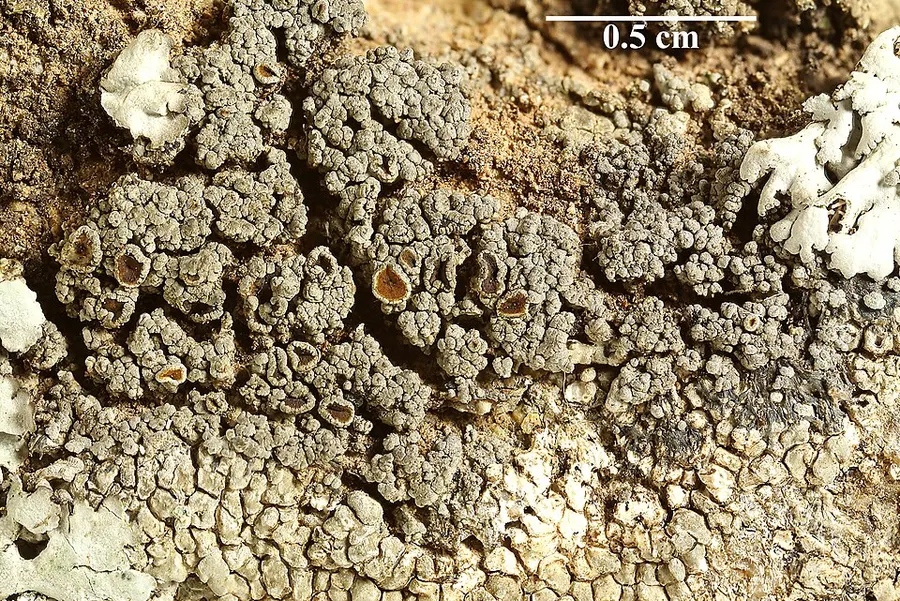
Kuettlingeria furax is a crustose lichen that grows as a parasite on Aspicilia species found on siliceous rocks. It forms small, rounded patches (rosettes) measuring 2–6 mm in diameter that often merge together. These patches are greyish to leaden-grey with a slightly brownish tint, and have a somewhat lobed margin. As the lichen matures, the centre begins to disintegrate, giving it a ring-like appearance. The thallus (main body) is relatively thick (135–175 μm) with a that contains a violet-grey pigment in its upper half. The reproductive structures (apothecia) measure 0.4–0.8 mm in diameter and are initially enclosed in wart-like protrusions of the thallus. As they develop, the bright orange gradually extends beyond the grey . The is round or sometimes deformed due to crowding, initially concave but becoming flat, and ranges from bright orange to orange-brown in colour. When tested with potassium hydroxide solution (K), the apothecia turn purple, while the thallus shows no reaction. The spores are (with two cells connected by a canal), broadly ellipsoid or nearly spherical ()), often with an equatorial swelling, and measure approximately 12.5–14 by 7–10 μm. Kuettlingeria furax differs from the similar species Caloplaca conglomerata by having a thalline margin that quickly becomes inconspicuous, larger and wider spores with equatorial swelling, and its parasitic lifestyle on silicicolous Aspicilia species.
Habitat dan peran ekologis
Kuettlingeria furax is a species of lichenicolous (lichen-dwelling) crustose lichen in the family Teloschistaceae. It grows as a parasite on other lichens in the genus Aspicilia that are found on silica-rich rock surfaces. Originally described in 1983 as Caloplaca furax from specimens found in southeastern Spain, it forms small, circular patches of deep brownish-grey colour with lobed edges. Kuettlingeria furax is a crustose lichen that grows as a parasite on Aspicilia species found on siliceous rocks. It forms small, rounded patches (rosettes) measuring 2–6 mm in diameter that often merge together. These patches are greyish to leaden-grey with a slightly brownish tint, and have a somewhat lobed margin. As the lichen matures, the centre begins to disintegrate, giving it a ring-like appearance. The thallus (main body) is relatively thick (135–175 μm) with a that contains a violet-grey pigment in its upper half. Kuettlingeria furax differs from the similar species Caloplaca conglomerata by having a thalline margin that quickly becomes inconspicuous, larger and wider spores with equatorial swelling, and its parasitic lifestyle on silicicolous Aspicilia species.
- Habitat atau konteks temuan
- Informasi belum tersedia pada sumber rilis ini.
- Substrat
- Informasi belum tersedia pada sumber rilis ini.
- Peran atau konteks
- Pembentuk liken
Reproduksi
The reproductive structures (apothecia) measure 0.4–0.8 mm in diameter and are initially enclosed in wart-like protrusions of the thallus. As they develop, the bright orange gradually extends beyond the grey . The is round or sometimes deformed due to crowding, initially concave but becoming flat, and ranges from bright orange to orange-brown in colour. When tested with potassium hydroxide solution (K), the apothecia turn purple, while the thallus shows no reaction. The spores are (with two cells connected by a canal), broadly ellipsoid or nearly spherical ()), often with an equatorial swelling, and measure approximately 12.5–14 by 7–10 μm. Kuettlingeria furax differs from the similar species Caloplaca conglomerata by having a thalline margin that quickly becomes inconspicuous, larger and wider spores with equatorial swelling, and its parasitic lifestyle on silicicolous Aspicilia species.
Catatan identitas dan cakupan
- Nama diterima mengikuti Catalogue of Life Base2026-09-11; uraian mempertahankan konsep dan nama sumber aslinya.
- Original geographic, specimen and life-cycle scope retained; source import awaits individual editorial review.
- Impor dan terjemahan otomatis belum diperiksa editorial per profil. Struktur reproduktif yang disebutkan tidak membuktikan seluruh siklus hidup diketahui.
- Pengukuran pada uraian mengikuti spesimen, kultur, dan metode sumber; angka tidak diperluas ke semua populasi.
Catatan distribusi dalam narasi mengikuti sumbernya. Dokumentasi spesimen atau foto mengikuti catatan sumber. Bukti wilayah Indonesia dan penilaian konservasi tidak disimpulkan dari gambar.
Melihat dengan konteks
Dokumentasi Kuettlingeria furax dari Wikimedia Commons. The parasitic lichen "Kuettlingeria furax", growing on a crustose Aspicilia lichen that itself is growing on sandstone; photographed in Greece Identifikasi mengikuti record berkas sumber.
- Jenis
- Fotografi
- Kredit
- Felix Schumm
- Lisensi
- CC BY-SA 4.0
- Sumber media
- Buka entri sumber
Sumber profil
- [1] Kuettlingeria furax — Wikipedia (en)
- [2] Catalogue of Life Base2026-09-11 — Kuettlingeria furax
- [3] Dokumentasi visual — Kuettlingeria furax
Rujukan halaman ini
Fungi. Kuettlingeria furax. Rilis data fungi-2026-10-12-expansion-2. https://fungi-atlas.mgadib.chatgpt.site/jamur/kuettlingeria-furax/.
Status: impor sumber; pemeriksaan editorial per profil belum selesai. Untuk klaim biologis, gunakan rujukan pada bagian terkait dan periksa konteks sumber aslinya.