01 / Morfologi

Ciri dan struktur

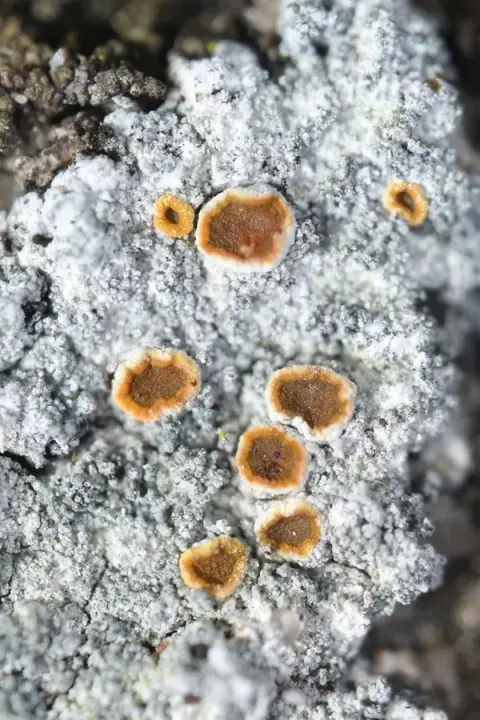
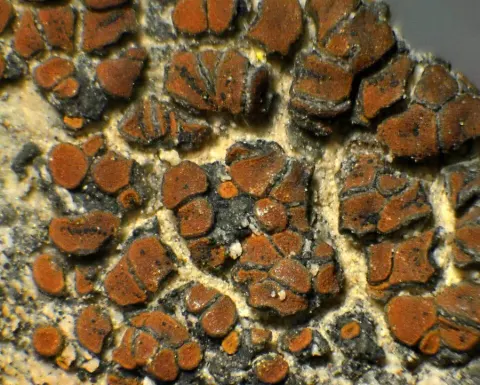
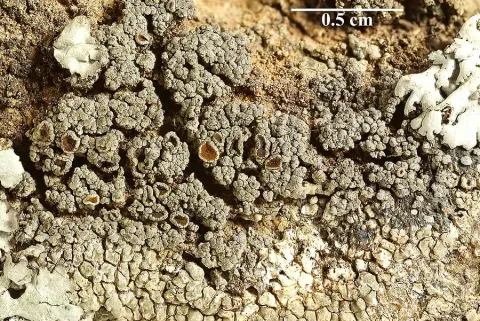
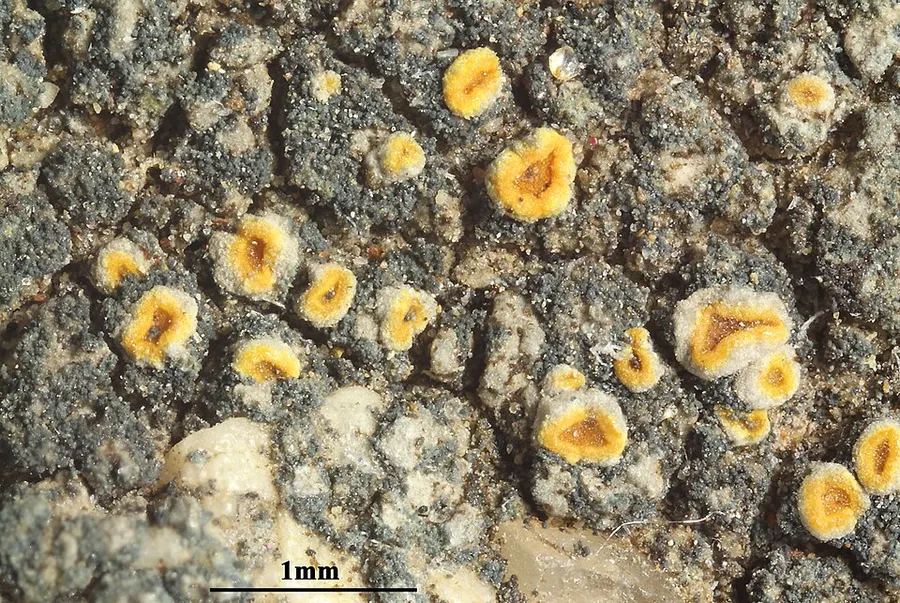
This lichen has a crustose, to somewhat thallus, typically dark to pale grey, and often appears whitish due to . The are flat to convex, measuring 0.2 to 0.8 mm in diameter. It produces dark grey to violet-grey soralia at the margins of the areoles and , which can sometimes cover the entire thallus surface. The of the thallus is greyish to violet-grey, and the comprises a mixture of algal and fungal cells. The soredia and cortex react positively to various chemical spot tests, indicating the presence of the pigment . Apothecia, when present, are small, with orange to brown and a yellow to orange . The hymenium is hyaline and contains oil drops. Asci are typically 50 to 80 μm in size, containing , hyaline spores.

Sebagian uraian ditampilkan dalam bahasa sumber; terjemahannya belum tersedia atau belum lolos pemeriksaan.

Rujukan: [1]

Pengukuran mengikuti objek, spesimen atau kultur, dan metode yang disebutkan sumber. Baca uraian asli untuk konteks lengkap.

02 / Kehidupan

Habitat dan peran ekologis

Caloplaca soralifera is predominantly found on artificial substrates like asphalt, concrete, and mortar, and occasionally on natural substrates such as calcareous and siliceous rocks. It has been recorded in several European countries, including Austria, Bulgaria, the Czech Republic, Germany, Slovakia, and Romania, growing in exposed horizontal sides of structures. Its recorded elevation range is between 220 and 1450 m. It has also been recorded from North America, Bering Island in the Russian Far East, and from southern Siberia. This species is often associated with other lichens like Caloplaca crenulatella and Lecanora muralis. Its presence has been increasing in certain areas, possibly due to expanding substrate preferences and climatic changes favouring nitrophilous and basiphilous lichens.

Sebagian uraian ditampilkan dalam bahasa sumber; terjemahannya belum tersedia atau belum lolos pemeriksaan.

Rujukan: [1]

Habitat atau konteks temuan
Informasi belum tersedia pada sumber rilis ini.
Substrat
Informasi belum tersedia pada sumber rilis ini.
Peran atau konteks
Pembentuk liken
Temukan hubungan serupa
03 / Siklus hidup

Reproduksi

This lichen has a crustose, to somewhat thallus, typically dark to pale grey, and often appears whitish due to . The are flat to convex, measuring 0.2 to 0.8 mm in diameter. It produces dark grey to violet-grey soralia at the margins of the areoles and , which can sometimes cover the entire thallus surface. The of the thallus is greyish to violet-grey, and the comprises a mixture of algal and fungal cells. The soredia and cortex react positively to various chemical spot tests, indicating the presence of the pigment . Apothecia, when present, are small, with orange to brown and a yellow to orange . The hymenium is hyaline and contains oil drops. Asci are typically 50 to 80 μm in size, containing , hyaline spores.

Sebagian uraian ditampilkan dalam bahasa sumber; terjemahannya belum tersedia atau belum lolos pemeriksaan.

Rujukan: [1]

Sinonim menurut acuan taksonomi rilis: Caloplaca soralifera; Pyrenodesmia soralifera
04 / Batas informasi

Catatan identitas dan cakupan

  • Nama diterima mengikuti Catalogue of Life Base2026-09-11; uraian mempertahankan konsep dan nama sumber aslinya.
  • Original geographic, specimen and life-cycle scope retained; source import awaits individual editorial review.
  • Impor dan terjemahan otomatis belum diperiksa editorial per profil. Struktur reproduktif yang disebutkan tidak membuktikan seluruh siklus hidup diketahui.
  • Pengukuran pada uraian mengikuti spesimen, kultur, dan metode sumber; angka tidak diperluas ke semua populasi.

Catatan distribusi dalam narasi mengikuti sumbernya. Dokumentasi spesimen atau foto mengikuti catatan sumber. Bukti wilayah Indonesia dan penilaian konservasi tidak disimpulkan dari gambar.

05 / Dokumentasi

Melihat dengan konteks

Dokumentasi Kuettlingeria soralifera dari Wikimedia Commons. The rock-dwelling, crustose lichen Kuettlingeria soralifera . Collection notes: "Czech Republic, Central Bohemia, Rakovník District, Krivoklat, near a small pond in Kalubice, on horizontal faces of a concrete wall. 50°02’56.3’’ N, 13°49’30.4’’ E, 348 m. Leg. J. Vondrák, J., 28 December 2004, det. J. Vondrák. VONDRAK, SELECTED EXSICCATES OF CALOPLACA NO 22. ISOTYPE." Identifikasi mengikuti record berkas sumber.

Jenis
Fotografi
Kredit
Felix Schumm
Sumber media
Buka entri sumber

Gambar menunjukkan objek menurut identifikasi sumber, bukan verifikasi independen spesimen oleh Fungi. Tidak ada skala baru yang ditambahkan.

06 / Rujukan

Sumber profil

  1. [1] Kuettlingeria soralifera — Wikipedia (en)Bagian sumber: Frozen revision 1336327146
    Tanggal penghimpunan sumber: 2026-10-12
    Teks sumber: CC BY-SA4.0 · Wikipedia contributors
  2. [2] Catalogue of Life Base2026-09-11 — Kuettlingeria soraliferaBagian sumber: ColDP NameUsage.tsv ID B2S7T; accepted species; source 2073
    Tanggal penghimpunan sumber: 2026-10-12
  3. [3] Dokumentasi visual — Kuettlingeria soraliferaBagian sumber: Individual media record; identification follows the source, not independent determination
    Tanggal penghimpunan sumber: 2026-10-12
    Media sumber: CC BY-SA 4.0 · Felix Schumm

Adaptasi teks: CC BY-SA 4.0. Wikipedia contributors — Kuettlingeria soralifera — Wikipedia (en)

Uraian asli dan riwayat sumber

Riwayat atau halaman sumber

Ringkasan sumber

Kuettlingeria soralifera is a saxicolous (rock-dwelling), crustose lichen species in the family Teloschistaceae, first described in 2006. It is similar to Kuettlingeria xerica but distinguished by the presence of soredia on its thallus. The lichen has a grey, often whitish-frosted thallus that produces powdery reproductive granules, and typically grows on artificial substrates such as concrete and asphalt, though it also occurs on natural rock. It is found across Europe, North America, and parts of Asia including Siberia and the Russian Far East.

Revisi sumber

Morfologi sumber

This lichen has a crustose, to somewhat thallus, typically dark to pale grey, and often appears whitish due to . The are flat to convex, measuring 0.2 to 0.8 mm in diameter. It produces dark grey to violet-grey soralia at the margins of the areoles and , which can sometimes cover the entire thallus surface. The of the thallus is greyish to violet-grey, and the comprises a mixture of algal and fungal cells. The soredia and cortex react positively to various chemical spot tests, indicating the presence of the pigment . Apothecia, when present, are small, with orange to brown and a yellow to orange . The hymenium is hyaline and contains oil drops. Asci are typically 50 to 80 μm in size, containing , hyaline spores.

Revisi sumber

Ekologi sumber

Caloplaca soralifera is predominantly found on artificial substrates like asphalt, concrete, and mortar, and occasionally on natural substrates such as calcareous and siliceous rocks. It has been recorded in several European countries, including Austria, Bulgaria, the Czech Republic, Germany, Slovakia, and Romania, growing in exposed horizontal sides of structures. Its recorded elevation range is between 220 and 1450 m. It has also been recorded from North America, Bering Island in the Russian Far East, and from southern Siberia. This species is often associated with other lichens like Caloplaca crenulatella and Lecanora muralis. Its presence has been increasing in certain areas, possibly due to expanding substrate preferences and climatic changes favouring nitrophilous and basiphilous lichens.

Revisi sumber

Struktur reproduksi sumber

This lichen has a crustose, to somewhat thallus, typically dark to pale grey, and often appears whitish due to . The are flat to convex, measuring 0.2 to 0.8 mm in diameter. It produces dark grey to violet-grey soralia at the margins of the areoles and , which can sometimes cover the entire thallus surface. The of the thallus is greyish to violet-grey, and the comprises a mixture of algal and fungal cells. The soredia and cortex react positively to various chemical spot tests, indicating the presence of the pigment . Apothecia, when present, are small, with orange to brown and a yellow to orange . The hymenium is hyaline and contains oil drops. Asci are typically 50 to 80 μm in size, containing , hyaline spores.

Revisi sumber

Rujukan halaman ini

Fungi. Kuettlingeria soralifera. Rilis data fungi-2026-10-12-expansion-2. https://fungi-atlas.mgadib.chatgpt.site/jamur/kuettlingeria-soralifera/.

Status: impor sumber; pemeriksaan editorial per profil belum selesai. Untuk klaim biologis, gunakan rujukan pada bagian terkait dan periksa konteks sumber aslinya.