Ciri dan struktur
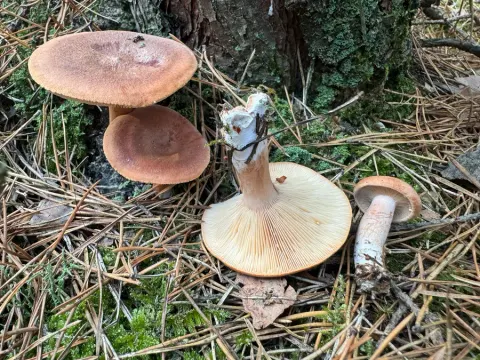
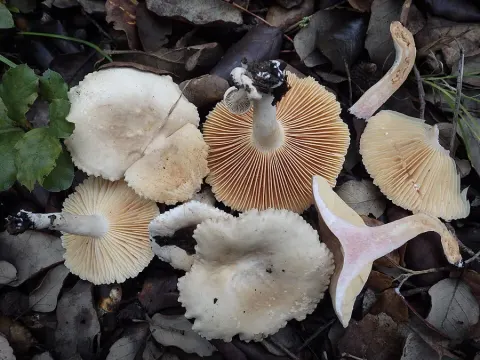
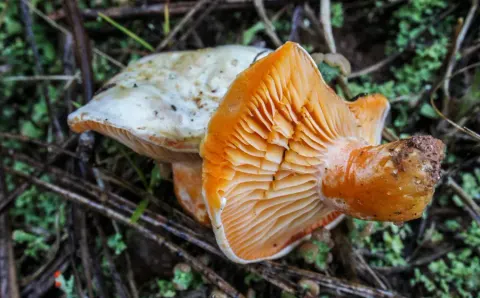
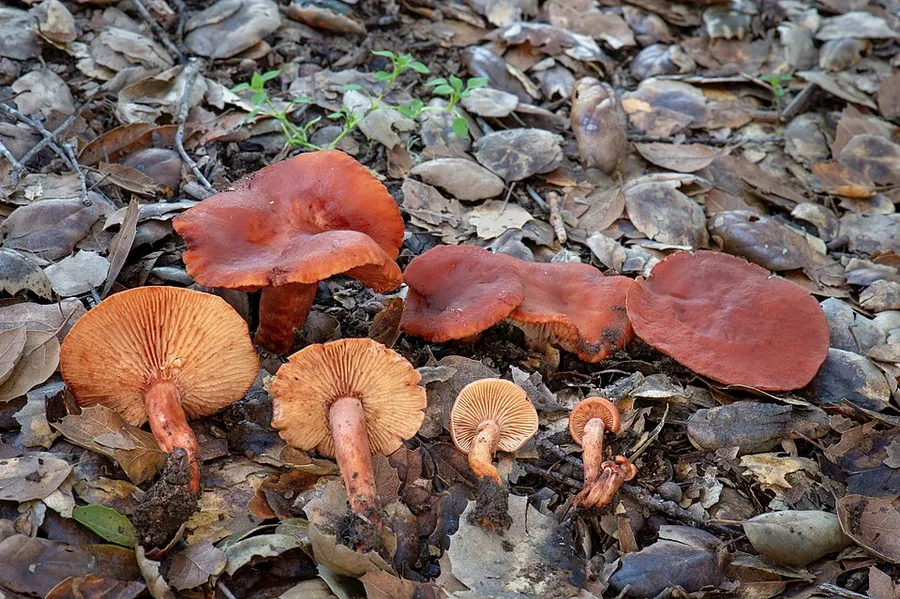
The cap of L. rufulus is 3 – 10 cm wide, broadly convex, becoming flattened and eventually shallowly funnel-shaped, sometimes with a slight umbo. The cap margin (edge) is initially curved inwards but becomes curved upward in maturity. The surface is usually uneven or wrinkled. It is brownish red at first, but fades to orange-brown with age. The attachment of the gills to the stem is adnate (squarely attached) to subdecurrent (running slightly down the length of the stem). They are packed close together, at first pinkish-yellow, but with age become a darker red or reddish brown. The gills are not forked, nor do they stain a different color when bruised. The stem is 4 – 8 cm long, about 0.5 – 1.5 cm thick, nearly equal or slightly enlarged downward, dry, smooth, and reddish brown. It may be solid or stuffed (filled with cotton-like mycelia), but may become partially hollow with age. The flesh is firm, white to pinkish-orange, and does not stain when cut. The latex is scant, white, unchanging, and does not stain tissues. Its taste is mild. The spore print is white to creamy yellow. The spores are 7–9 by 7–9 μm, spherical or nearly so, ornamented with a partial to complete reticulum (a system of raised, net-like ridges), with prominences up to 0.5 μm high. The basidia (spore-bearing cells) are both two- and four-spored, and measure 45–52 by 9–11 μm. The cap cuticle is a poorly formed layer of inflated cells with scattered filamentous pileocystidia (cystidia on the cap). Somewhat unusual for a Lactarius, L. rufulus lacks or has few swollen cells (sphaerocysts) in the cap and stem.
Habitat dan peran ekologis
Lactarius rufulus adalah spesies mikoriza, dan hidup dalam hubungan yang saling menguntungkan dengan spesies ek. Jamur membentuk ektomikorrizae ⁇ dipecahkan oleh lapisan eksternal yang mengelilingi akar pohon ek. Jamur menerima karbohidrat larut yang merupakan produk sampingan dari fotosintesis tanaman, sementara memberikan akses yang lebih besar ke nutrisi tanah yang dibutuhkan untuk pertumbuhan. The fruit bodies of L. rufulus grow scattered or in groups on the ground under oak, usually from January to March; their appearance is uncommon. Once thought hanya di California (di mana mereka paling umum di bagian selatan negara bagian), mereka dilaporkan dari Mexico in 1998, dan dari Arizona in 2006.
- Habitat atau konteks temuan
- Informasi belum tersedia pada sumber rilis ini.
- Substrat
- tanah
- Peran atau konteks
- Mitra tumbuhan
Reproduksi
The cap of L. rufulus is 3 – 10 cm wide, broadly convex, becoming flattened and eventually shallowly funnel-shaped, sometimes with a slight umbo. The cap margin (edge) is initially curved inwards but becomes curved upward in maturity. The surface is usually uneven or wrinkled. It is brownish red at first, but fades to orange-brown with age. The attachment of the gills to the stem is adnate (squarely attached) to subdecurrent (running slightly down the length of the stem). They are packed close together, at first pinkish-yellow, but with age become a darker red or reddish brown. The gills are not forked, nor do they stain a different color when bruised. The stem is 4 – 8 cm long, about 0.5 – 1.5 cm thick, nearly equal or slightly enlarged downward, dry, smooth, and reddish brown.
Catatan identitas dan cakupan
- Nama diterima mengikuti Catalogue of Life Base2026-09-11; uraian mempertahankan konsep dan nama sumber aslinya.
- Original geographic, specimen and life-cycle scope retained; source import awaits individual editorial review.
- Impor dan terjemahan otomatis belum diperiksa editorial per profil. Struktur reproduktif yang disebutkan tidak membuktikan seluruh siklus hidup diketahui.
- Pengukuran pada uraian mengikuti spesimen, kultur, dan metode sumber; angka tidak diperluas ke semua populasi.
Catatan distribusi dalam narasi mengikuti sumbernya. Dokumentasi spesimen atau foto mengikuti catatan sumber. Bukti wilayah Indonesia dan penilaian konservasi tidak disimpulkan dari gambar.
Melihat dengan konteks
Dokumentasi Lactarius rufulus dari Wikimedia Commons. Lactarius rufulus that I photographed in Southern California. Odor was sweet, and we ate them for dinner. They weren't bad. See also https://mushroomobserver.org/358361 Identifikasi mengikuti record berkas sumber.
- Jenis
- Fotografi
- Kredit
- Alan Rockefeller
- Lisensi
- CC BY-SA 4.0
- Sumber media
- Buka entri sumber
Sumber profil
- [1] Lactarius rufulus — Wikipedia (en)
- [2] Catalogue of Life Base2026-09-11 — Lactarius rufulus
- [3] Dokumentasi visual — Lactarius rufulus
Rujukan halaman ini
Fungi. Lactarius rufulus. Rilis data fungi-2026-10-12-expansion-2. https://fungi-atlas.mgadib.chatgpt.site/jamur/lactarius-rufulus/.
Status: impor sumber; pemeriksaan editorial per profil belum selesai. Untuk klaim biologis, gunakan rujukan pada bagian terkait dan periksa konteks sumber aslinya.