Ciri dan struktur
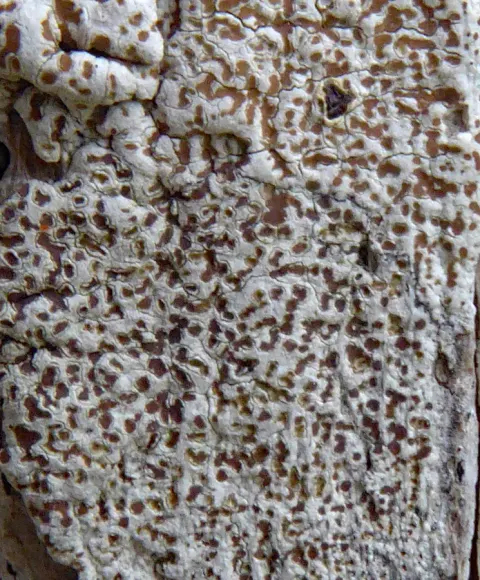
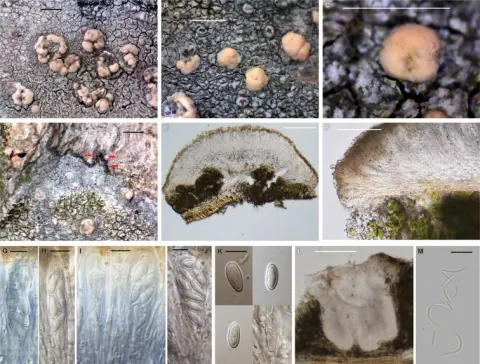
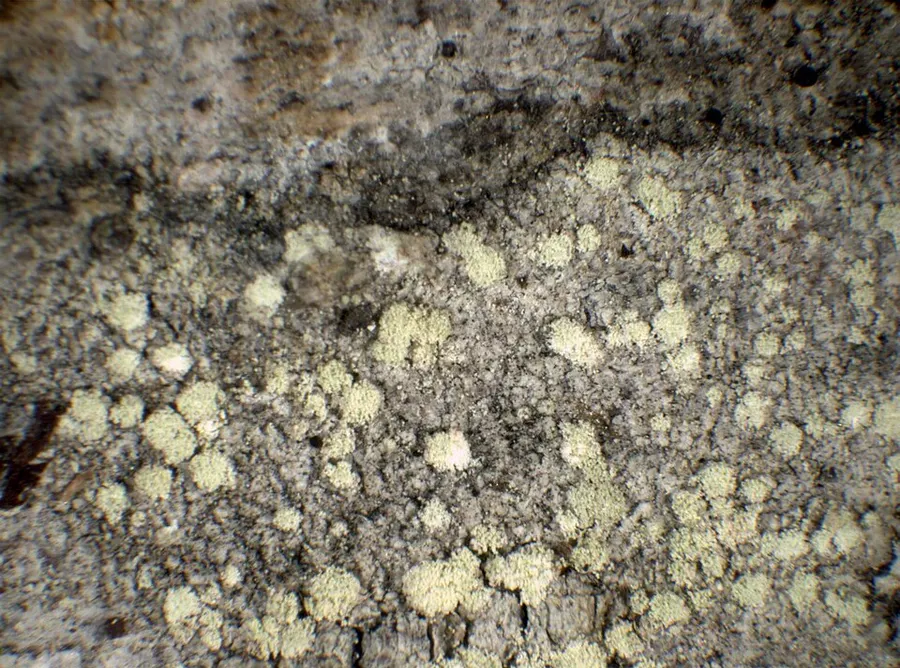
The lichen body (thallus) forms a thin, continuous crust that is pale grey to grey and smooth to slightly granular. A black basal layer () may or may not be present. The species reproduces vegetatively by soredia (powdery granules), which are floury (), pale citron yellow when fresh (paler in dried herbarium material), and grouped into discrete clusters (soralia) up to about 1 mm across; these are scattered over the thallus rather than forming a confluent sorediate mass. A later revision described the thallus as smooth to granular and the rounded soralia as 0.2–1.4 mm in diameter. The thallus contains discrete clusters of large oxalate crystals, which become visible as translucent spots when the surface is moistened and can help in recognising sterile material. Fruiting bodies (apothecia) are uncommon and small, reaching about 1 mm across and typically 0.3–0.9 mm in diameter. They are initially rounded but may later become irregular; the thallus-derived rim () is at first distinct but later disappears. The is level with the margin when mature and usually pale green to brownish green, only rarely becoming almost black. Under the microscope, the asci each contain eight simple, colourless spores that are broadly oval (ellipsoid) and measure 8.5–14.5 × 5.5–8.0 μm. Standard spot tests on the thallus and soredia are negative, or at most faintly yellow with potassium hydroxide solution. The species is also chemically distinctive in containing 2-O-methylsulphurellin, reported as unique to this species.
Habitat dan peran ekologis
In Britain and Ireland, Lecanora jamesii grows mainly on the bark of deciduous trees and only rarely on wood. Laundon considered it an Atlantic species, intolerant of nitrogen enrichment (nitrophobous) and confined to upland and western districts ("Highland Britain" in the older usage), where it favours smooth bark in very humid situations such as over water or around boggy ground. His records came from Wales (including Pembrokeshire, Merioneth, and Caernarfon), north-west England (Cumbria), western Scotland (including the Sunart–Morvern area), the Inner Hebrides, and a number of Irish localities, especially in the west and south-west. The species has since proved to be more widespread. On the Pacific coast of North America, it was reported from coastal lowlands up to about 240 m elevation in British Columbia, Washington, Oregon, and California, mostly on Alnus rubra but also on Lithocarpus densiflorus, Salix, and Thuja plicata; there too it showed clear oceanic affinities while tending to avoid deeply shaded sites. In Brazil, it was recorded from Tocantins. In Europe, later authors confirmed it from oceanic parts of western Europe and from humid parts of the Austrian Alps, listing specimens from Austria, France, and Great Britain.
- Habitat atau konteks temuan
- Informasi belum tersedia pada sumber rilis ini.
- Substrat
- kayu
- Peran atau konteks
- Pembentuk liken
Reproduksi
The lichen body (thallus) forms a thin, continuous crust that is pale grey to grey and smooth to slightly granular. A black basal layer () may or may not be present. The species reproduces vegetatively by soredia (powdery granules), which are floury (), pale citron yellow when fresh (paler in dried herbarium material), and grouped into discrete clusters (soralia) up to about 1 mm across; these are scattered over the thallus rather than forming a confluent sorediate mass. A later revision described the thallus as smooth to granular and the rounded soralia as 0.2–1.4 mm in diameter. The thallus contains discrete clusters of large oxalate crystals, which become visible as translucent spots when the surface is moistened and can help in recognising sterile material.
Catatan identitas dan cakupan
- Nama diterima mengikuti Catalogue of Life Base2026-09-11; uraian mempertahankan konsep dan nama sumber aslinya.
- Original geographic, specimen and life-cycle scope retained; source import awaits individual editorial review.
- Impor dan terjemahan otomatis belum diperiksa editorial per profil. Struktur reproduktif yang disebutkan tidak membuktikan seluruh siklus hidup diketahui.
- Pengukuran pada uraian mengikuti spesimen, kultur, dan metode sumber; angka tidak diperluas ke semua populasi.
Catatan distribusi dalam narasi mengikuti sumbernya. Dokumentasi spesimen atau foto mengikuti catatan sumber. Bukti wilayah Indonesia dan penilaian konservasi tidak disimpulkan dari gambar.
Melihat dengan konteks
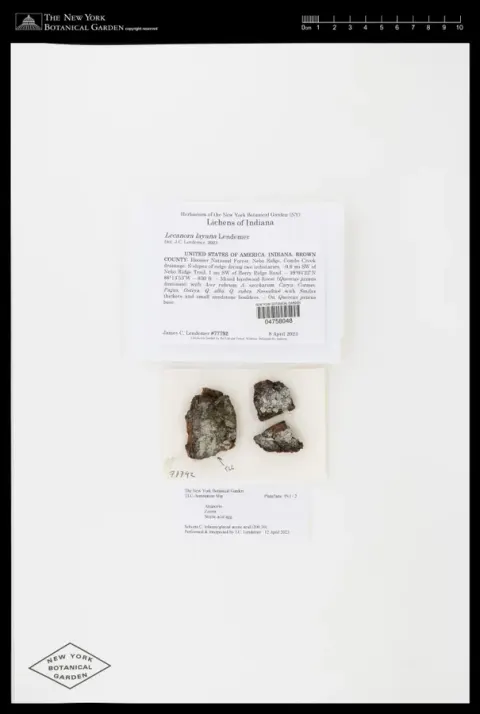
Dokumentasi Lecanora jamesii dari Wikimedia Commons. The bark-dwelling crustose lichen Lecanora jamesii Identifikasi mengikuti record berkas sumber.
- Jenis
- Fotografi
- Kredit
- Pier Luigi Nimis
- Lisensi
- CC BY-SA 4.0
- Sumber media
- Buka entri sumber
Sumber profil
- [1] Lecanora jamesii — Wikipedia (en)
- [2] Catalogue of Life Base2026-09-11 — Lecanora jamesii
- [3] Dokumentasi visual — Lecanora jamesii
Rujukan halaman ini
Fungi. Lecanora jamesii. Rilis data fungi-2026-10-12-expansion-2. https://fungi-atlas.mgadib.chatgpt.site/jamur/lecanora-jamesii/.
Status: impor sumber; pemeriksaan editorial per profil belum selesai. Untuk klaim biologis, gunakan rujukan pada bagian terkait dan periksa konteks sumber aslinya.