Ciri dan struktur
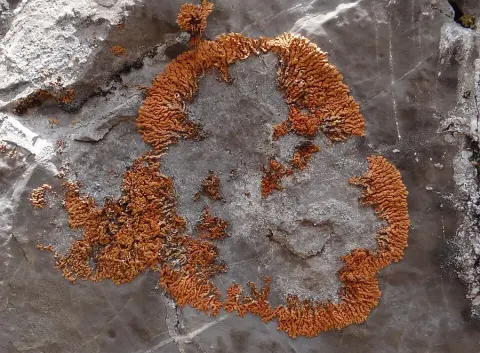
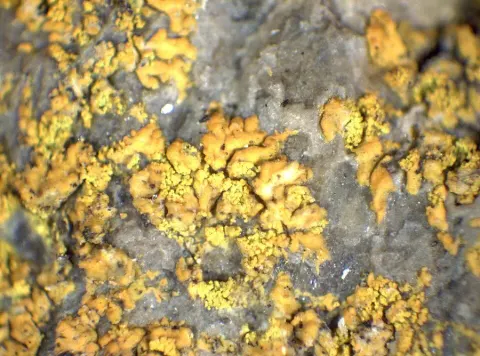
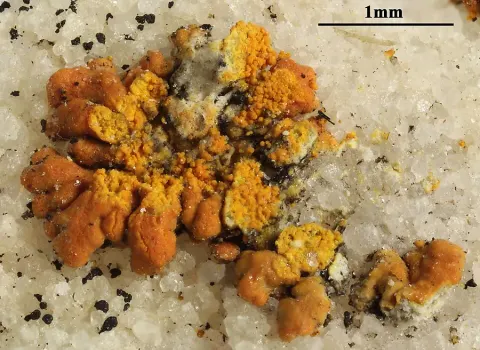
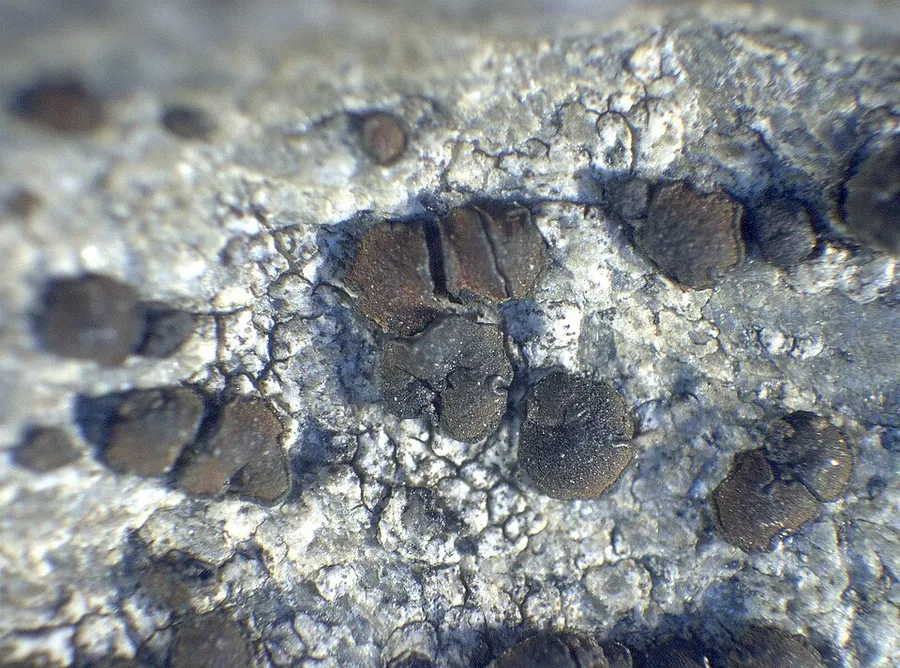
Lendemeriella exsecuta is a crustose lichen, meaning it grows as a thin, crust-like layer tightly attached to its . The main body (thallus) appears grey, occasionally dark grey or off-white, and forms a continuous surface that may develop small cracks creating distinct segments called . These areoles measure 0.5–1 mm across and may appear slightly pinched at their base. The reproductive structures (apothecia) are small disc-like organs measuring 0.2–0.7 mm in diameter. These sit directly on the surface without a stalk and display considerable colour variation – from brownish-yellow to orange-brown, eventually becoming completely black. The are surrounded by a raised rim () that ranges from black to olive in colour and may eventually become less prominent as the disc becomes more convex. When viewed under a microscope, the internal structure reveals several distinct layers. The spore-producing layer (hymenium) is colourless and 65–90 micrometres (μm) tall, occasionally reaching 135 μm. It contains cylindrical spore sacs (asci), each producing eight two-celled spores. These transparent spores are ellipsoid in shape, measuring roughly 12–16.5 by 6–7.5 μm, with a distinctive thickened area at their centre. The lichen contains various chemical compounds, including several pigments that give it its characteristic appearance. When tested with common chemical spot tests, the thallus is K−, C−, and P−. However, the apothecia are K± (red). The lichen's chemistry includes several secondary metabolites such as parietin, emodin, and fragilin, along with a unique substance that remains unidentified.
Habitat dan peran ekologis
Lendemeriella exsecuta primarily inhabits Arctic and alpine environments, where it grows on silica-rich rocks that have a basic (non-acidic) chemistry. This lichen shows a preference for sheltered locations protected from strong winds, particularly in areas around and above the treeline where conditions are humid. While it is believed to have a circumpolar distribution – occurring in a band around the Earth's polar regions – it is particularly well-documented in the Alps mountain range of Europe. A single collection has been recorded from Bering Island (Russian Far East). In the Antarctic, it has been documented from the South Shetland Islands and the Antarctic Peninsula, where it often grows alongside Umbilicaria decussata and Usnea sphacelata. Placopsis antarctica is another typical associate.
- Habitat atau konteks temuan
- Informasi belum tersedia pada sumber rilis ini.
- Substrat
- Informasi belum tersedia pada sumber rilis ini.
- Peran atau konteks
- Pembentuk liken
Reproduksi
The reproductive structures (apothecia) are small disc-like organs measuring 0.2–0.7 mm in diameter. These sit directly on the surface without a stalk and display considerable colour variation – from brownish-yellow to orange-brown, eventually becoming completely black. The are surrounded by a raised rim () that ranges from black to olive in colour and may eventually become less prominent as the disc becomes more convex. When viewed under a microscope, the internal structure reveals several distinct layers. The spore-producing layer (hymenium) is colourless and 65–90 micrometres (μm) tall, occasionally reaching 135 μm. It contains cylindrical spore sacs (asci), each producing eight two-celled spores.
Catatan identitas dan cakupan
- Nama diterima mengikuti Catalogue of Life Base2026-09-11; uraian mempertahankan konsep dan nama sumber aslinya.
- Original geographic, specimen and life-cycle scope retained; source import awaits individual editorial review.
- Impor dan terjemahan otomatis belum diperiksa editorial per profil. Struktur reproduktif yang disebutkan tidak membuktikan seluruh siklus hidup diketahui.
- Pengukuran pada uraian mengikuti spesimen, kultur, dan metode sumber; angka tidak diperluas ke semua populasi.
Catatan distribusi dalam narasi mengikuti sumbernya. Dokumentasi spesimen atau foto mengikuti catatan sumber. Bukti wilayah Indonesia dan penilaian konservasi tidak disimpulkan dari gambar.
Melihat dengan konteks
Dokumentasi Lendemeriella exsecuta dari Wikimedia Commons. The rock-dwelling crustose lichen Lendemeriella exsecuta . Identifikasi mengikuti record berkas sumber.
- Jenis
- Fotografi
- Kredit
- Pier Luigi Nimis
- Lisensi
- CC BY-SA 4.0
- Sumber media
- Buka entri sumber
Sumber profil
- [1] Lendemeriella exsecuta — Wikipedia (en)
- [2] Catalogue of Life Base2026-09-11 — Lendemeriella exsecuta
- [3] Dokumentasi visual — Lendemeriella exsecuta
Rujukan halaman ini
Fungi. Lendemeriella exsecuta. Rilis data fungi-2026-10-12-expansion-2. https://fungi-atlas.mgadib.chatgpt.site/jamur/lendemeriella-exsecuta/.
Status: impor sumber; pemeriksaan editorial per profil belum selesai. Untuk klaim biologis, gunakan rujukan pada bagian terkait dan periksa konteks sumber aslinya.