01 / Morfologi

Ciri dan struktur

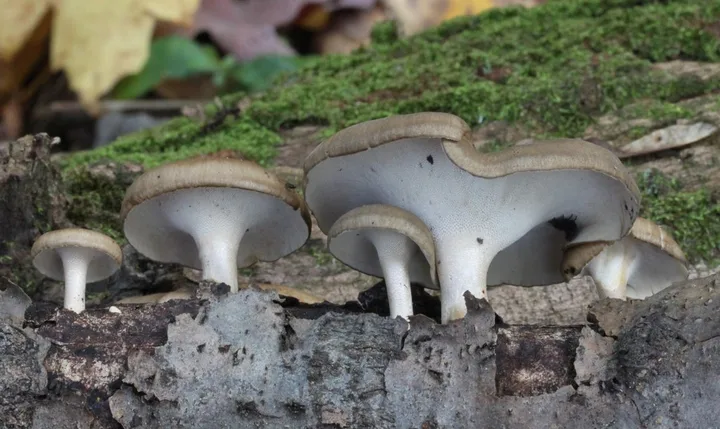
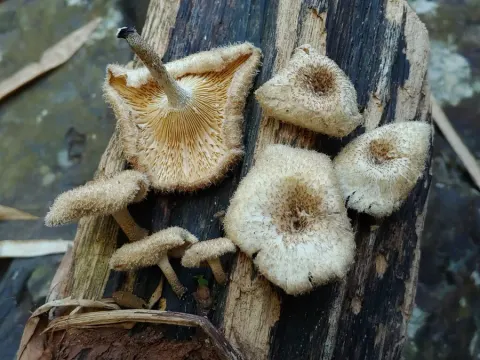
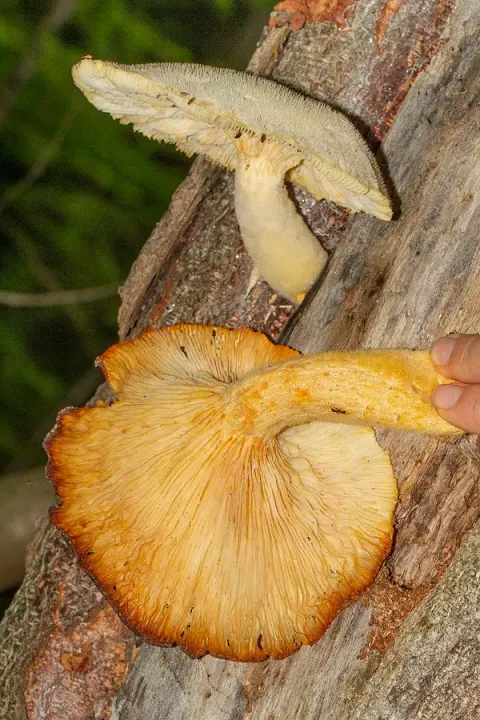
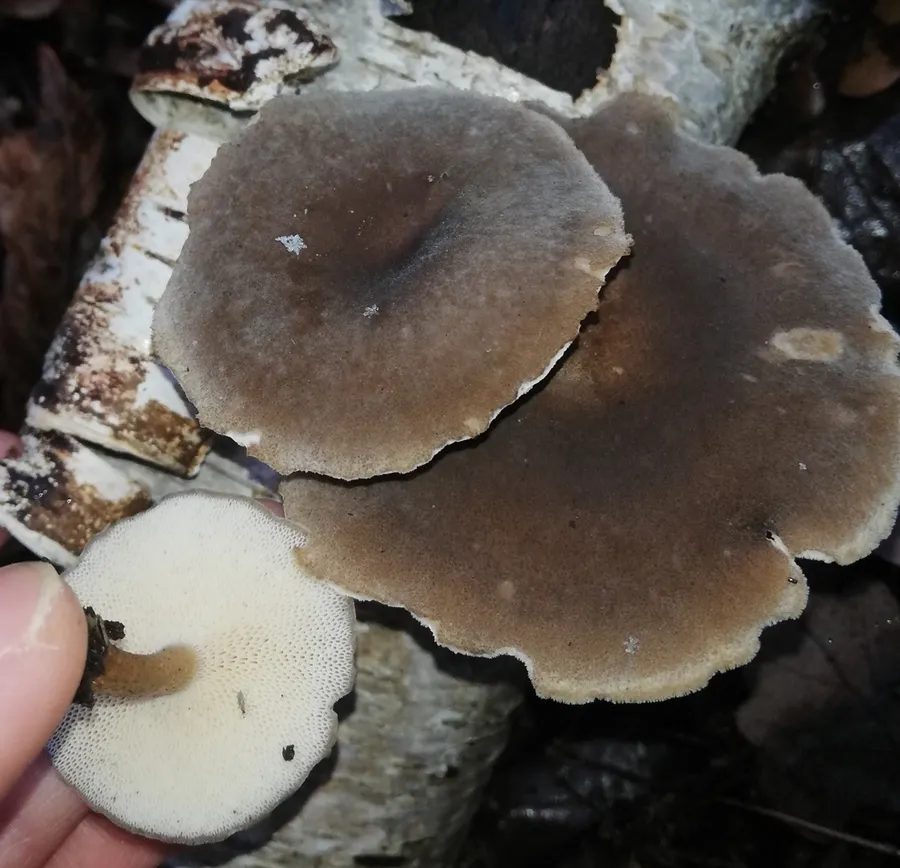
Lentinus brumalis has a round, broadly convex cap that has a diameter of 1.5 to 10 cm and is 0.5 cm thick. It is depressed in the middle and somewhat zoned. The surface of the cap is dry, though rarely hairy. It ranges from yellow-brown to dark brown in colour. The margin of the cap is often inrolled, particularly in young specimens. There are 3 mm deep pores on the white to cream underside of the cap. They are spaced 2-4 pores per mm2. They change in appearance from dull to lustrous when the orientation to light is changed. The spore print is white. The stalk is 2.5 to 4 cm long and 2–5 mm thick. It is gray to brown, occasionally with red tints and is generally lighter than the cap. Its dry surface is either smooth or finely felted to slightly scaly. The flesh is white and its consistency is tender to elastic. It does not have a particular taste or odour. The spores are elliptic to cylindrical and measure 5–7 × 1.5–2.5 μm. They are smooth inamyloid, not changing colour when mounted with iodine. KOH does not affect the colour of any parts of this fungi (negative reaction). When stained by guiaic gum, the flesh turns blue, over a period of 6–12 hours.

Sebagian uraian ditampilkan dalam bahasa sumber; terjemahannya belum tersedia atau belum lolos pemeriksaan.

Rujukan: [1]

Pengukuran mengikuti objek, spesimen atau kultur, dan metode yang disebutkan sumber. Baca uraian asli untuk konteks lengkap.

02 / Kehidupan

Habitat dan peran ekologis

It is saprotrophic on dead hardwoods, in particular, birch, beech and mountain ash, though in rare cases it grows on conifers such as hemlock and fir. In Uzbekistan, it grows on European nettle, willow and poplar trees as well. Tumbuh sendiri atau dalam kelompok kecil. Di Amerika Utara, Lentinus brumalis lebih umum di timur, di mana tumbuh June through Oktober. Di Eropa Utara, bagaimanapun, buahnya pada akhir Oktober, dan Maret.

Sebagian uraian ditampilkan dalam bahasa sumber; terjemahannya belum tersedia atau belum lolos pemeriksaan.

Rujukan: [1]

Habitat atau konteks temuan
Informasi belum tersedia pada sumber rilis ini.
Substrat
Informasi belum tersedia pada sumber rilis ini.
Peran atau konteks
Pengurai
Temukan hubungan serupa
03 / Siklus hidup

Reproduksi

There are 3 mm deep pores on the white to cream underside of the cap. They are spaced 2-4 pores per mm2. They change in appearance from dull to lustrous when the orientation to light is changed. The spore print is white. The spores are elliptic to cylindrical and measure 5–7 × 1.5–2.5 μm. They are smooth inamyloid, not changing colour when mounted with iodine.

Sebagian uraian ditampilkan dalam bahasa sumber; terjemahannya belum tersedia atau belum lolos pemeriksaan.

Rujukan: [1]

Sinonim menurut acuan taksonomi rilis: Boletus brumalis; Boletus brumalis var. fasciculatus; Boletus brumalis var. vernus; Boletus ciliatus; Boletus fasciculatus; Boletus fuscidulus; Boletus hypocrateriformis; Favolus apiahynus; Leucoporus brumalis; Leucoporus brumalis f. crassior; Leucoporus brumalis f. gracilis; Leucoporus brumalis f. rubripes; Leucoporus brumalis f. vernalis; Leucoporus brumalis var. vernalis; Leucoporus fuscidulus; Leucoporus rubripes; Leucoporus vernalis; Microporus substriatus; Polyporellus brumalis; Polyporellus brumalis f. trachypus; Polyporellus brumalis f. velatus; Polyporellus fuscidulus; Polyporus brumalis; Polyporus brumalis f. subarcularius; Polyporus brumalis var. megaloporus; Polyporus brumalis var. megalosporus; Polyporus brumalis var. nanus; Polyporus brumalis var. radicosus; Polyporus brumalis var. vernalis; Polyporus cyathoides; Polyporus fuscidulus; Polyporus luridus; Polyporus nanus; Polyporus pauperculus; Polyporus queletianus; Polyporus rubripes; Polyporus subarcularius; Polyporus substriatus; Polyporus tucumanensis; Polyporus vernalis; Polystictus substriatus
04 / Batas informasi

Catatan identitas dan cakupan

  • Nama diterima mengikuti Catalogue of Life Base2026-09-11; uraian mempertahankan konsep dan nama sumber aslinya.
  • Original geographic, specimen and life-cycle scope retained; source import awaits individual editorial review.
  • Impor dan terjemahan otomatis belum diperiksa editorial per profil. Struktur reproduktif yang disebutkan tidak membuktikan seluruh siklus hidup diketahui.
  • Pengukuran pada uraian mengikuti spesimen, kultur, dan metode sumber; angka tidak diperluas ke semua populasi.

Catatan distribusi dalam narasi mengikuti sumbernya. Dokumentasi spesimen atau foto mengikuti catatan sumber. Bukti wilayah Indonesia dan penilaian konservasi tidak disimpulkan dari gambar.

05 / Dokumentasi

Melihat dengan konteks

Dokumentasi Lentinus brumalis menurut asosiasi foto pada record takson iNaturalist. Kredit: Thomas. Identitas mengikuti sumber; bukan penentuan spesimen independen.

Jenis
Fotografi
Kredit
no rights reserved, uploaded by Thomas
Lisensi
CC0 1.0
Sumber media
Buka entri sumber

Gambar menunjukkan objek menurut identifikasi sumber, bukan verifikasi independen spesimen oleh Fungi. Tidak ada skala baru yang ditambahkan.

Dokumentasi tambahan

06 / Rujukan

Sumber profil

  1. [1] Lentinus brumalis — Wikipedia (en)Bagian sumber: Frozen revision 1365850757
    Tanggal penghimpunan sumber: 2026-10-12
    Teks sumber: CC BY-SA4.0 · Wikipedia contributors
  2. [2] Catalogue of Life Base2026-09-11 — Lentinus brumalisBagian sumber: ColDP NameUsage.tsv ID 3T5MH; accepted species; source 2073
    Tanggal penghimpunan sumber: 2026-10-12
  3. [3] Dokumentasi visual — Lentinus brumalisBagian sumber: Identitas mengikuti sumber dokumentasi; bukan penentuan spesimen independen.
    Tanggal penghimpunan sumber: 2026-10-17
    Media sumber: CC0 1.0 · no rights reserved, uploaded by Thomas
  4. [4] Dokumentasi visual — Lentinus brumalisBagian sumber: Identitas mengikuti sumber dokumentasi; bukan penentuan spesimen independen.
    Tanggal penghimpunan sumber: 2026-10-17
    Teks sumber: CC BY-SA 4.0 · (c) Fluff Berger, some rights reserved (CC BY-SA), uploaded by Fluff Berger

Adaptasi teks: CC BY-SA 4.0. Wikipedia contributors — Lentinus brumalis — Wikipedia (en)

Uraian asli dan riwayat sumber

Riwayat atau halaman sumber

Ringkasan sumber

Lentinus brumalis has a round, broadly convex cap that has a diameter of 1.5 to 10 cm and is 0.5 cm thick. It is depressed in the middle and somewhat zoned. The surface of the cap is dry, though rarely hairy. It ranges from yellow-brown to dark brown in colour. The margin of the cap is often inrolled, particularly in young specimens. There are 3 mm deep pores on the white to cream underside of the cap. They are spaced 2-4 pores per mm2. They change in appearance from dull to lustrous when the orientation to light is changed.

Revisi sumber

Morfologi sumber

Lentinus brumalis has a round, broadly convex cap that has a diameter of 1.5 to 10 cm and is 0.5 cm thick. It is depressed in the middle and somewhat zoned. The surface of the cap is dry, though rarely hairy. It ranges from yellow-brown to dark brown in colour. The margin of the cap is often inrolled, particularly in young specimens. There are 3 mm deep pores on the white to cream underside of the cap. They are spaced 2-4 pores per mm2. They change in appearance from dull to lustrous when the orientation to light is changed. The spore print is white. The stalk is 2.5 to 4 cm long and 2–5 mm thick. It is gray to brown, occasionally with red tints and is generally lighter than the cap. Its dry surface is either smooth or finely felted to slightly scaly. The flesh is white and its consistency is tender to elastic. It does not have a particular taste or odour. The spores are elliptic to cylindrical and measure 5–7 × 1.5–2.5 μm. They are smooth inamyloid, not changing colour when mounted with iodine. KOH does not affect the colour of any parts of this fungi (negative reaction). When stained by guiaic gum, the flesh turns blue, over a period of 6–12 hours.

Revisi sumber

Ekologi sumber

It is saprotrophic on dead hardwoods, in particular, birch, beech and mountain ash, though in rare cases it grows on conifers such as hemlock and fir. In Uzbekistan, it grows on European nettle, willow and poplar trees as well. It grows solitary or in small groups. In North America, Lentinus brumalis is more common in the east, where it grows June through October. In Northern Europe, however it fruits in late October, and March.

Revisi sumber

Struktur reproduksi sumber

There are 3 mm deep pores on the white to cream underside of the cap. They are spaced 2-4 pores per mm2. They change in appearance from dull to lustrous when the orientation to light is changed. The spore print is white. The spores are elliptic to cylindrical and measure 5–7 × 1.5–2.5 μm. They are smooth inamyloid, not changing colour when mounted with iodine.

Revisi sumber

Rujukan halaman ini

Fungi. Lentinus brumalis. Rilis data fungi-2026-10-12-expansion-2. https://fungi-atlas.mgadib.chatgpt.site/jamur/lentinus-brumalis/.

Status: impor sumber; pemeriksaan editorial per profil belum selesai. Untuk klaim biologis, gunakan rujukan pada bagian terkait dan periksa konteks sumber aslinya.