Ciri dan struktur
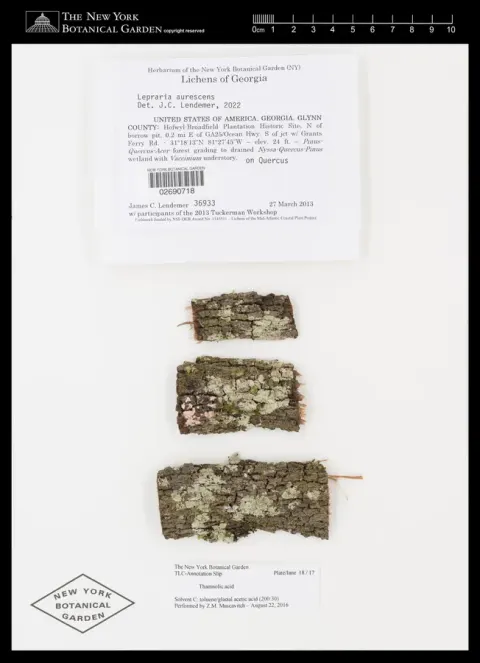
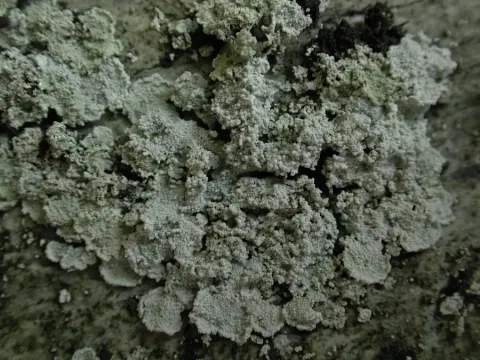
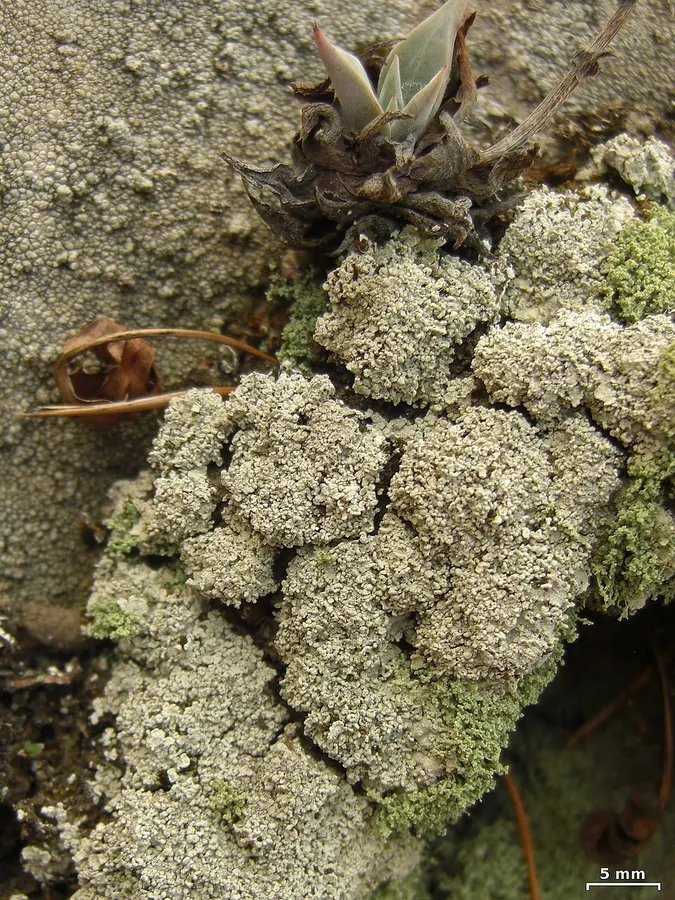
Lepraria xerophila has a thallus that is highly variable, usually (crust-like) and rarely (scaly). It forms compact, defined rosettes up to 2 cm in diameter, with marginal that are 2 to 3 millimeters (mm) wide and about 0.3 mm thick, having rounded tips and a distinctly raised margin up to 0.5 mm thick. These rosettes often merge with other neighbouring thalli to create a coarse, irregularly spreading, nearly continuous crust that can extend up to a decimeter or more in width. The upper surface of the thallus ranges from whitish-gray to pale yellowish-gray, with a texture that varies from smooth to rough. It supports numerous fragile (small lobes) that can be horizontal to vertical, regular to irregular, and easily detached. These lobules act as diaspores (reproductive structures) and evolve partly by budding off from the lobe margins, partly from the upper surface, and possibly from disintegrating lobes. Soredia (powdery reproductive structures) are few or absent. In thick specimens, the medulla (inner layer) is distinct and white. The (photosynthetic partner) is organized in roughly spherical groups, 24–50 μm in diameter, within the diaspores and forms a nearly continuous layer just beneath the thallus surface. The lower surface is whitish-gray and lacks a tomentum (a covering of fine hairs). Spot tests on this lichen yield the following results: K−, C−, KC−, and P+. The secondary metabolites present in Lepraria xerophila vary by chemotype. Chemotype I (most specimens) contains minor atranorin, major pannaric acid 6-methyl ester, usually major roccellic or rangiformic acids, and possibly trace amounts of methyl porphyrilate, pannaric, and porphyrilic acids.
Habitat dan peran ekologis
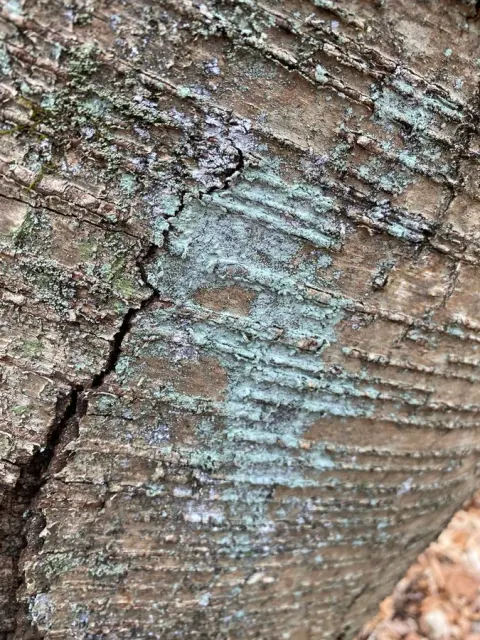
Lepraria xerophila typically grows on dry soil, though it is occasionally found on bare rock and on wood. It thrives in various habitats including grasslands, coastal scrubland, chaparral, and areas transitioning to desert. It is also present in mixed oak-chaparral-pasture regions and oak forests. Geographically, this lichen is found in Europe, where only chemotype I is present. In North America, it is distributed along the Pacific coast, from Mexico up to Marin County, California.
- Habitat atau konteks temuan
- hutan; padang rumput
- Substrat
- kayu
- Peran atau konteks
- Pembentuk liken
Reproduksi
The upper surface of the thallus ranges from whitish-gray to pale yellowish-gray, with a texture that varies from smooth to rough. It supports numerous fragile (small lobes) that can be horizontal to vertical, regular to irregular, and easily detached. These lobules act as diaspores (reproductive structures) and evolve partly by budding off from the lobe margins, partly from the upper surface, and possibly from disintegrating lobes. Soredia (powdery reproductive structures) are few or absent.
Catatan identitas dan cakupan
- Nama diterima mengikuti Catalogue of Life Base2026-09-11; uraian mempertahankan konsep dan nama sumber aslinya.
- Original geographic, specimen and life-cycle scope retained; source import awaits individual editorial review.
- Impor dan terjemahan otomatis belum diperiksa editorial per profil. Struktur reproduktif yang disebutkan tidak membuktikan seluruh siklus hidup diketahui.
- Pengukuran pada uraian mengikuti spesimen, kultur, dan metode sumber; angka tidak diperluas ke semua populasi.
Catatan distribusi dalam narasi mengikuti sumbernya. Dokumentasi spesimen atau foto mengikuti catatan sumber. Bukti wilayah Indonesia dan penilaian konservasi tidak disimpulkan dari gambar.
Melihat dengan konteks
Dokumentasi Lepraria xerophila dari Wikimedia Commons. Conejo Mountain, Santa Monica Mountains, southern California, 20111019 Identifikasi mengikuti record berkas sumber.
- Jenis
- Fotografi
- Kredit
- Jason Hollinger
- Lisensi
- CC BY 2.0
- Sumber media
- Buka entri sumber
Sumber profil
- [1] Lepraria xerophila — Wikipedia (en)
- [2] Catalogue of Life Base2026-09-11 — Lepraria xerophila
- [3] Dokumentasi visual — Lepraria xerophila
Rujukan halaman ini
Fungi. Lepraria xerophila. Rilis data fungi-2026-10-12-expansion-2. https://fungi-atlas.mgadib.chatgpt.site/jamur/lepraria-xerophila/.
Status: impor sumber; pemeriksaan editorial per profil belum selesai. Untuk klaim biologis, gunakan rujukan pada bagian terkait dan periksa konteks sumber aslinya.