01 / Morfologi

Ciri dan struktur

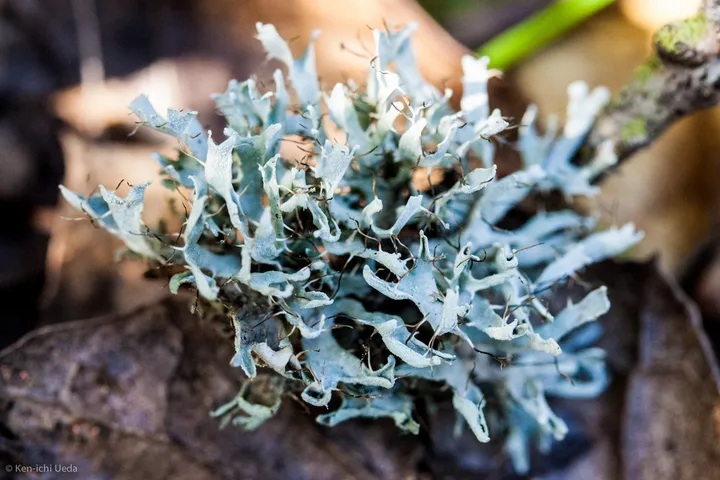
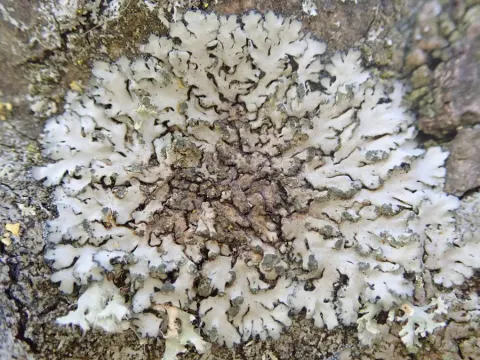
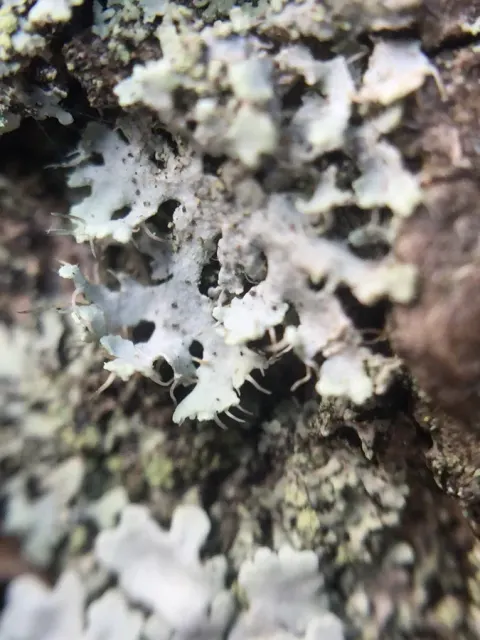
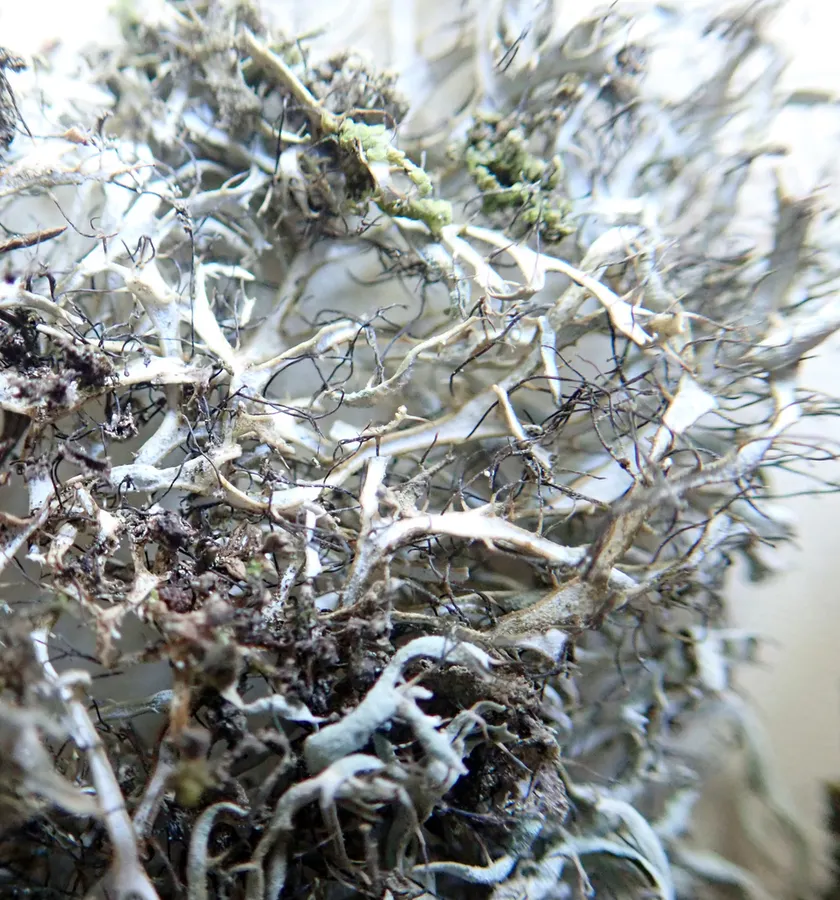
Leucodermia leucomelos has a foliose to somewhat fruticose thallus that grows loosely attached or partly free from its substrate in a characteristic leucomelos-growth form, forming loose circular patterns (rosettes) or tangled mats 5 – 15 cm wide. The thallus consists of elongated, narrow 0.5 – 4 mm wide that branch and bear long, typically branched, dark marginal . The upper surface is whitish to cream-coloured, smooth and somewhat shiny; the lower surface is usually white, sometimes pale to pinkish brown and rarely purple, and lacks a cortex except at the margins as well as rhizines, appearing (cobwebby) to woolly or powdery. Soredia are variably developed, typically arising on the distal portion of the lower surface which becomes exposed as the lobes curl upwards. The species rarely produces apothecia; when present they are (with a ), subterminal and somewhat stalked, and measure about 2 – 5 mm across with margins ranging from to and with small triangular lobules up to 3 mm long. The is dark brown to black and may be pruinose. The asci are club-shaped () and eight-spored with a Lecanora-type structure and characteristic iodine reactions; the are brown, ellipsoid and 1-septate, measuring 30–50 x 15–23 μm, and show Polyblastidium-type development with sporoblastidia. Pycnidia are rare and immersed, producing hyaline bacilliform conidia measuring 4–5 x 1 μm. The photobiont is a green alga.

Sebagian uraian ditampilkan dalam bahasa sumber; terjemahannya belum tersedia atau belum lolos pemeriksaan.

Rujukan: [1]

Pengukuran mengikuti objek, spesimen atau kultur, dan metode yang disebutkan sumber. Baca uraian asli untuk konteks lengkap.

02 / Kehidupan

Habitat dan peran ekologis

The North American range of Leucodermia leucomelos extends from Belleville, Ontario in the north, south to Mexico. The lichen grows in select locations spanning the central/southern Appalachian Mountains down to Florida and stretches along the North American west coast from Vancouver Island through Mexico and into Central America. Despite its broad distribution, it is not regarded as a particularly common lichen in North America. In Ontario, Canada, it was recorded for the first time in over 150 years in 2019. In the Azores, where it is abundant, it grows on sunny coastal rocks and walls to mossy trees in the moist cloud forest to elevations of 1000 m. In Afromontane forests of South Africa, L. leucomelos occurs at altitudes between 1500 and 1600 metres, where it experiences a climate characterized by warm, wet summers and dry, cold winters with temperatures reaching freezing. In these habitats, the species shows particular affinity for Leucosidea sericea, though it can colonise various other tree species. In the Pacific Northwest of North America, Leucodermia leucomelos is a rare coastal lichen. It grows in forested dunes, marine terraces, and headlands up to elevations of 250 m. It is located within 4 km of the coast, specifically in the marine fog belt stretching from Point Reyes near San Francisco to the boundary of Oregon and Washington.

Sebagian uraian ditampilkan dalam bahasa sumber; terjemahannya belum tersedia atau belum lolos pemeriksaan.

Rujukan: [1]

Habitat atau konteks temuan
hutan
Substrat
Informasi belum tersedia pada sumber rilis ini.
Peran atau konteks
Pembentuk liken
Temukan hubungan serupa
03 / Siklus hidup

Reproduksi

Leucodermia leucomelos has a foliose to somewhat fruticose thallus that grows loosely attached or partly free from its substrate in a characteristic leucomelos-growth form, forming loose circular patterns (rosettes) or tangled mats 5 – 15 cm wide. The thallus consists of elongated, narrow 0.5 – 4 mm wide that branch and bear long, typically branched, dark marginal . The upper surface is whitish to cream-coloured, smooth and somewhat shiny; the lower surface is usually white, sometimes pale to pinkish brown and rarely purple, and lacks a cortex except at the margins as well as rhizines, appearing (cobwebby) to woolly or powdery. Soredia are variably developed, typically arising on the distal portion of the lower surface which becomes exposed as the lobes curl upwards.

Sebagian uraian ditampilkan dalam bahasa sumber; terjemahannya belum tersedia atau belum lolos pemeriksaan.

Rujukan: [1]

Sinonim menurut acuan taksonomi rilis: Anaptychia albociliata; Anaptychia leucomelos; Anaptychia leucomelos f. albociliata; Anaptychia ophioglossa f. albociliata; Borrera leucomelos; Hagenia leucomelos; Heterodermia leucomelos; Heterodermia leucomelos f. albociliata; Lichen leucomelos; Lobaria leucomelos; Parmelia leucomelos; Parmelia speciosa var. leucomelos; Physcia leucomelos; Physcia speciosa subsp. leucomelos; Physcia speciosa var. leucomelos; Teloschistes leucomelos; Xanthoria leucomelos
04 / Batas informasi

Catatan identitas dan cakupan

  • Nama diterima mengikuti Catalogue of Life Base2026-09-11; uraian mempertahankan konsep dan nama sumber aslinya.
  • Original geographic, specimen and life-cycle scope retained; source import awaits individual editorial review.
  • Impor dan terjemahan otomatis belum diperiksa editorial per profil. Struktur reproduktif yang disebutkan tidak membuktikan seluruh siklus hidup diketahui.
  • Pengukuran pada uraian mengikuti spesimen, kultur, dan metode sumber; angka tidak diperluas ke semua populasi.

Catatan distribusi dalam narasi mengikuti sumbernya. Dokumentasi spesimen atau foto mengikuti catatan sumber. Bukti wilayah Indonesia dan penilaian konservasi tidak disimpulkan dari gambar.

05 / Dokumentasi

Melihat dengan konteks

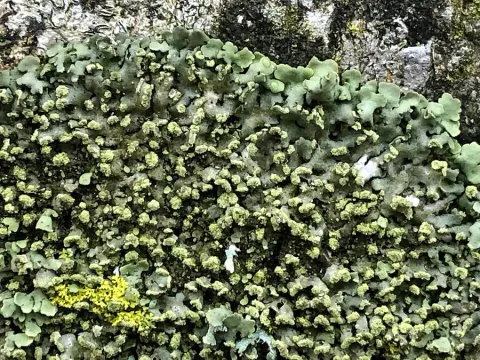
Dokumentasi Heterodermia leucomelos menurut asosiasi foto pada record takson iNaturalist. Kredit: Peter de Lange. Identitas mengikuti sumber; bukan penentuan spesimen independen.

Jenis
Fotografi
Kredit
no rights reserved, uploaded by Peter de Lange
Lisensi
CC0 1.0
Sumber media
Buka entri sumber

Gambar menunjukkan objek menurut identifikasi sumber, bukan verifikasi independen spesimen oleh Fungi. Tidak ada skala baru yang ditambahkan.

Dokumentasi tambahan

06 / Rujukan

Sumber profil

  1. [1] Leucodermia leucomelos — Wikipedia (en)Bagian sumber: Frozen revision 1330478238
    Tanggal penghimpunan sumber: 2026-10-12
    Teks sumber: CC BY-SA4.0 · Wikipedia contributors
  2. [2] Catalogue of Life Base2026-09-11 — Leucodermia leucomelosBagian sumber: ColDP NameUsage.tsv ID 6Q59X; accepted species; source 2073
    Tanggal penghimpunan sumber: 2026-10-12
  3. [3] Dokumentasi visual — Leucodermia leucomelosBagian sumber: Identitas mengikuti sumber dokumentasi; bukan penentuan spesimen independen.
    Tanggal penghimpunan sumber: 2026-10-17
    Media sumber: CC0 1.0 · no rights reserved, uploaded by Peter de Lange
  4. [4] Dokumentasi visual — Leucodermia leucomelosBagian sumber: Identitas mengikuti sumber dokumentasi; bukan penentuan spesimen independen.
    Tanggal penghimpunan sumber: 2026-10-17
    Teks sumber: CC BY 4.0 · (c) Ken-ichi Ueda, some rights reserved (CC BY)

Adaptasi teks: CC BY-SA 4.0. Wikipedia contributors — Leucodermia leucomelos — Wikipedia (en)

Uraian asli dan riwayat sumber

Riwayat atau halaman sumber

Ringkasan sumber

Leucodermia leucomelos is a species of fruticose lichen in the family Physciaceae, and the type species of the genus Leucodermia. This species is widely distributed in tropical, subtropical, and warm temperate regions, where it grows on both trees and rock faces. The species forms pale, narrow branches 4 – 8 cm long that divide repeatedly as they grow. The cream-coloured to whitish branches have distinctive long, dark hairs () along their edges, and typically grow in loose clusters on trees or rocks.

Revisi sumber

Morfologi sumber

Leucodermia leucomelos has a foliose to somewhat fruticose thallus that grows loosely attached or partly free from its substrate in a characteristic leucomelos-growth form, forming loose circular patterns (rosettes) or tangled mats 5 – 15 cm wide. The thallus consists of elongated, narrow 0.5 – 4 mm wide that branch and bear long, typically branched, dark marginal . The upper surface is whitish to cream-coloured, smooth and somewhat shiny; the lower surface is usually white, sometimes pale to pinkish brown and rarely purple, and lacks a cortex except at the margins as well as rhizines, appearing (cobwebby) to woolly or powdery. Soredia are variably developed, typically arising on the distal portion of the lower surface which becomes exposed as the lobes curl upwards. The species rarely produces apothecia; when present they are (with a ), subterminal and somewhat stalked, and measure about 2 – 5 mm across with margins ranging from to and with small triangular lobules up to 3 mm long. The is dark brown to black and may be pruinose. The asci are club-shaped () and eight-spored with a Lecanora-type structure and characteristic iodine reactions; the are brown, ellipsoid and 1-septate, measuring 30–50 x 15–23 μm, and show Polyblastidium-type development with sporoblastidia. Pycnidia are rare and immersed, producing hyaline bacilliform conidia measuring 4–5 x 1 μm. The photobiont is a green alga.

Revisi sumber

Ekologi sumber

The North American range of Leucodermia leucomelos extends from Belleville, Ontario in the north, south to Mexico. The lichen grows in select locations spanning the central/southern Appalachian Mountains down to Florida and stretches along the North American west coast from Vancouver Island through Mexico and into Central America. Despite its broad distribution, it is not regarded as a particularly common lichen in North America. In Ontario, Canada, it was recorded for the first time in over 150 years in 2019. In the Azores, where it is abundant, it grows on sunny coastal rocks and walls to mossy trees in the moist cloud forest to elevations of 1000 m. In Afromontane forests of South Africa, L. leucomelos occurs at altitudes between 1500 and 1600 metres, where it experiences a climate characterized by warm, wet summers and dry, cold winters with temperatures reaching freezing. In these habitats, the species shows particular affinity for Leucosidea sericea, though it can colonise various other tree species. In the Pacific Northwest of North America, Leucodermia leucomelos is a rare coastal lichen. It grows in forested dunes, marine terraces, and headlands up to elevations of 250 m. It is located within 4 km of the coast, specifically in the marine fog belt stretching from Point Reyes near San Francisco to the boundary of Oregon and Washington.

Revisi sumber

Struktur reproduksi sumber

Leucodermia leucomelos has a foliose to somewhat fruticose thallus that grows loosely attached or partly free from its substrate in a characteristic leucomelos-growth form, forming loose circular patterns (rosettes) or tangled mats 5 – 15 cm wide. The thallus consists of elongated, narrow 0.5 – 4 mm wide that branch and bear long, typically branched, dark marginal . The upper surface is whitish to cream-coloured, smooth and somewhat shiny; the lower surface is usually white, sometimes pale to pinkish brown and rarely purple, and lacks a cortex except at the margins as well as rhizines, appearing (cobwebby) to woolly or powdery. Soredia are variably developed, typically arising on the distal portion of the lower surface which becomes exposed as the lobes curl upwards.

Revisi sumber

Rujukan halaman ini

Fungi. Leucodermia leucomelos. Rilis data fungi-2026-10-12-expansion-2. https://fungi-atlas.mgadib.chatgpt.site/jamur/leucodermia-leucomelos/.

Status: impor sumber; pemeriksaan editorial per profil belum selesai. Untuk klaim biologis, gunakan rujukan pada bagian terkait dan periksa konteks sumber aslinya.