01 / Morfologi

Ciri dan struktur

Thallus crustose, grey, matt, thin (at the margin) or more usually thick, continuous or cracked, slightly folded at least the margins, later areolate-verrucose to tuberculate (sometimes only part of the thallus tuberculate). Areoles usually strongly convex, tuberculate and constricted at the base or resembling coarse isidia, sometimes pustulate, dispersed or aggregated. Soralia whitish to greenish-grey, flat or more often convex, rounded or more often irregular, bursting from the top of areoles, often fused and tending to coalesce locally on the thallus or covering most parts of the thallus, sometimes developing from irregular cracks of the thallus. Soredia up to 60 µm in diam., often in consoredia up to 120 µm wide. Apothecia rare, up to 1.2 mm in diam., single or grouped up to five apothecia. Thalline margin present in young apothecia, smooth to flexuose, verrucose or dentate, sometimes with small soralia, later excluded. Excipulum proprium thin, flesh-coloured to white grey in surface view, orange-brown in section, smooth or more often flexuous, up to 100 µm wide in section. Disc reddish-brown, thinly white pruinose. Hymenium up to 125 µm high. Epihymenium straw-brown (K+ pale reddish-brown), with dense granules dissolving in K. Paraphyses not capitate, sometimes anastomosing. Asci 8-spored, with uniformly KI+ blue apical dome. Ascospores 0–5-septate, spiralled in asci, hyaline, fusiform, curved, 35–53(–64) × 4.5–6.5(–7) µm. Pycnidia not known. Photobiont chlorococcoid, cells up to 12 µm in diam.

Sebagian uraian ditampilkan dalam bahasa sumber; terjemahannya belum tersedia atau belum lolos pemeriksaan.

Rujukan: [1]

Pengukuran mengikuti objek, spesimen atau kultur, dan metode yang disebutkan sumber. Baca uraian asli untuk konteks lengkap.

02 / Kehidupan

Habitat dan peran ekologis

The species is corticolous or lignicolous and grows on bark of various coniferous and deciduous tree in forests. The species was reported from many countries in the Northern Hemisphere; however, as some records may belong to L. chloropolia, its distribution needs revision. In the course of this study, we examined specimens from Austria, Czechia, Estonia, Finland, Latvia, Lithuania, Poland, Slovakia, United Kingdom, Ukraine and USA.

Sebagian uraian ditampilkan dalam bahasa sumber; terjemahannya belum tersedia atau belum lolos pemeriksaan.

Rujukan: [1]

Habitat atau konteks temuan
hutan
Substrat
kulit kayu
Peran atau konteks
Pembentuk liken
Temukan hubungan serupa
03 / Siklus hidup

Reproduksi

Thallus crustose, grey, matt, thin (at the margin) or more usually thick, continuous or cracked, slightly folded at least the margins, later areolate-verrucose to tuberculate (sometimes only part of the thallus tuberculate). Areoles usually strongly convex, tuberculate and constricted at the base or resembling coarse isidia, sometimes pustulate, dispersed or aggregated. Soralia whitish to greenish-grey, flat or more often convex, rounded or more often irregular, bursting from the top of areoles, often fused and tending to coalesce locally on the thallus or covering most parts of the thallus, sometimes developing from irregular cracks of the thallus. Soredia up to 60 µm in diam., often in consoredia up to 120 µm wide.

Sebagian uraian ditampilkan dalam bahasa sumber; terjemahannya belum tersedia atau belum lolos pemeriksaan.

Rujukan: [1]

Sinonim menurut acuan taksonomi rilis: Haematomma elatinum; Lecania elatina; Lecanora elatina; Lecidea incana var. elatina; Lichen peltatus elatina; Parmelia elatina; Patellaria elatina; Scleromium elatinum; Zeora elatina
04 / Batas informasi

Catatan identitas dan cakupan

  • Nama diterima mengikuti Catalogue of Life Base2026-09-11; uraian mempertahankan konsep dan nama sumber aslinya.
  • Preserve original treatment localities, hosts and substrate scope. Materials examined describe documented specimens, not the full global range.
  • Impor dan terjemahan otomatis belum diperiksa editorial per profil. Struktur reproduktif yang disebutkan tidak membuktikan seluruh siklus hidup diketahui.
  • Pengukuran pada uraian mengikuti spesimen, kultur, dan metode sumber; angka tidak diperluas ke semua populasi.

Catatan distribusi dalam narasi mengikuti sumbernya. Dokumentasi spesimen atau foto mengikuti catatan sumber. Bukti wilayah Indonesia dan penilaian konservasi tidak disimpulkan dari gambar.

05 / Dokumentasi

Melihat dengan konteks

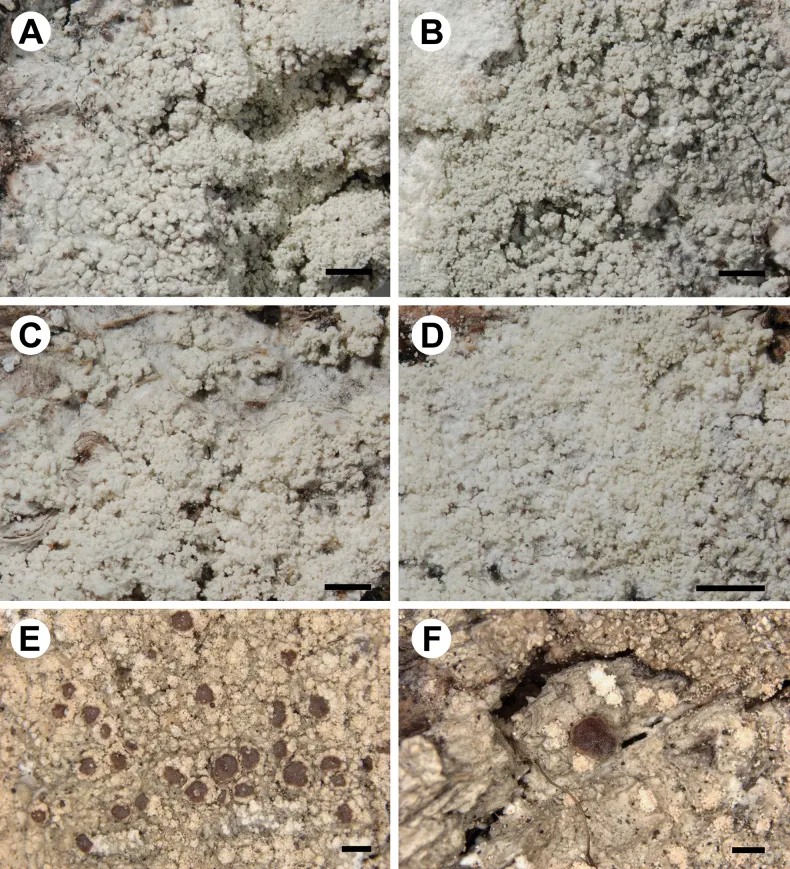
Morphology of Loxospora elatina (for details of specimens, see Table 1, Suppl. material 3) A, B thalli with tuberculate areoles and irregular and partly fused soralia (A UGDA L-47757 B UGDA L- 47762) C thallus with soralia bursting from areoles and later fused (UGDA L-47761) D soralia covering most parts of the thallus (UGDA L-47760) E, F apothecia with sorediate or esorediate margins (O L-97759). Scale bars: 1 mm.

Jenis
Pelat ilmiah
Kredit
Łucja Ptach-Styn, Beata Guzow-Krzemińska, James C. Lendemer, Tor Tønsberg, Martin Kukwa
Lisensi
CC BY 4.0
Sumber media
Buka entri sumber

Gambar menunjukkan objek menurut identifikasi sumber, bukan verifikasi independen spesimen oleh Fungi. Tidak ada skala baru yang ditambahkan.

06 / Rujukan

Sumber profil

  1. [1] Phylogeny of the genus Loxospora s.l. (Sarrameanales, Lecanoromycetes, Ascomycota), with Chicitaea gen. nov. and five new combinations in Chicitaea and Loxospora — Loxospora elatinaBagian sumber: PMC10897838_section_27
    Tanggal penghimpunan sumber: 2026-10-12
    Teks sumber: CC BY 4.0 · Ptach-Styn Ł, Guzow-Krzemińska B, Lendemer JC, Tønsberg T, Kukwa M.
  2. [2] Catalogue of Life Base2026-09-11 — Loxospora elatinaBagian sumber: ColDP NameUsage.tsv ID 6QNMJ; accepted species; source 2073
    Tanggal penghimpunan sumber: 2026-10-12
  3. [3] Dokumentasi visual — Loxospora elatinaBagian sumber: Individual media record; identification follows the source, not independent determination
    Tanggal penghimpunan sumber: 2026-10-12
    Media sumber: CC BY 4.0 · Łucja Ptach-Styn, Beata Guzow-Krzemińska, James C. Lendemer, Tor Tønsberg, Martin Kukwa

Adaptasi teks: CC BY 4.0. Ptach-Styn Ł, Guzow-Krzemińska B, Lendemer JC, Tønsberg T, Kukwa M. — Phylogeny of the genus Loxospora s.l. (Sarrameanales, Lecanoromycetes, Ascomycota), with Chicitaea gen. nov. and five new combinations in Chicitaea and Loxospora — Loxospora elatina

Uraian asli dan riwayat sumber

Riwayat atau halaman sumber

Ringkasan sumber

Thallus crustose, grey, matt, thin (at the margin) or more usually thick, continuous or cracked, slightly folded at least the margins, later areolate-verrucose to tuberculate (sometimes only part of the thallus tuberculate). Areoles usually strongly convex, tuberculate and constricted at the base or resembling coarse isidia, sometimes pustulate, dispersed or aggregated. Soralia whitish to greenish-grey, flat or more often convex, rounded or more often irregular, bursting from the top of areoles, often fused and tending to coalesce locally on the thallus or covering most parts of the thallus, sometimes developing from irregular cracks of the thallus.

Revisi sumber

Morfologi sumber

Thallus crustose, grey, matt, thin (at the margin) or more usually thick, continuous or cracked, slightly folded at least the margins, later areolate-verrucose to tuberculate (sometimes only part of the thallus tuberculate). Areoles usually strongly convex, tuberculate and constricted at the base or resembling coarse isidia, sometimes pustulate, dispersed or aggregated. Soralia whitish to greenish-grey, flat or more often convex, rounded or more often irregular, bursting from the top of areoles, often fused and tending to coalesce locally on the thallus or covering most parts of the thallus, sometimes developing from irregular cracks of the thallus. Soredia up to 60 µm in diam., often in consoredia up to 120 µm wide. Apothecia rare, up to 1.2 mm in diam., single or grouped up to five apothecia. Thalline margin present in young apothecia, smooth to flexuose, verrucose or dentate, sometimes with small soralia, later excluded. Excipulum proprium thin, flesh-coloured to white grey in surface view, orange-brown in section, smooth or more often flexuous, up to 100 µm wide in section. Disc reddish-brown, thinly white pruinose. Hymenium up to 125 µm high. Epihymenium straw-brown (K+ pale reddish-brown), with dense granules dissolving in K. Paraphyses not capitate, sometimes anastomosing. Asci 8-spored, with uniformly KI+ blue apical dome. Ascospores 0–5-septate, spiralled in asci, hyaline, fusiform, curved, 35–53(–64) × 4.5–6.5(–7) µm. Pycnidia not known. Photobiont chlorococcoid, cells up to 12 µm in diam.

Revisi sumber

Ekologi sumber

The species is corticolous or lignicolous and grows on bark of various coniferous and deciduous tree in forests. The species was reported from many countries in the Northern Hemisphere; however, as some records may belong to L. chloropolia, its distribution needs revision. In the course of this study, we examined specimens from Austria, Czechia, Estonia, Finland, Latvia, Lithuania, Poland, Slovakia, United Kingdom, Ukraine and USA.

Revisi sumber

Struktur reproduksi sumber

Thallus crustose, grey, matt, thin (at the margin) or more usually thick, continuous or cracked, slightly folded at least the margins, later areolate-verrucose to tuberculate (sometimes only part of the thallus tuberculate). Areoles usually strongly convex, tuberculate and constricted at the base or resembling coarse isidia, sometimes pustulate, dispersed or aggregated. Soralia whitish to greenish-grey, flat or more often convex, rounded or more often irregular, bursting from the top of areoles, often fused and tending to coalesce locally on the thallus or covering most parts of the thallus, sometimes developing from irregular cracks of the thallus. Soredia up to 60 µm in diam., often in consoredia up to 120 µm wide.

Revisi sumber

Rujukan halaman ini

Fungi. Loxospora elatina. Rilis data fungi-2026-10-12-expansion-2. https://fungi-atlas.mgadib.chatgpt.site/jamur/loxospora-elatina/.

Status: impor sumber; pemeriksaan editorial per profil belum selesai. Untuk klaim biologis, gunakan rujukan pada bagian terkait dan periksa konteks sumber aslinya.