Ciri dan struktur
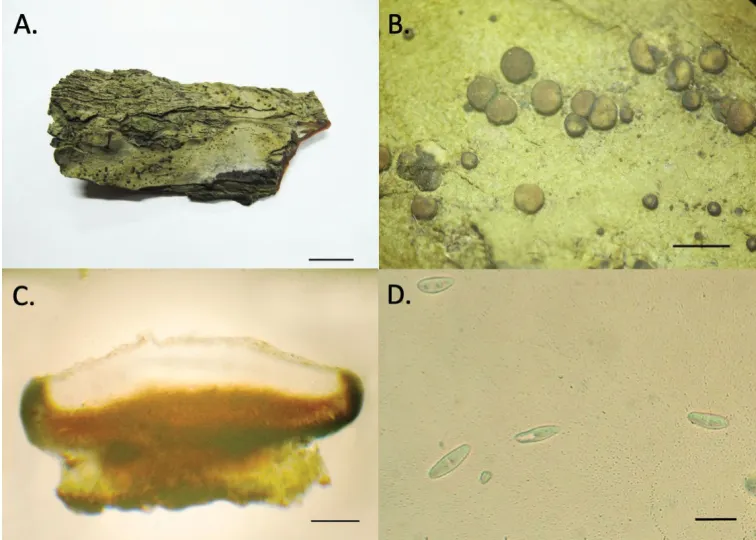
Similar to Megalaria bengalensis, but differs in an ochre to brownish apothecial disc (black in M. bengalensis) and in lacking isidia and secondary products (atranorin in M. bengalensis). Thallus crustose, corticolous, gray to olive-gray or greenish gray, up to 10 cm in diameter, smooth, cracked, without soredia or isidia. Apothecia biatorine, plain and flat, becoming slightly convex with age, circular in outline or becoming deformed, sessile, 0.3–0.8 mm in diameter; margins black, shining, contrasting strongly with the coloration of the discs; discs beige to brownish, epruinose. Epihymenium 2–5 μm thick, not pigmented or light beige, K–, N–. Hymenium 75–100 μm thick, hyaline, not inspersed. Subhymenium 10–20 μm thick, hyaline. Central hypothecium 50–80 μm thick, pigmented red-brown, K+ wine-red, N–; lateral hypothecium blue to blue-black, K–, N+ purple. Excipulum 15–25 μm thick, comprised of thick, gelatinized hyaline to blue hyphae, not inspersed with crystals, K–, N+ purple. Asci cylindrical to clavate, eight-spored; ascospores narrowly ellipsoid, hyaline, one-septate (rarely simple), thin walled, not halonate, (9–)11–15 × 4–5 μm. Pycnidia not seen. Secondary metabolites. Thallus K–, C–, and KC–, UV–, no lichen substances found using TLC.
Habitat dan peran ekologis
The new species was found in the south-eastern province of Chumphon where it was growing in old mangrove forests on the bark of Excoecaria agallocha, Hibiscus tiliaceus, Rhizophora apiculata, and Rhizophora mucronata.
- Habitat atau konteks temuan
- hutan
- Substrat
- Informasi belum tersedia pada sumber rilis ini.
- Peran atau konteks
- Pembentuk liken
Reproduksi
Similar to Megalaria bengalensis, but differs in an ochre to brownish apothecial disc (black in M. bengalensis) and in lacking isidia and secondary products (atranorin in M. bengalensis). Thallus crustose, corticolous, gray to olive-gray or greenish gray, up to 10 cm in diameter, smooth, cracked, without soredia or isidia. Apothecia biatorine, plain and flat, becoming slightly convex with age, circular in outline or becoming deformed, sessile, 0.3–0.8 mm in diameter; margins black, shining, contrasting strongly with the coloration of the discs; discs beige to brownish, epruinose. Epihymenium 2–5 μm thick, not pigmented or light beige, K–, N–. Hymenium 75–100 μm thick, hyaline, not inspersed.
Catatan identitas dan cakupan
- Nama diterima mengikuti Catalogue of Life Base2026-09-11; uraian mempertahankan konsep dan nama sumber aslinya.
- Preserve original treatment localities, hosts and substrate scope. Materials examined describe documented specimens, not the full global range.
- Impor dan terjemahan otomatis belum diperiksa editorial per profil. Struktur reproduktif yang disebutkan tidak membuktikan seluruh siklus hidup diketahui.
- Pengukuran pada uraian mengikuti spesimen, kultur, dan metode sumber; angka tidak diperluas ke semua populasi.
Catatan distribusi dalam narasi mengikuti sumbernya. Dokumentasi spesimen atau foto mengikuti catatan sumber. Bukti wilayah Indonesia dan penilaian konservasi tidak disimpulkan dari gambar.
Melihat dengan konteks
Megalaria pachaylenophila (RAMK 36122) A thallus B thallus and ascomata C apothecia cross section D ascospore. Photos by P. Phraphuchamnong. Scale bars: 1 cm (A); 0.5 mm (B); 200 µm (C); 10 µm (D).
- Jenis
- Pelat ilmiah
- Kredit
- Phimpisa Phraphuchamnong, Matthew P. Nelsen, Isabel Distefano, Joel A. Mercado-Diaz, Sittiporn Parnmen, Achariya Rangsiruji, Kawinnat Buaruang, Robert Lücking, H. Thorsten Lumbsch
- Lisensi
- CC BY 4.0
- Sumber media
- Buka entri sumber
Sumber profil
- [1] A new species of Megalaria (Ramalinaceae, Ascomycota) from Thailand, and recognition of subgenus Catillochroma — Megalaria pachaylenophila
- [2] Catalogue of Life Base2026-09-11 — Megalaria pachaylenophila
- [3] Dokumentasi visual — Megalaria pachaylenophila
Rujukan halaman ini
Fungi. Megalaria pachaylenophila. Rilis data fungi-2026-10-12-expansion-2. https://fungi-atlas.mgadib.chatgpt.site/jamur/megalaria-pachaylenophila/.
Status: impor sumber; pemeriksaan editorial per profil belum selesai. Untuk klaim biologis, gunakan rujukan pada bagian terkait dan periksa konteks sumber aslinya.