01 / Morfologi

Ciri dan struktur

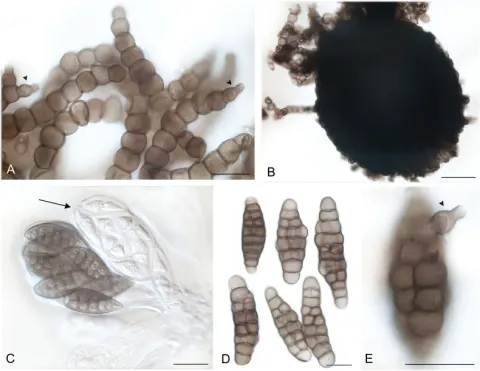
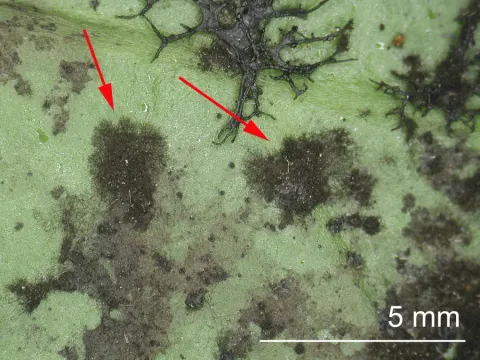
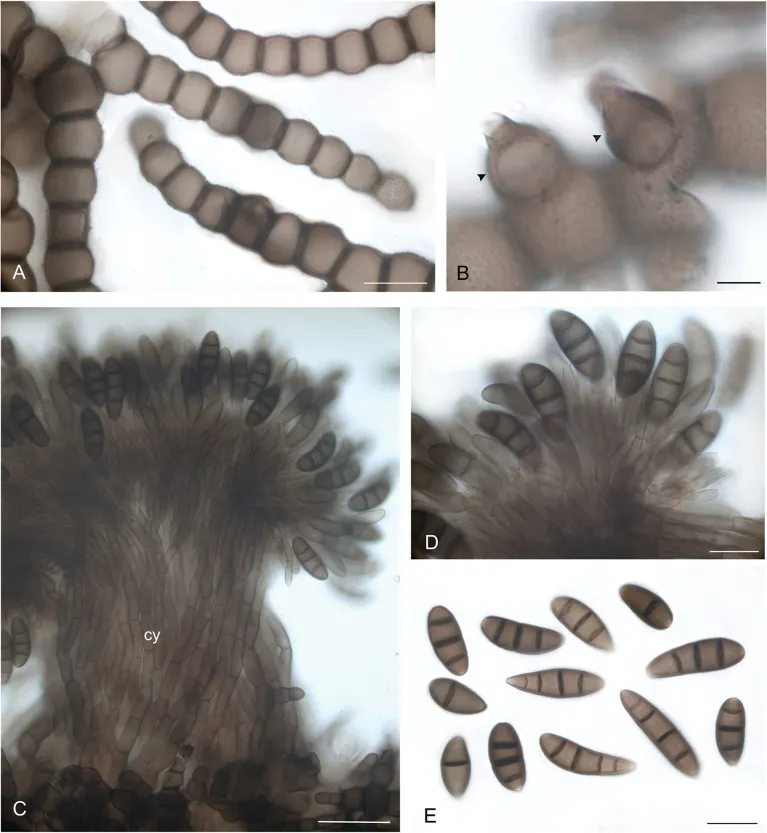
Subicula black, superficial, and thick. Hoerl (1939) describes subicula as 13–19 mm thick, and illustrates one extending more than 12 cm over a branch. Sexual form. Not observed. Asexual forms. Capnocybe – Synnemata sparse throughout the subicula, hyphae loosely compacted at their bases. The stipe is composed of fasciculate hyphae that are closely compacted with somewhat ellipsoidal to cylindrical cells, branching in a penicillate manner towards the apex. Conidia ellipsoid with a conspicuous clear area at their tips, 1–5, mostly 3–septate, dark brown. Conidia from OSC 135428, (30)–35.8–(38) +/– 3.0 × (9)–10.85–(12) +/– 1.3 µm, N = 20 (3–septate); OSC 61673 (25)–35–(39) +/– 3.9 × (9)–12–(14) +/– 1.0 µm, N = 18 (3–septate) 39–45 × 10.5–12 µm (4–septate). Capnophialophora – Phialides similar to M. ericophilum, collarettes subcylindrical rather than flaring.

Sebagian uraian ditampilkan dalam bahasa sumber; terjemahannya belum tersedia atau belum lolos pemeriksaan.

Rujukan: [1]

Pengukuran mengikuti objek, spesimen atau kultur, dan metode yang disebutkan sumber. Baca uraian asli untuk konteks lengkap.

02 / Kehidupan

Habitat dan peran ekologis

USA, California and Oregon, on branches of conifers Calocedrus decurrens, Chamaecyparis lawsoniana, Hesperocyparis sargentii (Hughes 1981).

Sebagian uraian ditampilkan dalam bahasa sumber; terjemahannya belum tersedia atau belum lolos pemeriksaan.

Rujukan: [1]

Habitat atau konteks temuan
Informasi belum tersedia pada sumber rilis ini.
Substrat
kayu
Peran atau konteks
Belum dikategorikan pada rilis ini.
Temukan hubungan serupa
03 / Siklus hidup

Reproduksi

Subicula black, superficial, and thick. Hoerl (1939) describes subicula as 13–19 mm thick, and illustrates one extending more than 12 cm over a branch. Sexual form. Not observed. Asexual forms. Capnocybe – Synnemata sparse throughout the subicula, hyphae loosely compacted at their bases. The stipe is composed of fasciculate hyphae that are closely compacted with somewhat ellipsoidal to cylindrical cells, branching in a penicillate manner towards the apex. Conidia ellipsoid with a conspicuous clear area at their tips, 1–5, mostly 3–septate, dark brown. Conidia from OSC 135428, (30)–35.8–(38) +/– 3.0 × (9)–10.85–(12) +/– 1.3 µm, N = 20 (3–septate); OSC 61673 (25)–35–(39) +/– 3.9 × (9)–12–(14) +/– 1.0 µm, N = 18 (3–septate) 39–45 × 10.5–12 µm (4–septate).

Sebagian uraian ditampilkan dalam bahasa sumber; terjemahannya belum tersedia atau belum lolos pemeriksaan.

Rujukan: [1]

04 / Batas informasi

Catatan identitas dan cakupan

  • Nama diterima mengikuti Catalogue of Life Base2026-09-11; uraian mempertahankan konsep dan nama sumber aslinya.
  • Preserve original treatment localities, hosts and substrate scope. Materials examined describe documented specimens, not the full global range.
  • Impor dan terjemahan otomatis belum diperiksa editorial per profil. Struktur reproduktif yang disebutkan tidak membuktikan seluruh siklus hidup diketahui.
  • Pengukuran pada uraian mengikuti spesimen, kultur, dan metode sumber; angka tidak diperluas ke semua populasi.

Catatan distribusi dalam narasi mengikuti sumbernya. Dokumentasi spesimen atau foto mengikuti catatan sumber. Bukti wilayah Indonesia dan penilaian konservasi tidak disimpulkan dari gambar.

05 / Dokumentasi

Melihat dengan konteks

Metacapnodium spongiosum (OSC61673). A. Moniliform hyphae; B. Phialides (arrowheads); C–E. Capnocybe form, synnema; C. Overview, cy = cylindrical internal hyphae; D. Tips of synnematous hyphae with conidia; E. Conidia. Scale bars: 20 µm (A, D, E); 5 µm (B); 50 µm (C).

Jenis
Pelat ilmiah
Kredit
Faezeh Aliabadi, Ludovic Le Renard, Mary L. Berbee
Lisensi
CC BY 4.0
Sumber media
Buka entri sumber

Gambar menunjukkan objek menurut identifikasi sumber, bukan verifikasi independen spesimen oleh Fungi. Tidak ada skala baru yang ditambahkan.

06 / Rujukan

Sumber profil

  1. [1] Taxonomy and phylogeny of the epiphytic sooty molds in family Metacapnodiaceae (class Eurotiomycetes, subclass Chaetothyriomycetidae) — Metacapnodium spongiosumBagian sumber: PMC13291639_section_82
    Tanggal penghimpunan sumber: 2026-10-12
    Teks sumber: CC BY 4.0 · Aliabadi F, Le Renard L, Berbee ML.
  2. [2] Catalogue of Life Base2026-09-11 — Metacapnodium spongiosumBagian sumber: ColDP NameUsage.tsv ID 428WR; accepted species; source 2073
    Tanggal penghimpunan sumber: 2026-10-12
  3. [3] Dokumentasi visual — Metacapnodium spongiosumBagian sumber: Individual media record; identification follows the source, not independent determination
    Tanggal penghimpunan sumber: 2026-10-12
    Media sumber: CC BY 4.0 · Faezeh Aliabadi, Ludovic Le Renard, Mary L. Berbee

Adaptasi teks: CC BY 4.0. Aliabadi F, Le Renard L, Berbee ML. — Taxonomy and phylogeny of the epiphytic sooty molds in family Metacapnodiaceae (class Eurotiomycetes, subclass Chaetothyriomycetidae) — Metacapnodium spongiosum

Uraian asli dan riwayat sumber

Riwayat atau halaman sumber

Ringkasan sumber

Subicula black, superficial, and thick. Hoerl (1939) describes subicula as 13–19 mm thick, and illustrates one extending more than 12 cm over a branch. Sexual form. Not observed. Asexual forms. Capnocybe – Synnemata sparse throughout the subicula, hyphae loosely compacted at their bases. The stipe is composed of fasciculate hyphae that are closely compacted with somewhat ellipsoidal to cylindrical cells, branching in a penicillate manner towards the apex. Conidia ellipsoid with a conspicuous clear area at their tips, 1–5, mostly 3–septate, dark brown.

Revisi sumber

Morfologi sumber

Subicula black, superficial, and thick. Hoerl (1939) describes subicula as 13–19 mm thick, and illustrates one extending more than 12 cm over a branch. Sexual form. Not observed. Asexual forms. Capnocybe – Synnemata sparse throughout the subicula, hyphae loosely compacted at their bases. The stipe is composed of fasciculate hyphae that are closely compacted with somewhat ellipsoidal to cylindrical cells, branching in a penicillate manner towards the apex. Conidia ellipsoid with a conspicuous clear area at their tips, 1–5, mostly 3–septate, dark brown. Conidia from OSC 135428, (30)–35.8–(38) +/– 3.0 × (9)–10.85–(12) +/– 1.3 µm, N = 20 (3–septate); OSC 61673 (25)–35–(39) +/– 3.9 × (9)–12–(14) +/– 1.0 µm, N = 18 (3–septate) 39–45 × 10.5–12 µm (4–septate). Capnophialophora – Phialides similar to M. ericophilum, collarettes subcylindrical rather than flaring.

Revisi sumber

Ekologi sumber

USA, California and Oregon, on branches of conifers Calocedrus decurrens, Chamaecyparis lawsoniana, Hesperocyparis sargentii (Hughes 1981).

Revisi sumber

Struktur reproduksi sumber

Subicula black, superficial, and thick. Hoerl (1939) describes subicula as 13–19 mm thick, and illustrates one extending more than 12 cm over a branch. Sexual form. Not observed. Asexual forms. Capnocybe – Synnemata sparse throughout the subicula, hyphae loosely compacted at their bases. The stipe is composed of fasciculate hyphae that are closely compacted with somewhat ellipsoidal to cylindrical cells, branching in a penicillate manner towards the apex. Conidia ellipsoid with a conspicuous clear area at their tips, 1–5, mostly 3–septate, dark brown. Conidia from OSC 135428, (30)–35.8–(38) +/– 3.0 × (9)–10.85–(12) +/– 1.3 µm, N = 20 (3–septate); OSC 61673 (25)–35–(39) +/– 3.9 × (9)–12–(14) +/– 1.0 µm, N = 18 (3–septate) 39–45 × 10.5–12 µm (4–septate).

Revisi sumber

Rujukan halaman ini

Fungi. Metacapnodium spongiosum. Rilis data fungi-2026-10-12-expansion-2. https://fungi-atlas.mgadib.chatgpt.site/jamur/metacapnodium-spongiosum/.

Status: impor sumber; pemeriksaan editorial per profil belum selesai. Untuk klaim biologis, gunakan rujukan pada bagian terkait dan periksa konteks sumber aslinya.