01 / Morfologi

Ciri dan struktur

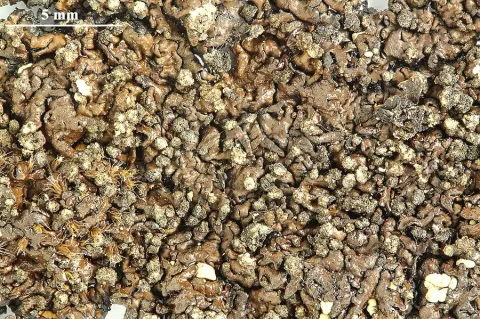
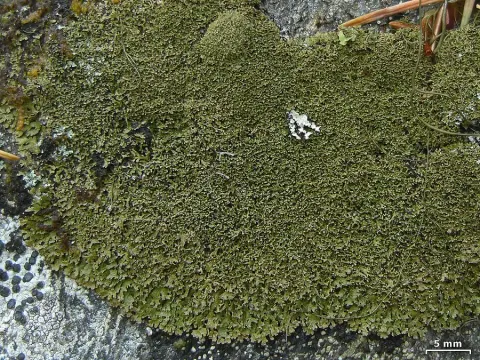
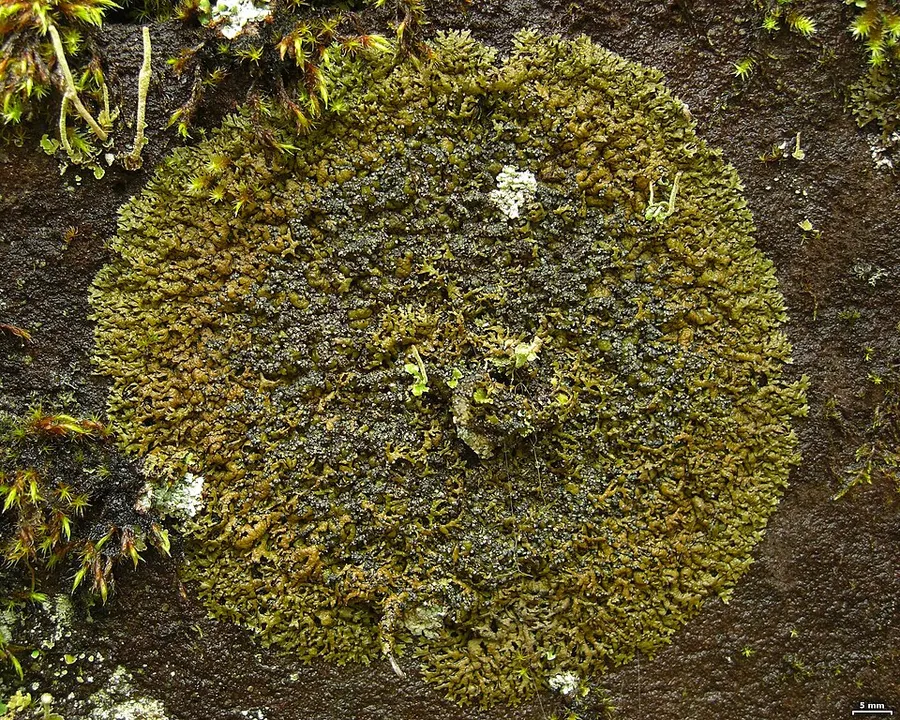
Montanelia sorediata forms a small, leaf-like thallus (the lichen body) that is loosely attached to rock. The lobes are narrow (about 0.2–0.6 mm wide), flat to slightly convex and often elongate and strap-like, with tips that appear crinkled and faintly pitted. The upper thallus surface is olive to dark brown, usually matt though the lobe ends may shine a little, and it is generally smooth. The species reproduces mainly by abundant terminal , which are small, convex, button-like patches (about 0.2–0.8 mm across) that form at the ends of the main lobes or on short, upright side branches. These soralia release , which are powdery clumps of algal and fungal cells used for vegetative spread. The soredia are and can become , and although dark they often look whitish where rubbed. Diagnostic absences include no pseudocyphellae (the minute pores/lines seen on the surface of some related taxa) and no pycnidia (tiny asexual spore bodies); sexual fruiting bodies (apothecia) were not seen in the material examined. Chemically, the thallus contains perlatolic and stenosporic acids, chemical markers useful for separating it from similar brown parmelioid lichens.

Sebagian uraian ditampilkan dalam bahasa sumber; terjemahannya belum tersedia atau belum lolos pemeriksaan.

Rujukan: [1]

Pengukuran mengikuti objek, spesimen atau kultur, dan metode yang disebutkan sumber. Baca uraian asli untuk konteks lengkap.

02 / Kehidupan

Habitat dan peran ekologis

Montanelia sorediata is a rock-dwelling (saxicolous) species that prefers siliceous substrates. In lowland settings it is typically found on siliceous erratic boulders in open, well-lit places, while in mountains it occurs on natural outcrops such as granite, sandstone and gneiss. Species distribution modelling for Central Europe indicates that precipitation-related variables are the strongest drivers of its potential range. It occurs in North America and Europe and is widespread in Central and Eastern Europe. In Poland it is relatively frequent from lowlands to mountains, with an eastern bias; it has not been recorded from the Sudetes, and in the Carpathians it is mainly in valleys and lower slopes up to about 800 m elevation. Modelling points to the Carpathians and the eastern Alps as the areas of highest suitability, with additional favourable zones in several regional uplands; lowland occurrences likely reflect local microclimates and the availability of silicate rock.

Sebagian uraian ditampilkan dalam bahasa sumber; terjemahannya belum tersedia atau belum lolos pemeriksaan.

Rujukan: [1]

Habitat atau konteks temuan
Informasi belum tersedia pada sumber rilis ini.
Substrat
Informasi belum tersedia pada sumber rilis ini.
Peran atau konteks
Pembentuk liken
Temukan hubungan serupa
03 / Siklus hidup

Reproduksi

Montanelia sorediata forms a small, leaf-like thallus (the lichen body) that is loosely attached to rock. The lobes are narrow (about 0.2–0.6 mm wide), flat to slightly convex and often elongate and strap-like, with tips that appear crinkled and faintly pitted. The upper thallus surface is olive to dark brown, usually matt though the lobe ends may shine a little, and it is generally smooth. The species reproduces mainly by abundant terminal , which are small, convex, button-like patches (about 0.2–0.8 mm across) that form at the ends of the main lobes or on short, upright side branches. These soralia release , which are powdery clumps of algal and fungal cells used for vegetative spread. The soredia are and can become , and although dark they often look whitish where rubbed.

Sebagian uraian ditampilkan dalam bahasa sumber; terjemahannya belum tersedia atau belum lolos pemeriksaan.

Rujukan: [1]

Sinonim menurut acuan taksonomi rilis: Imbricaria sorediata; Melanelia sorediata; Melanelia sorediosa; Parmelia olivacea f. sorediata; Parmelia olivacea subsp. sorediata; Parmelia olivacea var. sorediata; Parmelia prolixa f. sorediata; Parmelia prolixa subsp. sorediata; Parmelia prolixa var. sorediata; Parmelia sorediosa; Parmelia stygia f. sorediata; Parmelia stygia var. sorediata
04 / Batas informasi

Catatan identitas dan cakupan

  • Nama diterima mengikuti Catalogue of Life Base2026-09-11; uraian mempertahankan konsep dan nama sumber aslinya.
  • Original geographic, specimen and life-cycle scope retained; source import awaits individual editorial review.
  • Impor dan terjemahan otomatis belum diperiksa editorial per profil. Struktur reproduktif yang disebutkan tidak membuktikan seluruh siklus hidup diketahui.
  • Pengukuran pada uraian mengikuti spesimen, kultur, dan metode sumber; angka tidak diperluas ke semua populasi.

Catatan distribusi dalam narasi mengikuti sumbernya. Dokumentasi spesimen atau foto mengikuti catatan sumber. Bukti wilayah Indonesia dan penilaian konservasi tidak disimpulkan dari gambar.

05 / Dokumentasi

Melihat dengan konteks

Dokumentasi Montanelia sorediata dari Wikimedia Commons. Upper Clearwater Valley, British Columbia, 20110731 Identifikasi mengikuti record berkas sumber.

Jenis
Fotografi
Kredit
Jason Hollinger
Lisensi
CC BY 2.0
Sumber media
Buka entri sumber

Gambar menunjukkan objek menurut identifikasi sumber, bukan verifikasi independen spesimen oleh Fungi. Tidak ada skala baru yang ditambahkan.

06 / Rujukan

Sumber profil

  1. [1] Montanelia sorediata — Wikipedia (en)Bagian sumber: Frozen revision 1332500731
    Tanggal penghimpunan sumber: 2026-10-12
    Teks sumber: CC BY-SA4.0 · Wikipedia contributors
  2. [2] Catalogue of Life Base2026-09-11 — Montanelia sorediataBagian sumber: ColDP NameUsage.tsv ID 6S26Z; accepted species; source 2073
    Tanggal penghimpunan sumber: 2026-10-12
  3. [3] Dokumentasi visual — Montanelia sorediataBagian sumber: Individual media record; identification follows the source, not independent determination
    Tanggal penghimpunan sumber: 2026-10-12
    Media sumber: CC BY 2.0 · Jason Hollinger

Adaptasi teks: CC BY-SA 4.0. Wikipedia contributors — Montanelia sorediata — Wikipedia (en)

Uraian asli dan riwayat sumber

Riwayat atau halaman sumber

Ringkasan sumber

Montanelia sorediata is a species of saxicolous (rock-dwelling) foliose lichen in the family Parmeliaceae. It has narrow, olive to dark brown and reproduces vegetatively through powdery soredia. The species occurs on siliceous rocks in North America and Europe, favouring mountainous regions and upland areas.

Revisi sumber

Morfologi sumber

Montanelia sorediata forms a small, leaf-like thallus (the lichen body) that is loosely attached to rock. The lobes are narrow (about 0.2–0.6 mm wide), flat to slightly convex and often elongate and strap-like, with tips that appear crinkled and faintly pitted. The upper thallus surface is olive to dark brown, usually matt though the lobe ends may shine a little, and it is generally smooth. The species reproduces mainly by abundant terminal , which are small, convex, button-like patches (about 0.2–0.8 mm across) that form at the ends of the main lobes or on short, upright side branches. These soralia release , which are powdery clumps of algal and fungal cells used for vegetative spread. The soredia are and can become , and although dark they often look whitish where rubbed. Diagnostic absences include no pseudocyphellae (the minute pores/lines seen on the surface of some related taxa) and no pycnidia (tiny asexual spore bodies); sexual fruiting bodies (apothecia) were not seen in the material examined. Chemically, the thallus contains perlatolic and stenosporic acids, chemical markers useful for separating it from similar brown parmelioid lichens.

Revisi sumber

Ekologi sumber

Montanelia sorediata is a rock-dwelling (saxicolous) species that prefers siliceous substrates. In lowland settings it is typically found on siliceous erratic boulders in open, well-lit places, while in mountains it occurs on natural outcrops such as granite, sandstone and gneiss. Species distribution modelling for Central Europe indicates that precipitation-related variables are the strongest drivers of its potential range. It occurs in North America and Europe and is widespread in Central and Eastern Europe. In Poland it is relatively frequent from lowlands to mountains, with an eastern bias; it has not been recorded from the Sudetes, and in the Carpathians it is mainly in valleys and lower slopes up to about 800 m elevation. Modelling points to the Carpathians and the eastern Alps as the areas of highest suitability, with additional favourable zones in several regional uplands; lowland occurrences likely reflect local microclimates and the availability of silicate rock.

Revisi sumber

Struktur reproduksi sumber

Montanelia sorediata forms a small, leaf-like thallus (the lichen body) that is loosely attached to rock. The lobes are narrow (about 0.2–0.6 mm wide), flat to slightly convex and often elongate and strap-like, with tips that appear crinkled and faintly pitted. The upper thallus surface is olive to dark brown, usually matt though the lobe ends may shine a little, and it is generally smooth. The species reproduces mainly by abundant terminal , which are small, convex, button-like patches (about 0.2–0.8 mm across) that form at the ends of the main lobes or on short, upright side branches. These soralia release , which are powdery clumps of algal and fungal cells used for vegetative spread. The soredia are and can become , and although dark they often look whitish where rubbed.

Revisi sumber

Rujukan halaman ini

Fungi. Montanelia sorediata. Rilis data fungi-2026-10-12-expansion-2. https://fungi-atlas.mgadib.chatgpt.site/jamur/montanelia-sorediata/.

Status: impor sumber; pemeriksaan editorial per profil belum selesai. Untuk klaim biologis, gunakan rujukan pada bagian terkait dan periksa konteks sumber aslinya.