01 / Morfologi

Ciri dan struktur

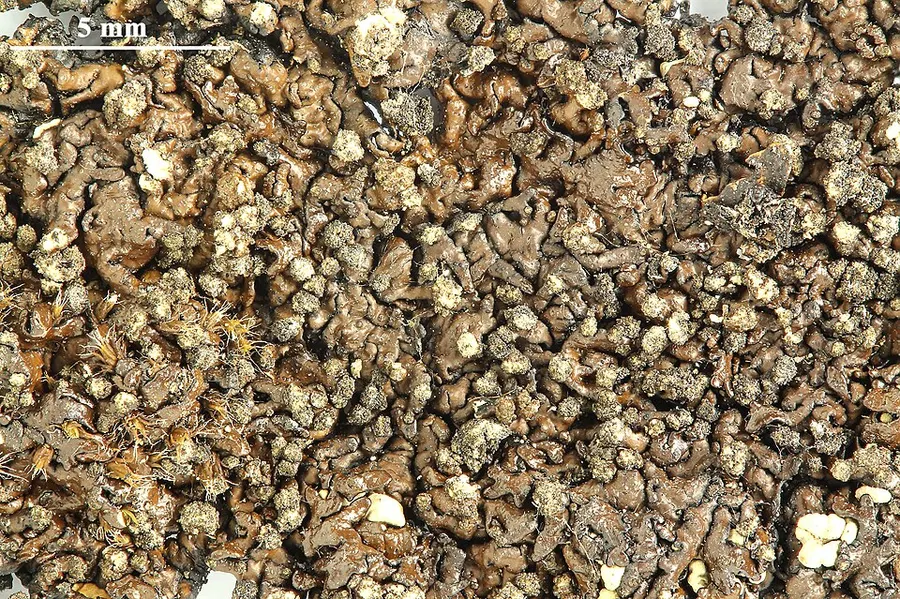
Montanelia tominii is a foliose lichen whose thallus is usually but can become thicker and more cushion-like, reaching about 10(–14) cm across. are short and typically about 1–3(–4) mm wide; the upper surface ranges from pale olive-brown or tan-brown to yellowish- or reddish-brown, sometimes darkening, and may be dull to strongly glossy. The surface is often smoother near lobe tips but becomes more fissured or wrinkled () towards the centre. The lower surface is dark brown to black (at least centrally), sometimes paler near lobe ends, with moderately developed rhizines (root-like attachment threads). Pseudocyphellae on the upper surface (laminal pseudocyphellae) are usually present and may be conspicuous and roundish to somewhat elongate. In very exposed northern habitats they can be hard to see. More sheltered parts of the same thallus may still show them clearly. Asexual reproduction is variable. Many thalli develop soralia that produce coarse soredia, but some thalli lack soredia altogether (esorediate forms). Intermediate forms are common, and Esslinger regarded this variation as essentially continuous rather than evidence for separate taxa. Apothecia (sexual fruiting bodies) are often present. They are up to about 6 mm across, may become irregular with age, and the margin frequently becomes sorediate. Each ascus typically contains eight ascospores that measure about 8.5–11 × 4.5–7 micrometres (μm). Pycnidia are common, immersed in the upper surface, and produce asexual spores (conidia) about 5–7 × 1 μm with a cylindrical to weakly shape. In standard lichen spot tests, the outer layer () shows no K reaction (K–), while the inner layer (medulla) turns rose to rose-red with C (C+) and with KC (KC+).

Sebagian uraian ditampilkan dalam bahasa sumber; terjemahannya belum tersedia atau belum lolos pemeriksaan.

Rujukan: [1]

Pengukuran mengikuti objek, spesimen atau kultur, dan metode yang disebutkan sumber. Baca uraian asli untuk konteks lengkap.

02 / Kehidupan

Habitat dan peran ekologis

On the basis of more than 300 specimens, M. tominii was treated as a single, widely distributed Northern Hemisphere species. The type material of Parmelia tominii and its synonyms was collected from rock, and Oxner's later synonym P. altaica was explicitly collected on non-calcareous rock in the Altai Mountains. In discussing northern morphology, Esslinger compared the Oxner types with material from far-northern regions (including Alaska, northern Canada, and Greenland) and with specimens from Europe and North America more generally. The species was first reported from Armenia in 2016. Wang and co-authors documented the species from multiple mountain localities in China, where it was collected on rock at about 1,600–5,000 m elevation (for example, Mt Arxan in Inner Mongolia and Mt Qomolangma in Tibet). They described it as widely distributed across the Northern Hemisphere. In Nepal, Melanelia tominii has been reported from 3,200 to 3,600 m elevation in a compilation of published records. In Colorado, Montanelia tominii has been recorded from White Rocks Open Space in Boulder, Colorado, a sandstone outcrop site surveyed in 2014. In that inventory it was assessed as an occasional species.

Sebagian uraian ditampilkan dalam bahasa sumber; terjemahannya belum tersedia atau belum lolos pemeriksaan.

Rujukan: [1]

Habitat atau konteks temuan
Informasi belum tersedia pada sumber rilis ini.
Substrat
Informasi belum tersedia pada sumber rilis ini.
Peran atau konteks
Pembentuk liken
Temukan hubungan serupa
03 / Siklus hidup

Reproduksi

Pseudocyphellae on the upper surface (laminal pseudocyphellae) are usually present and may be conspicuous and roundish to somewhat elongate. In very exposed northern habitats they can be hard to see. More sheltered parts of the same thallus may still show them clearly. Asexual reproduction is variable. Many thalli develop soralia that produce coarse soredia, but some thalli lack soredia altogether (esorediate forms). Intermediate forms are common, and Esslinger regarded this variation as essentially continuous rather than evidence for separate taxa. Apothecia (sexual fruiting bodies) are often present. They are up to about 6 mm across, may become irregular with age, and the margin frequently becomes sorediate.

Sebagian uraian ditampilkan dalam bahasa sumber; terjemahannya belum tersedia atau belum lolos pemeriksaan.

Rujukan: [1]

Sinonim menurut acuan taksonomi rilis: Melanelia tominii; Parmelia tominii
04 / Batas informasi

Catatan identitas dan cakupan

  • Nama diterima mengikuti Catalogue of Life Base2026-09-11; uraian mempertahankan konsep dan nama sumber aslinya.
  • Original geographic, specimen and life-cycle scope retained; source import awaits individual editorial review.
  • Impor dan terjemahan otomatis belum diperiksa editorial per profil. Struktur reproduktif yang disebutkan tidak membuktikan seluruh siklus hidup diketahui.
  • Pengukuran pada uraian mengikuti spesimen, kultur, dan metode sumber; angka tidak diperluas ke semua populasi.

Catatan distribusi dalam narasi mengikuti sumbernya. Dokumentasi spesimen atau foto mengikuti catatan sumber. Bukti wilayah Indonesia dan penilaian konservasi tidak disimpulkan dari gambar.

05 / Dokumentasi

Melihat dengan konteks

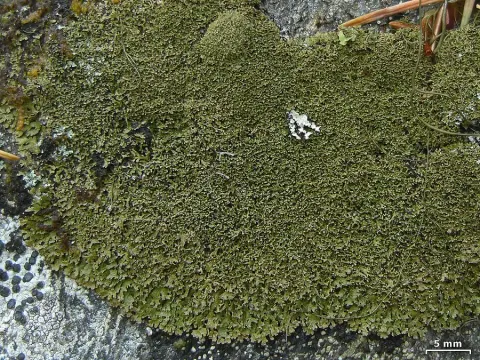
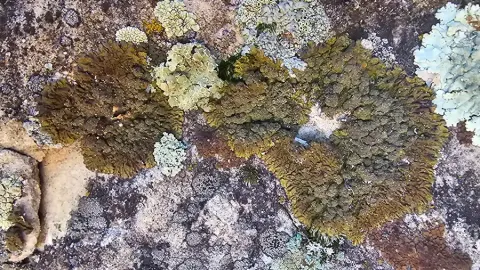
Dokumentasi Montanelia tominii dari Wikimedia Commons. The rock-dwelling foliose lichen Montanelia tominii ; photographed in Austria Identifikasi mengikuti record berkas sumber.

Jenis
Fotografi
Kredit
Felix Schumm
Sumber media
Buka entri sumber

Gambar menunjukkan objek menurut identifikasi sumber, bukan verifikasi independen spesimen oleh Fungi. Tidak ada skala baru yang ditambahkan.

06 / Rujukan

Sumber profil

  1. [1] Montanelia tominii — Wikipedia (en)Bagian sumber: Frozen revision 1342793694
    Tanggal penghimpunan sumber: 2026-10-12
    Teks sumber: CC BY-SA4.0 · Wikipedia contributors
  2. [2] Catalogue of Life Base2026-09-11 — Montanelia tominiiBagian sumber: ColDP NameUsage.tsv ID 73Q6Z; accepted species; source 2073
    Tanggal penghimpunan sumber: 2026-10-12
  3. [3] Dokumentasi visual — Montanelia tominiiBagian sumber: Individual media record; identification follows the source, not independent determination
    Tanggal penghimpunan sumber: 2026-10-12
    Media sumber: CC BY-SA 4.0 · Felix Schumm

Adaptasi teks: CC BY-SA 4.0. Wikipedia contributors — Montanelia tominii — Wikipedia (en)

Uraian asli dan riwayat sumber

Riwayat atau halaman sumber

Ringkasan sumber

Montanelia tominii, the dimpled camouflage lichen, is a species of foliose lichen in the family Parmeliaceae. The lichen forms variable, leaf-like thalli that range from thin and closely pressed to thicker and cushion-like, typically olive-brown to reddish-brown on the upper surface, with a dark brown to black underside. It is characterized by whitish pit-like or slit-like markings on the upper surface, sometimes forming faint patterns, and by powdery reproductive granules that can become coarse and clumped.

Revisi sumber

Morfologi sumber

Montanelia tominii is a foliose lichen whose thallus is usually but can become thicker and more cushion-like, reaching about 10(–14) cm across. are short and typically about 1–3(–4) mm wide; the upper surface ranges from pale olive-brown or tan-brown to yellowish- or reddish-brown, sometimes darkening, and may be dull to strongly glossy. The surface is often smoother near lobe tips but becomes more fissured or wrinkled () towards the centre. The lower surface is dark brown to black (at least centrally), sometimes paler near lobe ends, with moderately developed rhizines (root-like attachment threads). Pseudocyphellae on the upper surface (laminal pseudocyphellae) are usually present and may be conspicuous and roundish to somewhat elongate. In very exposed northern habitats they can be hard to see. More sheltered parts of the same thallus may still show them clearly. Asexual reproduction is variable. Many thalli develop soralia that produce coarse soredia, but some thalli lack soredia altogether (esorediate forms). Intermediate forms are common, and Esslinger regarded this variation as essentially continuous rather than evidence for separate taxa. Apothecia (sexual fruiting bodies) are often present. They are up to about 6 mm across, may become irregular with age, and the margin frequently becomes sorediate. Each ascus typically contains eight ascospores that measure about 8.5–11 × 4.5–7 micrometres (μm). Pycnidia are common, immersed in the upper surface, and produce asexual spores (conidia) about 5–7 × 1 μm with a cylindrical to weakly shape. In standard lichen spot tests, the outer layer () shows no K reaction (K–), while the inner layer (medulla) turns rose to rose-red with C (C+) and with KC (KC+).

Revisi sumber

Ekologi sumber

On the basis of more than 300 specimens, M. tominii was treated as a single, widely distributed Northern Hemisphere species. The type material of Parmelia tominii and its synonyms was collected from rock, and Oxner's later synonym P. altaica was explicitly collected on non-calcareous rock in the Altai Mountains. In discussing northern morphology, Esslinger compared the Oxner types with material from far-northern regions (including Alaska, northern Canada, and Greenland) and with specimens from Europe and North America more generally. The species was first reported from Armenia in 2016. Wang and co-authors documented the species from multiple mountain localities in China, where it was collected on rock at about 1,600–5,000 m elevation (for example, Mt Arxan in Inner Mongolia and Mt Qomolangma in Tibet). They described it as widely distributed across the Northern Hemisphere. In Nepal, Melanelia tominii has been reported from 3,200 to 3,600 m elevation in a compilation of published records. In Colorado, Montanelia tominii has been recorded from White Rocks Open Space in Boulder, Colorado, a sandstone outcrop site surveyed in 2014. In that inventory it was assessed as an occasional species.

Revisi sumber

Struktur reproduksi sumber

Pseudocyphellae on the upper surface (laminal pseudocyphellae) are usually present and may be conspicuous and roundish to somewhat elongate. In very exposed northern habitats they can be hard to see. More sheltered parts of the same thallus may still show them clearly. Asexual reproduction is variable. Many thalli develop soralia that produce coarse soredia, but some thalli lack soredia altogether (esorediate forms). Intermediate forms are common, and Esslinger regarded this variation as essentially continuous rather than evidence for separate taxa. Apothecia (sexual fruiting bodies) are often present. They are up to about 6 mm across, may become irregular with age, and the margin frequently becomes sorediate.

Revisi sumber

Rujukan halaman ini

Fungi. Montanelia tominii. Rilis data fungi-2026-10-12-expansion-2. https://fungi-atlas.mgadib.chatgpt.site/jamur/montanelia-tominii/.

Status: impor sumber; pemeriksaan editorial per profil belum selesai. Untuk klaim biologis, gunakan rujukan pada bagian terkait dan periksa konteks sumber aslinya.