Ciri dan struktur
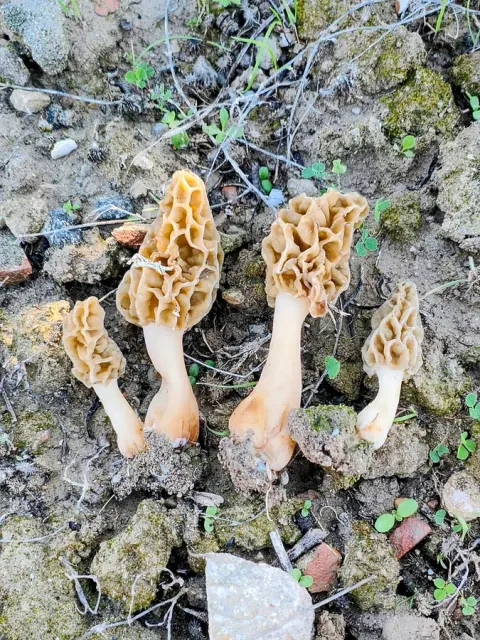
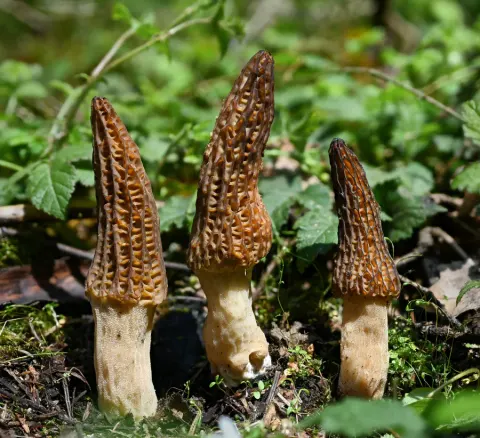
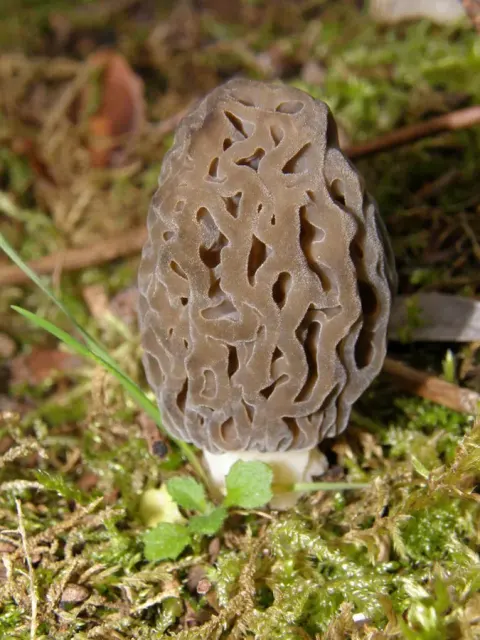
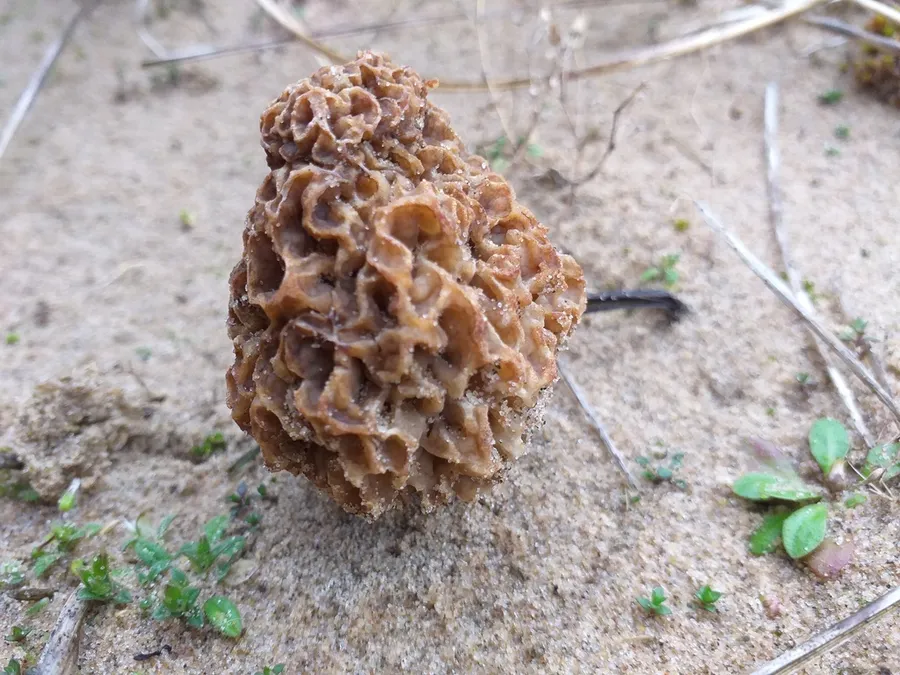
The cap is pale brownish cream, yellow to tan or pale brown to grayish brown. The edges of the ridges are usually lighter than the pits, and somewhat oval in outline, sometimes bluntly cone-shaped with a rounded top or more elongate. Caps are hollow, attached to the stem at the lower edge, and typically about 2–7 cm broad by 2–10 cm tall. The flesh is brittle. The stem is white to pallid or pale yellow, hollow, and straight or with a club-shaped or bulbous base. It is finely granular overall, somewhat ridged, generally about 2–9 cm long by 2–5 cm thick. In age it may have brownish stains near the base. The spores range from white to cream to slightly yellow in deposit, although a spore print may be difficult to obtain given the shape of the fruit body. The spores are formed in asci lining the pits—the ridges are sterile. They are ellipsoidal, smooth, thin-walled, translucent (hyaline), and measure 17.5–21.9 by 8.8–11.0 μm. The asci are eight-spored, 223–300 by 19–20 μm, cylindrical, and hyaline. The paraphyses are filamentous, cylindrical, 5.8–8.8 μm wide, and hyaline. The hyphae of the stem are interwoven, hyaline, and measure 5.8–9.4 μm wide. The surface hyphae are inflated, spherical to pear-shaped, 22–44 μm wide, covered by a network of interwoven hyphae 11–16.8 μm wide with recurved cylindrical hyphal ends.
Habitat dan peran ekologis
The fruit bodies are sometimes solitary, but more often in groups, on the ground in a variety of habitats. A preference for soil with a limestone base (alkaline) has been noted, It can also be found in Brazil and Bulgaria. Centipedes sometimes make their home inside these morels. Infested morels usually have a hole in the top.
- Habitat atau konteks temuan
- Informasi belum tersedia pada sumber rilis ini.
- Substrat
- tanah
- Peran atau konteks
- Belum dikategorikan pada rilis ini.
Reproduksi
The spores range from white to cream to slightly yellow in deposit, although a spore print may be difficult to obtain given the shape of the fruit body. The spores are formed in asci lining the pits—the ridges are sterile. They are ellipsoidal, smooth, thin-walled, translucent (hyaline), and measure 17.5–21.9 by 8.8–11.0 μm. The asci are eight-spored, 223–300 by 19–20 μm, cylindrical, and hyaline. The paraphyses are filamentous, cylindrical, 5.8–8.8 μm wide, and hyaline.
Catatan identitas dan cakupan
- Nama diterima mengikuti Catalogue of Life Base2026-09-11; uraian mempertahankan konsep dan nama sumber aslinya.
- Original geographic, specimen and life-cycle scope retained; source import awaits individual editorial review.
- Impor dan terjemahan otomatis belum diperiksa editorial per profil. Struktur reproduktif yang disebutkan tidak membuktikan seluruh siklus hidup diketahui.
- Pengukuran pada uraian mengikuti spesimen, kultur, dan metode sumber; angka tidak diperluas ke semua populasi.
Catatan distribusi dalam narasi mengikuti sumbernya. Dokumentasi spesimen atau foto mengikuti catatan sumber. Bukti wilayah Indonesia dan penilaian konservasi tidak disimpulkan dari gambar.
Melihat dengan konteks
Dokumentasi Morchella dunensis menurut asosiasi foto pada record takson iNaturalist. Kredit: Jacqueline Worthington. Identitas mengikuti sumber; bukan penentuan spesimen independen.
- Jenis
- Fotografi
- Kredit
- (c) Jacqueline Worthington, some rights reserved (CC BY), uploaded by Jacqueline Worthington
- Lisensi
- CC BY 4.0
- Sumber media
- Buka entri sumber
Sumber profil
- [1] Morchella esculenta — Wikipedia (en)
- [2] Catalogue of Life Base2026-09-11 — Morchella esculenta
- [3] Dokumentasi visual — Morchella dunensis
Rujukan halaman ini
Fungi. Morchella esculenta. Rilis data fungi-2026-10-12-expansion-2. https://fungi-atlas.mgadib.chatgpt.site/jamur/morchella-esculenta/.
Status: impor sumber; pemeriksaan editorial per profil belum selesai. Untuk klaim biologis, gunakan rujukan pada bagian terkait dan periksa konteks sumber aslinya.