Ciri dan struktur
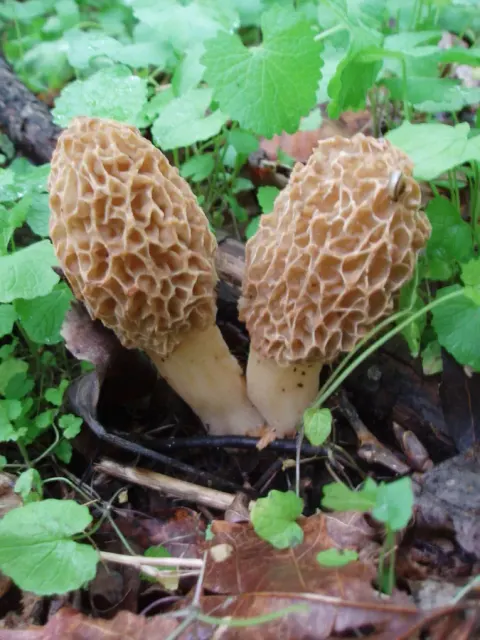
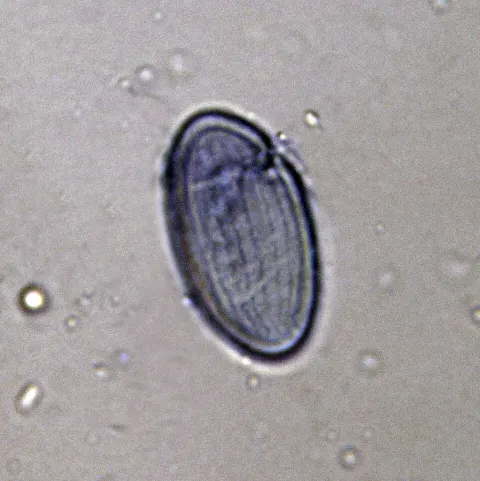
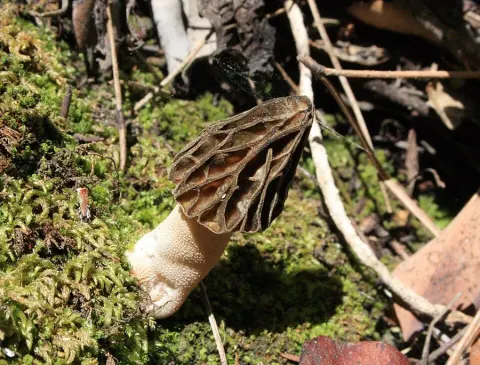
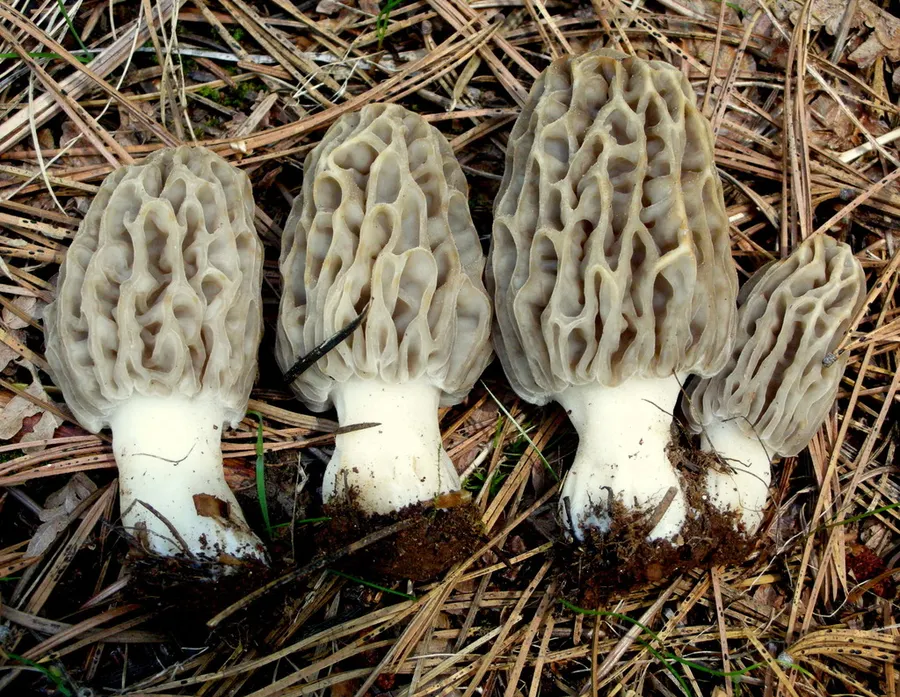
The fruit bodies are often rufescent and 9 – 20 cm high. The conical cap is 4 – 6 cm high and 2.5 – 4 cm wide at the widest point. The cap surface features pits and ridges, which are formed from the intersection of 16–22 primary vertical ridges and few shorter, secondary vertical ridges, with frequent, sunken, horizontal ridges. The cap is attached to the stipe with a distinct sinus about 2–4 mm deep and 2–4 mm wide. The smooth, splitting ridges remain persistently pale throughout the maturity process, easily distinguishing this species from other species in section Distantes, or black morels, which have ridges that typically darken with age. Pits are usually elongated vertically. They are smooth and greyish when young, but later the entire fruit body fades to pale tan to pale ochre-tan. The stipe is 2 – 6 cm high by 1 – 4 cm wide and is more or less equal in width throughout its length or sometimes slightly enlarged at the base. Its white surface is smooth or finely mealy with whitish granules (having hyaline erect "hairs" when viewed under a microscope). The flesh is whitish and measures 1–2 mm thick in the hollow cap and the sterile inner surface of the cap is whitish and pubescent. The ascospores are elliptical and measure 20–26 by 13–18 μm. Spores appear smooth in normal light microscopy, but when viewed under a scanning electron microscope or in the appropriate staining medium, they can be inconspicuously sculpted. The asci (spore-bearing cells) measure 225–330 by 15–25 μm and are cylindrical, eight-spored, and hyaline (translucent) when mounted in dilute (2%) potassium hydroxide (KOH).
Habitat dan peran ekologis
Morchella tridentina has a widespread but disjunct distribution. So far, its presence has been molecularly verified in Argentina, Armenia, Chile, Cyprus, France, India, Israel, North America, Spain and Turkey. Kuo suggests that it might be also widely distributed in western North America, but so far it has only been confirmed to be present in Oregon and California. It is usually found in mountainous forests and Mediterranean shrubland, growing solitary, scattered, or in small groups in the spring. Its exact trophic mode is not yet known with certainty, but it is suspected to be facultatively biotrophic and may form endosymbiotic associations with a wide array of trees and shrubs. Tree species associated with the fungus in North America include pacific madrone (Arbutus menziesii), oaks (Quercus spp.), Douglas fir (Pseudotsuga menziesii), ponderosa pine (Pinus ponderosa), sugar pine (Pinus lambertiana), and white fir (Abies concolor). In Europe it is often found with holm oak (Quercus ilex), strawberry trees (Arbutus andrachne), olive trees (Olea europaea), Spanish fir (Abies pinsapo), Silver fir (Abies alba), Calabrian pine (Pinus brutia), and Scot's pine (P. sylvestris). Although it was initially hypothesised that collections of M. tridentina from Turkey might have been antrhopogenically introduced from the Pacific Northwest of North America, numerous collections reported since from remote and undisturbed areas in the Mediterranean and the Alps (including Bresadola's original collection from Trentino), suggest a long-time and well-established presence of this species in Europe.
- Habitat atau konteks temuan
- hutan
- Substrat
- Informasi belum tersedia pada sumber rilis ini.
- Peran atau konteks
- Belum dikategorikan pada rilis ini.
Reproduksi
The ascospores are elliptical and measure 20–26 by 13–18 μm. Spores appear smooth in normal light microscopy, but when viewed under a scanning electron microscope or in the appropriate staining medium, they can be inconspicuously sculpted. The asci (spore-bearing cells) measure 225–330 by 15–25 μm and are cylindrical, eight-spored, and hyaline (translucent) when mounted in dilute (2%) potassium hydroxide (KOH). The paraphyses are cylindrical to capitate or moniliform, measuring 95–250 long by 10–25 μm wide, and are septate. Their tips are rounded to somewhat club-shaped or infrequently somewhat fuse-shaped. The acroparaphyses on the sterile ridges are cylindrical to club-shaped, septate, sometimes with incrustations at the apex, and measure 50–175 by 12.5–20 μm.
Catatan identitas dan cakupan
- Nama diterima mengikuti Catalogue of Life Base2026-09-11; uraian mempertahankan konsep dan nama sumber aslinya.
- Original geographic, specimen and life-cycle scope retained; source import awaits individual editorial review.
- Impor dan terjemahan otomatis belum diperiksa editorial per profil. Struktur reproduktif yang disebutkan tidak membuktikan seluruh siklus hidup diketahui.
- Pengukuran pada uraian mengikuti spesimen, kultur, dan metode sumber; angka tidak diperluas ke semua populasi.
Catatan distribusi dalam narasi mengikuti sumbernya. Dokumentasi spesimen atau foto mengikuti catatan sumber. Bukti wilayah Indonesia dan penilaian konservasi tidak disimpulkan dari gambar.
Melihat dengan konteks
Dokumentasi Morchella tridentina menurut asosiasi foto pada record takson iNaturalist. Kredit: MushroomObserverUser|1=9|2=Ron Pastorino (Ronpast). Identitas mengikuti sumber; bukan penentuan spesimen independen.
- Jenis
- Fotografi
- Kredit
- (c) MushroomObserverUser|1=9|2=Ron Pastorino (Ronpast), some rights reserved (CC BY-SA)
- Lisensi
- CC BY-SA 4.0
- Sumber media
- Buka entri sumber
Dokumentasi tambahan
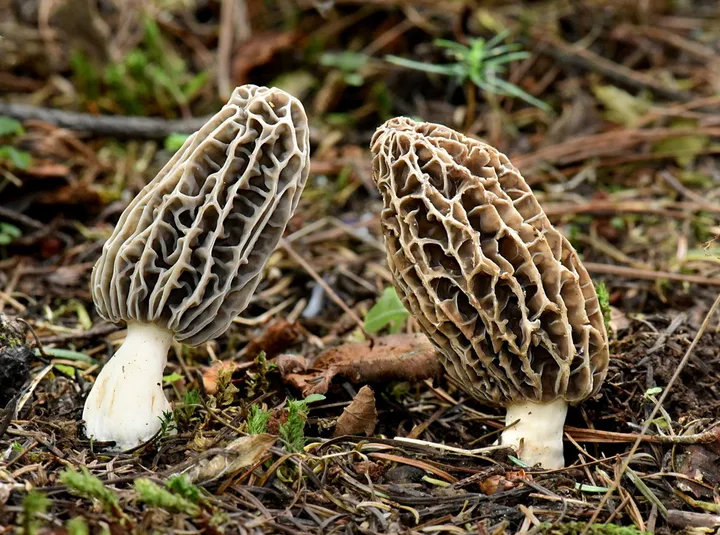
Foto yang diasosiasikan dengan Morchella tridentina pada iNaturalist. Identifikasi mengikuti sumber; bukan penentuan spesimen independen.
Kredit dan penggunaan
(c) Alan Rockefeller, some rights reserved (CC BY), uploaded by Alan Rockefeller
Ukuran dan format gambar disesuaikan tanpa pemotongan, retus, atau penambahan skala. Lisensi sumber dipertahankan.
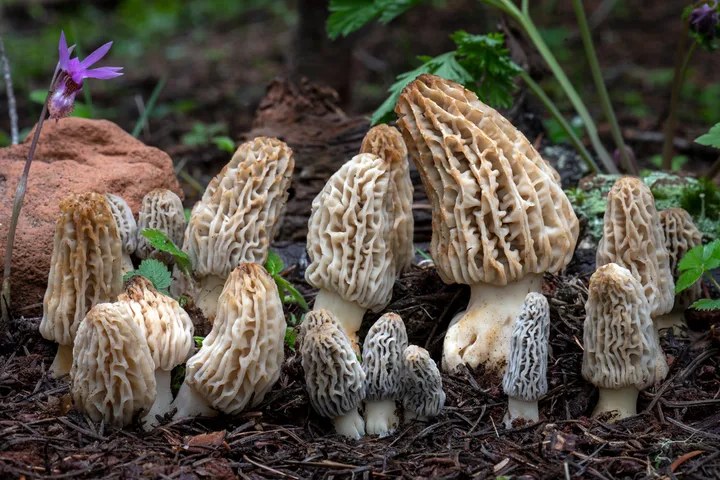
Foto yang diasosiasikan dengan Morchella tridentina pada iNaturalist. Identifikasi mengikuti sumber; bukan penentuan spesimen independen.
Kredit dan penggunaan
(c) Alan Rockefeller, some rights reserved (CC BY), uploaded by Alan Rockefeller
Ukuran dan format gambar disesuaikan tanpa pemotongan, retus, atau penambahan skala. Lisensi sumber dipertahankan.
Sumber profil
- [1] Morchella tridentina — Wikipedia (en)
- [2] Catalogue of Life Base2026-09-11 — Morchella tridentina
- [3] Dokumentasi visual — Morchella tridentina
- [4] Dokumentasi visual — Morchella tridentina
- [5] Dokumentasi visual — Morchella tridentina
Rujukan halaman ini
Fungi. Morchella tridentina. Rilis data fungi-2026-10-12-expansion-2. https://fungi-atlas.mgadib.chatgpt.site/jamur/morchella-tridentina/.
Status: impor sumber; pemeriksaan editorial per profil belum selesai. Untuk klaim biologis, gunakan rujukan pada bagian terkait dan periksa konteks sumber aslinya.