Ciri dan struktur
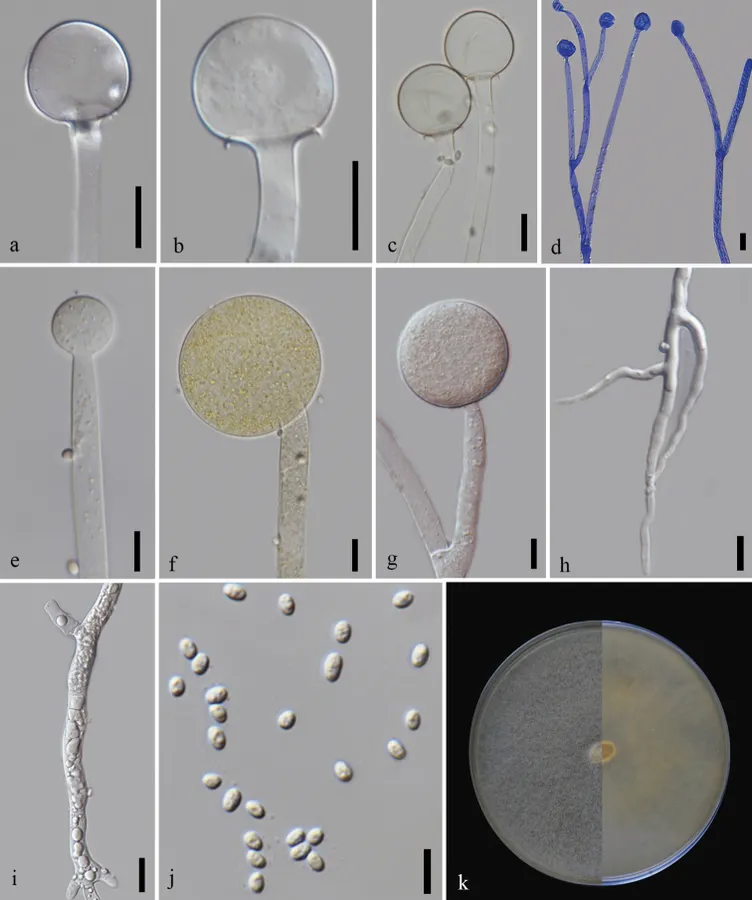
Mucor aseptatophorus is phylogenetically distinct from M. irregularis. In the phylogenetic analysis, M. aseptatophorus groups as sister to two Mucor sp. and all of them cluster as sister to the clade formed by M. irregularis strains with high bootstrap support. In contrast to M. irregularis, the ellipsoidal, cylindrical, or pyriform columella are not observed in M. aseptatophorus. Columella formed in the latter are globose. Mucor aseptatophorus has smaller sporangiospores (3.5–5 × 2–2.5 µm), slightly bigger sporangia, forms sympodial, and monopodial branching of sporangiospores and has a lower growth rate than M. irregularis. The species differs from M. merdicola and M. nidicola, by having smaller columella, sporangia and sporangiospore. Compared to M. souzae, sporangiophores in M. aseptatophorus are aseptate (below sporangia). Septation, when observed, is usually present at the branching point. Septae below the sporangia rarely observed. Asexual morph (based on cultures grown in MEA at 25 °C): Sporangiophores hyaline to pale brown, variable in length, erect, arising directly from the substrate, up to 17 µm in width (x – = 8.5 µm, n = 30), sympodial, and monopodial, with occasional circinate branches (mostly sympodial branches), and no septae observed. Sporangia 18–56.5 × 19–54 µm (x – = 41.5 × 41.5 µm, n = 40), globose to subglobose, smooth-walled, thick-walled and persistent, yellow to pale brown. Columellae 13–35 × 14–37.5 µm (x – = 19 × 20 µm, n = 40), globose, with very short collar, hyaline to pale brown, non-collapsing, smooth-walled. Sporangiospores 3.5–6 × 2–4 µm (x – = 4 × 3 µm, n = 70), mostly ellipsoidal, occasionally oval to globose, some irregular, hyaline.
Habitat dan peran ekologis
Colonies on MEA reaching 62 mm diameter after 2 days of incubation at 25 °C. Colony white at first, becoming pale yellow with age; reverse pale yellow. Colony fully covers the Petri plate (90 mm) by the third day at 25 and 30 °C but does not reach the lid of the plate. At 20 °C, colony reaches a diameter of 70.5 mm after 3 days. Vertical growth is lower at 25 and 30 °C than at 20 °C. The colony does not reach the lid after 3 days. At 30 °C, sporulation is excellent, with branching of sporangiophore more frequent than in others. Monopodial branching more prominent but sympodial and dichotomous branches also observed. On PDA, cultures are white and pale brown in the middle with grey to pale brown sporangia. Colony reaching 64 mm diameter after 3 days of incubation at 25 °C. Optimal growth and excellent sporulation were observed on both MEA and PDA media at 30 °C. At 37 and 8 °C in MEA, growth is observed but with no sporulation. The colony reaches a diameter of 31 mm at 37 °C after 3 days. At 8 °C, the colony reaches a diameter of 14 mm after 9 days. Growth is observed at temperatures ranging from 8 to 37 °C.
- Habitat atau konteks temuan
- kultur yang didokumentasikan
- Substrat
- Informasi belum tersedia pada sumber rilis ini.
- Peran atau konteks
- Belum dikategorikan pada rilis ini.
Reproduksi
Mucor aseptatophorus is phylogenetically distinct from M. irregularis. In the phylogenetic analysis, M. aseptatophorus groups as sister to two Mucor sp. and all of them cluster as sister to the clade formed by M. irregularis strains with high bootstrap support. In contrast to M. irregularis, the ellipsoidal, cylindrical, or pyriform columella are not observed in M. aseptatophorus. Columella formed in the latter are globose. Mucor aseptatophorus has smaller sporangiospores (3.5–5 × 2–2.5 µm), slightly bigger sporangia, forms sympodial, and monopodial branching of sporangiospores and has a lower growth rate than M. irregularis. The species differs from M. merdicola and M. nidicola, by having smaller columella, sporangia and sporangiospore.
Catatan identitas dan cakupan
- Nama diterima mengikuti Catalogue of Life Base2026-09-11; uraian mempertahankan konsep dan nama sumber aslinya.
- Preserve original treatment localities, hosts and substrate scope. Materials examined describe documented specimens, not the full global range.
- Impor dan terjemahan otomatis belum diperiksa editorial per profil. Struktur reproduktif yang disebutkan tidak membuktikan seluruh siklus hidup diketahui.
- Pengukuran pada uraian mengikuti spesimen, kultur, dan metode sumber; angka tidak diperluas ke semua populasi.
Catatan distribusi dalam narasi mengikuti sumbernya. Dokumentasi spesimen atau foto mengikuti catatan sumber. Bukti wilayah Indonesia dan penilaian konservasi tidak disimpulkan dari gambar.
Melihat dengan konteks
Mucor aseptatophorus (MFLU 21–0145) a–c columella with collar d branching of sporangiophores e, f developing sporangium g short sporangiophore with sporangium h rhizoids i granular content in mycelium j sporangiospores k front and reverse of the colony in MEA. Scale bars: 10 µm (a–c, e–h, j); 20 µm (d, i).
- Jenis
- Pelat ilmiah
- Kredit
- Vedprakash G. Hurdeal, Eleni Gentekaki, Kevin D. Hyde, Thuong T. T. Nguyen, Hyang Burm Lee
- Lisensi
- CC BY 4.0
- Sumber media
- Buka entri sumber
Sumber profil
- [1] Novel Mucor species (Mucoromycetes, Mucoraceae) from northern Thailand — Mucor aseptatophorus
- [2] Catalogue of Life Base2026-09-11 — Mucor aseptatophorus
- [3] Dokumentasi visual — Mucor aseptatophorus
Rujukan halaman ini
Fungi. Mucor aseptatophorus. Rilis data fungi-2026-10-12-expansion-2. https://fungi-atlas.mgadib.chatgpt.site/jamur/mucor-aseptatophorus/.
Status: impor sumber; pemeriksaan editorial per profil belum selesai. Untuk klaim biologis, gunakan rujukan pada bagian terkait dan periksa konteks sumber aslinya.