01 / Morfologi

Ciri dan struktur

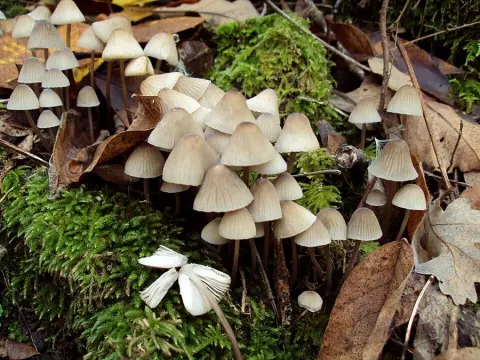
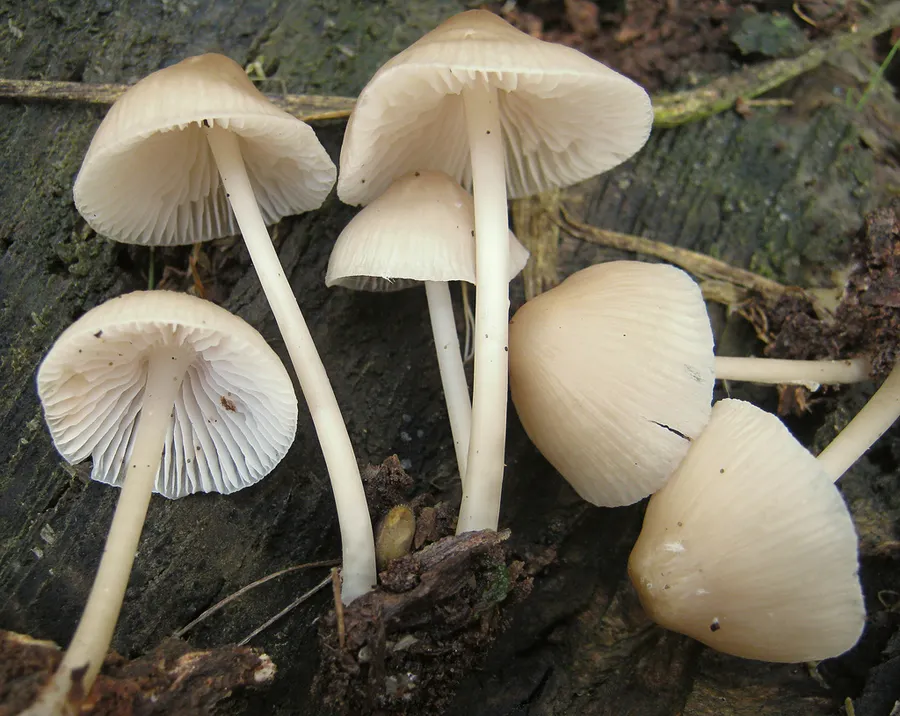
The cap of M. galericulata is roughly conical when young, and eventually becomes broadly bell-shaped or with a broad umbo that can reach diameters of 2-5 cm. The cap margin is initially somewhat curved inward, but soon evens out or even becomes uplifted, and often splits radially in age. The surface has radial grooves that extend nearly to the center, and feels greasy but not sticky. The color is somewhat buff-brown on the margin, and fades gradually to pale dirty tan to dirty cinnamon-brown. The flesh is thick in the center of the cap and tapers evenly to the margin, and is watery gray, with a cartilage-like texture. The odor and taste are mildly to strongly farinaceous (similar to the smell of freshly ground flour), to radish-like. The spores are ellipsoid, 8–10 by 5.5–7 μm, and amyloid—which means they will turn blue-black to black when stained with Melzer's reagent. The basidia (spore-bearing cells) have stout sterigmata, and measure 34–40 by 7–9 μm. They may be either two-spored or four-spored. There are numerous club-shaped to rounded cheilocystidia (cystidia on the gill edge), that measure 32–40 by 8–12 μm; their apices or the entire enlarged portion bear rodlike projections that become increasingly elongated and branched in age. There are no pleurocystidia (cystidia on the gill face). The gill tissue has a very thin cuticle, under which is a narrow hypoderm, while the remainder of the tissue comprises densely matted tufts of mycelia, and stains deep vinaceous-brown in iodine.

Sebagian uraian ditampilkan dalam bahasa sumber; terjemahannya belum tersedia atau belum lolos pemeriksaan.

Rujukan: [1]

Pengukuran mengikuti objek, spesimen atau kultur, dan metode yang disebutkan sumber. Baca uraian asli untuk konteks lengkap.

02 / Kehidupan

Habitat dan peran ekologis

Mycena galericulata adalah spesies yang sangat umum dan tersebar luas, ditemukan di seluruh zona tempuh di Belahan Daratan Utara. Although the mushroom has occasionally been reported from Australia, these collections are probably based on misidentifications. Di 2025, jamur dikumpulkan di China where tumbuh di kayu busuk dan cabang pohon konifer mati di Mongolia Dalam, dan di pusat dan timur laut China. Mycena galericulata adalah saprobik, dan tumbuh pada kayu keras dan kayu lunak yang membusuk, chip, log, dan batang. Ia juga bisa tumbuh dari kayu yang terendam, yang mungkin membuatnya tampak seperti tanah. Biasanya tumbuh dalam kelompok kecil atau kadang-kadang secara individual. Buah jamur dari akhir musim semi hingga awal musim dingin. Sebuah studi tentang jamur yang membusuk sampah di hutan konifer di Finland showed yang M. galericulata menghasilkan enzim hidrolisik ekstraseluler di humus dan tanah eluvial, termasuk β-glucosidase, β-xylosidase, α-glucosidase, butyrate esterase dan sulfatase. Enzim membentuk kompleks dengan partikel anorganik dan organik di tanah dan memecah (depolimerisasi) biopolymer seperti selulosa, hemicellulose, dan pati, yang berkontribusi pada siklus karbon dan nutrisi.

Sebagian uraian ditampilkan dalam bahasa sumber; terjemahannya belum tersedia atau belum lolos pemeriksaan.

Rujukan: [1]

Habitat atau konteks temuan
hutan
Substrat
Informasi belum tersedia pada sumber rilis ini.
Peran atau konteks
Pengurai
Temukan hubungan serupa
03 / Siklus hidup

Reproduksi

The cap of M. galericulata is roughly conical when young, and eventually becomes broadly bell-shaped or with a broad umbo that can reach diameters of 2-5 cm. The cap margin is initially somewhat curved inward, but soon evens out or even becomes uplifted, and often splits radially in age. The surface has radial grooves that extend nearly to the center, and feels greasy but not sticky. The color is somewhat buff-brown on the margin, and fades gradually to pale dirty tan to dirty cinnamon-brown. The flesh is thick in the center of the cap and tapers evenly to the margin, and is watery gray, with a cartilage-like texture. The odor and taste are mildly to strongly farinaceous (similar to the smell of freshly ground flour), to radish-like.

Sebagian uraian ditampilkan dalam bahasa sumber; terjemahannya belum tersedia atau belum lolos pemeriksaan.

Rujukan: [1]

Sinonim menurut acuan taksonomi rilis: Agaricus galericulatus; Agaricus galericulatus var. albidus; Agaricus galericulatus var. clypeolatus; Agaricus galericulatus var. epigaeus; Agaricus galericulatus var. lividus; Agaricus galericulatus var. lutescens; Agaricus galericulatus var. myurus; Agaricus galericulatus var. praemorsus; Agaricus galericulatus var. rubellus; Agaricus galericulatus var. senecio; Agaricus galericulatus var. solitarius; Agaricus galericulatus var. spadiceus; Agaricus galericulatus var. vulgatus; Agaricus nubigenus; Agaricus radicatellus; Agaricus rugosus; Collybia rugulosiceps; Mycena berkeleyi; Mycena galericulata f. nana; Mycena galericulata subsp. sparsa; Mycena galericulata var. albida; Mycena galericulata var. candicans; Mycena galericulata var. elongata; Mycena galericulata var. erubescens; Mycena galericulata var. ferrugineomaculata; Mycena galericulata var. furcata; Mycena galericulata var. hiemalis; Mycena galericulata var. laevigata; Mycena galericulata var. nubigena; Mycena galericulata var. sparsa; Mycena galericulata var. subterranea; Mycena nubigena; Mycena radicatella; Mycena rugosa; Mycena rugulosiceps; Prunulus galericulatus; Prunulus radicatellus
04 / Batas informasi

Catatan identitas dan cakupan

  • Nama diterima mengikuti Catalogue of Life Base2026-09-11; uraian mempertahankan konsep dan nama sumber aslinya.
  • Original geographic, specimen and life-cycle scope retained; source import awaits individual editorial review.
  • Impor dan terjemahan otomatis belum diperiksa editorial per profil. Struktur reproduktif yang disebutkan tidak membuktikan seluruh siklus hidup diketahui.
  • Pengukuran pada uraian mengikuti spesimen, kultur, dan metode sumber; angka tidak diperluas ke semua populasi.

Catatan distribusi dalam narasi mengikuti sumbernya. Dokumentasi spesimen atau foto mengikuti catatan sumber. Bukti wilayah Indonesia dan penilaian konservasi tidak disimpulkan dari gambar.

05 / Dokumentasi

Melihat dengan konteks

Dokumentasi Mycena galericulata menurut asosiasi foto pada record takson iNaturalist. Kredit: 2011-12-03_Mycena_galericulata_(Scop.)_Gray_188645.jpg. Identitas mengikuti sumber; bukan penentuan spesimen independen.

Jenis
Fotografi
Kredit
(c) 2011-12-03_Mycena_galericulata_(Scop.)_Gray_188645.jpg, some rights reserved (CC BY-SA)
Sumber media
Buka entri sumber

Gambar menunjukkan objek menurut identifikasi sumber, bukan verifikasi independen spesimen oleh Fungi. Tidak ada skala baru yang ditambahkan.

06 / Rujukan

Sumber profil

  1. [1] Mycena galericulata — Wikipedia (en)Bagian sumber: Frozen revision 1363018482
    Tanggal penghimpunan sumber: 2026-10-12
    Teks sumber: CC BY-SA4.0 · Wikipedia contributors
  2. [2] Catalogue of Life Base2026-09-11 — Mycena galericulataBagian sumber: ColDP NameUsage.tsv ID 44T6F; accepted species; source 2073
    Tanggal penghimpunan sumber: 2026-10-12
  3. [3] Dokumentasi visual — Mycena galericulataBagian sumber: Individual media record; identification follows the source, not independent determination
    Tanggal penghimpunan sumber: 2026-10-12
    Media sumber: CC BY-SA 4.0 · (c) 2011-12-03_Mycena_galericulata_(Scop.)_Gray_188645.jpg, some rights reserved (CC BY-SA)

Adaptasi teks: CC BY-SA 4.0. Wikipedia contributors — Mycena galericulata — Wikipedia (en)

Uraian asli dan riwayat sumber

Riwayat atau halaman sumber

Ringkasan sumber

Mycena galericulata is a mushroom species commonly known as the common bonnet, the toque mycena, the common mycena or the rosy-gill fairy helmet. The type species of the genus Mycena was first described scientifically in 1772, but was not considered a Mycena until 1821. It is quite variable in color, size, and shape, which makes it somewhat difficult to reliably identify in the field. The caps can reach 4 cm in diameter, with distinct radial grooves, particularly at the margin. The cap's color varies from grayish brown to dark brown and the shape ranges from bell-like to bluntly conical to flattened with an umbo.

Revisi sumber

Morfologi sumber

The cap of M. galericulata is roughly conical when young, and eventually becomes broadly bell-shaped or with a broad umbo that can reach diameters of 2-5 cm. The cap margin is initially somewhat curved inward, but soon evens out or even becomes uplifted, and often splits radially in age. The surface has radial grooves that extend nearly to the center, and feels greasy but not sticky. The color is somewhat buff-brown on the margin, and fades gradually to pale dirty tan to dirty cinnamon-brown. The flesh is thick in the center of the cap and tapers evenly to the margin, and is watery gray, with a cartilage-like texture. The odor and taste are mildly to strongly farinaceous (similar to the smell of freshly ground flour), to radish-like. The spores are ellipsoid, 8–10 by 5.5–7 μm, and amyloid—which means they will turn blue-black to black when stained with Melzer's reagent. The basidia (spore-bearing cells) have stout sterigmata, and measure 34–40 by 7–9 μm. They may be either two-spored or four-spored. There are numerous club-shaped to rounded cheilocystidia (cystidia on the gill edge), that measure 32–40 by 8–12 μm; their apices or the entire enlarged portion bear rodlike projections that become increasingly elongated and branched in age. There are no pleurocystidia (cystidia on the gill face). The gill tissue has a very thin cuticle, under which is a narrow hypoderm, while the remainder of the tissue comprises densely matted tufts of mycelia, and stains deep vinaceous-brown in iodine.

Revisi sumber

Ekologi sumber

Mycena galericulata is a very common and widely distributed species, found throughout the entire temperate zone of the Northern Hemisphere. Although the mushroom has occasionally been reported from Australia, these collections are probably based on misidentifications. In 2025, the mushroom was collected in China where it grows on rotten wood and dead branches of coniferous trees in Inner Mongolia, and in central and northeast China. Mycena galericulata is saprobic, and grows on decaying hardwood and softwood sticks, chips, logs, and stumps. It can also grow from submerged wood, which may give it a terrestrial appearance. It typically grows in small clusters or sometimes singly. The fungus fruits from late spring to early winter. A study of litter-decomposing fungi in a coniferous forest in Finland showed that M. galericulata produces extracellular hydrolytic enzymes in the humus and eluvial soil, including β-glucosidase, β-xylosidase, α-glucosidase, butyrate esterase and sulphatase. The enzymes form complexes with inorganic and organic particles in the soil and break down (depolymerize) biopolymers such as cellulose, hemicellulose, and starch, which contributes to the cycling of carbon and nutrients.

Revisi sumber

Struktur reproduksi sumber

The cap of M. galericulata is roughly conical when young, and eventually becomes broadly bell-shaped or with a broad umbo that can reach diameters of 2-5 cm. The cap margin is initially somewhat curved inward, but soon evens out or even becomes uplifted, and often splits radially in age. The surface has radial grooves that extend nearly to the center, and feels greasy but not sticky. The color is somewhat buff-brown on the margin, and fades gradually to pale dirty tan to dirty cinnamon-brown. The flesh is thick in the center of the cap and tapers evenly to the margin, and is watery gray, with a cartilage-like texture. The odor and taste are mildly to strongly farinaceous (similar to the smell of freshly ground flour), to radish-like.

Revisi sumber

Rujukan halaman ini

Fungi. Mycena galericulata. Rilis data fungi-2026-10-12-expansion-2. https://fungi-atlas.mgadib.chatgpt.site/jamur/mycena-galericulata/.

Status: impor sumber; pemeriksaan editorial per profil belum selesai. Untuk klaim biologis, gunakan rujukan pada bagian terkait dan periksa konteks sumber aslinya.