01 / Morfologi

Ciri dan struktur

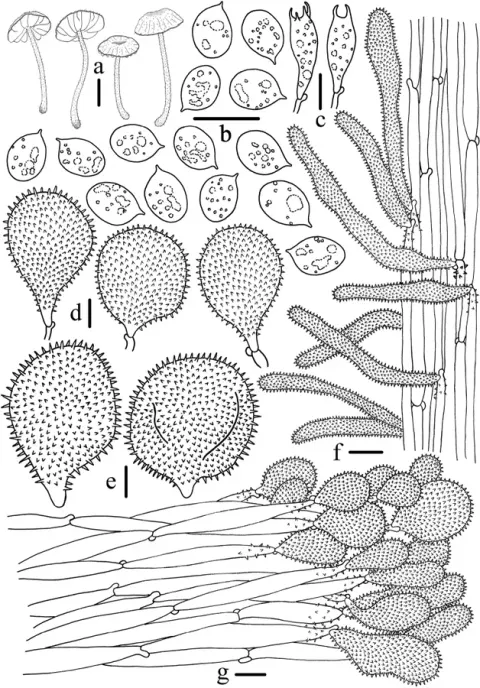
The cap of M. galopus is egg-shaped when young, later becoming conic to somewhat bell-shaped, and eventually reaching a diameter of 0.5 to 2.5 cm. The variety candida is similar in appearance to the main variety, except its fruit body is completely white. Variety nigra has a dark or blackish-gray cap, and gills that are initially whitish before turning gray. Although not poisonous, M. galopus and the varieties candida and nigra are inedible. The spores are 9–13 by 5–6.5 μm, smooth, ellipsoid, occasionally somewhat pear-shaped, and very weakly amyloid. The basidia are four-spored. The pleurocystidia and cheilocystidia are similar and very abundant, and measure 70–90 by 9–15 μm. They are narrowly fusoid-ventricose and usually have abruptly pointed tips, sometimes forked or branched near the apex, hyaline, and smooth. The flesh of the gill is homogeneous, and stains dark vinaceous-brown in iodine. The flesh of the cap has a thin but clearly differentiated pellicle, a well-developed hypoderm (the tissue layer immediately underneath the pellicle), and the remainder is filamentous. All but the pellicle stain vinaceous-brown in iodine.

Sebagian uraian ditampilkan dalam bahasa sumber; terjemahannya belum tersedia atau belum lolos pemeriksaan.

Rujukan: [1]

Pengukuran mengikuti objek, spesimen atau kultur, dan metode yang disebutkan sumber. Baca uraian asli untuk konteks lengkap.

02 / Kehidupan

Habitat dan peran ekologis

Mycena galopus adalah jamur saprobik, dan memainkan peran penting dalam ekosistem hutan sebagai pengurai sampah daun. Di Inggris diperkirakan untuk menyumbang sebagian besar dari kerusakan daun musim gugur di British woodlands. Hal ini mampu memecah komponen lignin dan selulosa dari sampah daun. Grown in budaya axenik di laboratorium, mycelium jamur telah terbukti memburuk (selain lignin dan selulosa) hemicellulose, protein, karbohidrat larut, dan xylan dan pektin yang dimurnikan menggunakan enzim seperti polifenol oksidase, cellulase, dan katalase. Hal ini sangat terampil dalam memecah lignin, yang merupakan senyawa organik terbarukan kedua yang paling banyak di biosfer, setelah selulosa. Research also menunjukkan bahwa jamur mengurai mineral tanah, sehingga lebih mudah diakses oleh tanaman mikoriza. Fosfor, makronutrien penting yang mempengaruhi pertumbuhan tanaman, biasanya terjadi pada mineral primer seperti apatit, atau kompleks organik lainnya, dan kelarutan rendahnya sering menghasilkan ketersediaan fosfor yang rendah di tanah. Aktivitas biologis M. galopus micelium dapat meningkatkan ketersediaan fosfor dan nutrisi lainnya, baik sebagai akibat dari penyedutan tanah karena penyerapan kation dan melalui pelepasan agen cuaca seperti asam organik massa molekul rendah.

Rujukan: [1]

Habitat atau konteks temuan
hutan; kultur yang didokumentasikan
Substrat
tanah
Peran atau konteks
Pengurai; Mitra tumbuhan
Temukan hubungan serupa
03 / Siklus hidup

Reproduksi

The spores are 9–13 by 5–6.5 μm, smooth, ellipsoid, occasionally somewhat pear-shaped, and very weakly amyloid. The basidia are four-spored. The pleurocystidia and cheilocystidia are similar and very abundant, and measure 70–90 by 9–15 μm. They are narrowly fusoid-ventricose and usually have abruptly pointed tips, sometimes forked or branched near the apex, hyaline, and smooth. The flesh of the gill is homogeneous, and stains dark vinaceous-brown in iodine. The flesh of the cap has a thin but clearly differentiated pellicle, a well-developed hypoderm (the tissue layer immediately underneath the pellicle), and the remainder is filamentous. All but the pellicle stain vinaceous-brown in iodine.

Sebagian uraian ditampilkan dalam bahasa sumber; terjemahannya belum tersedia atau belum lolos pemeriksaan.

Rujukan: [1]

Sinonim menurut acuan taksonomi rilis: Agaricus galopus; Agaricus galopus var. pilosus; Agaricus leucogalus; Mycena atrocyanea var. nigricans; Mycena fusconigra; Mycena galopus f. ampelodesmi; Mycena galopus f. gracilis; Mycena galopus var. alba; Mycena galopus var. candida; Mycena galopus var. leucogala; Mycena galopus var. nigra; Mycena leucogala
04 / Batas informasi

Catatan identitas dan cakupan

  • Nama diterima mengikuti Catalogue of Life Base2026-09-11; uraian mempertahankan konsep dan nama sumber aslinya.
  • Original geographic, specimen and life-cycle scope retained; source import awaits individual editorial review.
  • Impor dan terjemahan otomatis belum diperiksa editorial per profil. Struktur reproduktif yang disebutkan tidak membuktikan seluruh siklus hidup diketahui.
  • Pengukuran pada uraian mengikuti spesimen, kultur, dan metode sumber; angka tidak diperluas ke semua populasi.

Catatan distribusi dalam narasi mengikuti sumbernya. Dokumentasi spesimen atau foto mengikuti catatan sumber. Bukti wilayah Indonesia dan penilaian konservasi tidak disimpulkan dari gambar.

05 / Dokumentasi

Melihat dengan konteks

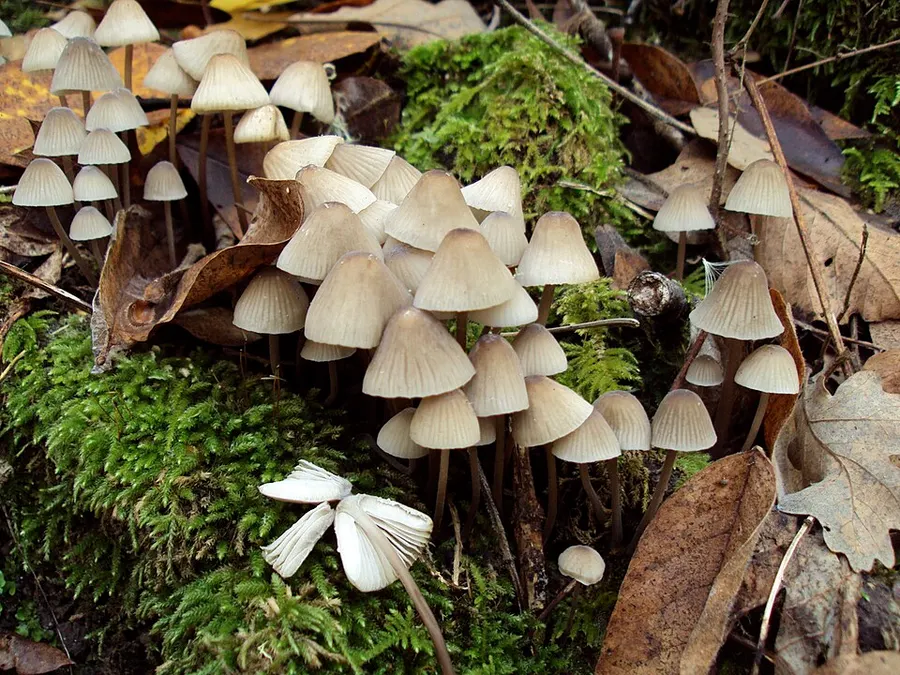
Dokumentasi Mycena galopus dari Wikimedia Commons. Fruit bodies of the fungus Mycena galopus (Pers.) P. Kumm. Specimens photographed in San Pablo Reservoir, Contra Costa Co., California, USA. Notes: "These were growing densely on a well decayed branch under live oak, Quercus agriflolia, in moist shady conditions." Identifikasi mengikuti record berkas sumber.

Jenis
Fotografi
Kredit
This image was created by user Richard Sullivan (enchplant) at Mushroom Observer , a source for mycological images. You can contact this user here .
Sumber media
Buka entri sumber

Gambar menunjukkan objek menurut identifikasi sumber, bukan verifikasi independen spesimen oleh Fungi. Tidak ada skala baru yang ditambahkan.

06 / Rujukan

Sumber profil

  1. [1] Mycena galopus — Wikipedia (en)Bagian sumber: Frozen revision 1319456302
    Tanggal penghimpunan sumber: 2026-10-12
    Teks sumber: CC BY-SA4.0 · Wikipedia contributors
  2. [2] Catalogue of Life Base2026-09-11 — Mycena galopusBagian sumber: ColDP NameUsage.tsv ID 44T6J; accepted species; source 2073
    Tanggal penghimpunan sumber: 2026-10-12
  3. [3] Dokumentasi visual — Mycena galopusBagian sumber: Individual media record; identification follows the source, not independent determination
    Tanggal penghimpunan sumber: 2026-10-12
    Media sumber: CC BY-SA 3.0 · This image was created by user Richard Sullivan (enchplant) at Mushroom Observer , a source for mycological images. You can contact this user here .

Adaptasi teks: CC BY-SA 4.0. Wikipedia contributors — Mycena galopus — Wikipedia (en)

Uraian asli dan riwayat sumber

Riwayat atau halaman sumber

Ringkasan sumber

Mycena galopus is found in North America and Europe. The saprobic fungus is an important leaf litter decomposer, and able to utilize all the major constituents of plant litter. It is especially adept at attacking cellulose and lignin, the latter of which is the second most abundant renewable organic compound in the biosphere. The mushroom latex contains chemicals called benzoxepines, which are thought to play a role in a wound-activated chemical defense mechanism against yeasts and parasitic fungi.

Revisi sumber

Morfologi sumber

The cap of M. galopus is egg-shaped when young, later becoming conic to somewhat bell-shaped, and eventually reaching a diameter of 0.5 to 2.5 cm. The variety candida is similar in appearance to the main variety, except its fruit body is completely white. Variety nigra has a dark or blackish-gray cap, and gills that are initially whitish before turning gray. Although not poisonous, M. galopus and the varieties candida and nigra are inedible. The spores are 9–13 by 5–6.5 μm, smooth, ellipsoid, occasionally somewhat pear-shaped, and very weakly amyloid. The basidia are four-spored. The pleurocystidia and cheilocystidia are similar and very abundant, and measure 70–90 by 9–15 μm. They are narrowly fusoid-ventricose and usually have abruptly pointed tips, sometimes forked or branched near the apex, hyaline, and smooth. The flesh of the gill is homogeneous, and stains dark vinaceous-brown in iodine. The flesh of the cap has a thin but clearly differentiated pellicle, a well-developed hypoderm (the tissue layer immediately underneath the pellicle), and the remainder is filamentous. All but the pellicle stain vinaceous-brown in iodine.

Revisi sumber

Ekologi sumber

Mycena galopus is a saprobic fungus, and plays an important role in forest ecosystems as a decomposer of leaf litter. It has been estimated in the UK to account for a large portion of the decomposition of the autumn leaf litter in British woodlands. It is able to break down the lignin and cellulose components of leaf litter. Grown in axenic culture in the laboratory, the fungus mycelium has been shown to degrade (in addition to lignin and cellulose) hemicelluloses, protein, soluble carbohydrates, and purified xylan and pectin using enzymes such as polyphenol oxidases, cellulases, and catalase. It is particularly adept at breaking down lignin, which is the second most abundant renewable organic compound in the biosphere, after cellulose. Research also suggests that the fungus weathers soil minerals, making them more available to mycorrhizal plants. Phosphorus, an important macronutrient influencing plant growth, typically occurs in primary minerals like apatite, or other organic complexes, and its low solubility often results in low phosphorus availability in soil. The biological activity of M. galopus mycelium can increase the availability of phosphorus and other nutrients, both as a result of soil acidification due to cation uptake and via the release of weathering agents such low molecular mass organic acids.

Revisi sumber

Struktur reproduksi sumber

The spores are 9–13 by 5–6.5 μm, smooth, ellipsoid, occasionally somewhat pear-shaped, and very weakly amyloid. The basidia are four-spored. The pleurocystidia and cheilocystidia are similar and very abundant, and measure 70–90 by 9–15 μm. They are narrowly fusoid-ventricose and usually have abruptly pointed tips, sometimes forked or branched near the apex, hyaline, and smooth. The flesh of the gill is homogeneous, and stains dark vinaceous-brown in iodine. The flesh of the cap has a thin but clearly differentiated pellicle, a well-developed hypoderm (the tissue layer immediately underneath the pellicle), and the remainder is filamentous. All but the pellicle stain vinaceous-brown in iodine.

Revisi sumber

Rujukan halaman ini

Fungi. Mycena galopus. Rilis data fungi-2026-10-12-expansion-2. https://fungi-atlas.mgadib.chatgpt.site/jamur/mycena-galopus/.

Status: impor sumber; pemeriksaan editorial per profil belum selesai. Untuk klaim biologis, gunakan rujukan pada bagian terkait dan periksa konteks sumber aslinya.