01 / Morfologi

Ciri dan struktur

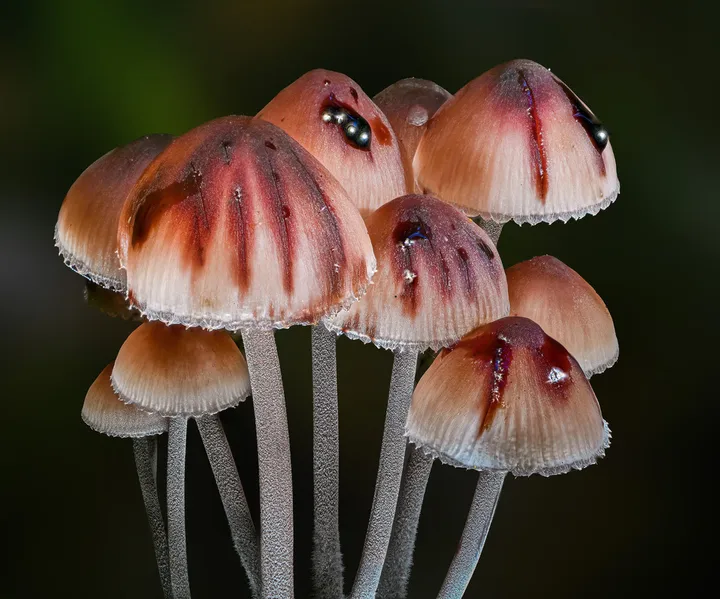
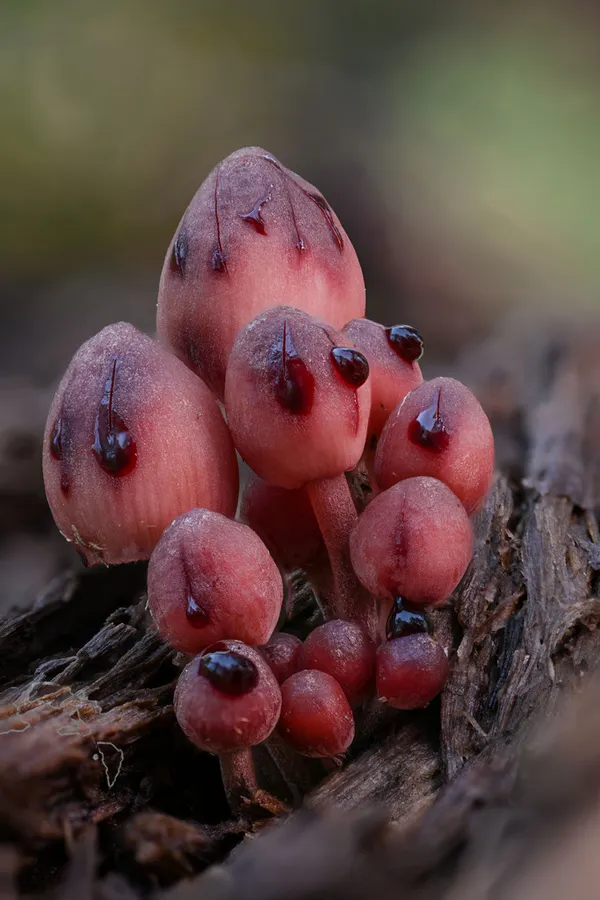
The fruit bodies of Mycena haematopus are the reproductive structures produced by cellular threads or hyphae which grow in rotting wood. The shape of the cap of the fruit body will vary depending on its maturity. Young caps, or "buttons", are ovoid (egg-shaped) to conical; later they are campanulate (bell-shaped), and as the fruit body matures, the margins (cap edge) lift upward so that the cap becomes somewhat flat with an umbo (a central nipple-shaped bump). The fully grown cap can reach up to 4 cm in diameter. The surface of the cap initially appears dry and covered with what appears to be a very fine whitish powder, but it soon becomes polished and moist. Mature caps appear somewhat translucent, and develop radial grooves mirroring the position of the gills underneath. The color of the cap is reddish- or pinkish-brown, often tinged with violet, and paler towards the edge. The margin is wavy like the edge of a scallop and may appear ragged because of lingering remnants of the partial veil. The gills have an adnate attachment to the stem, meaning they are more or less directly attached to it. They are initially whitish or "grayish vinaceous" in color, and can develop reddish-brown stains. Between 20 and 30 gills reach from the cap edge to the stem, resulting in a gill spacing that is described as "close to subdistant"—gaps are visible between adjacent gills. There are additional gills, called lamellulae, that do not extend directly from the margin to the stem; these are arranged in two or three series (tiers) of equal length. The stem is 3-9 cm tall and 0.1–0.2 cm thick, hollow and brittle, and a dark reddish-brown color.

Sebagian uraian ditampilkan dalam bahasa sumber; terjemahannya belum tersedia atau belum lolos pemeriksaan.

Rujukan: [1]

Pengukuran mengikuti objek, spesimen atau kultur, dan metode yang disebutkan sumber. Baca uraian asli untuk konteks lengkap.

02 / Kehidupan

Habitat dan peran ekologis

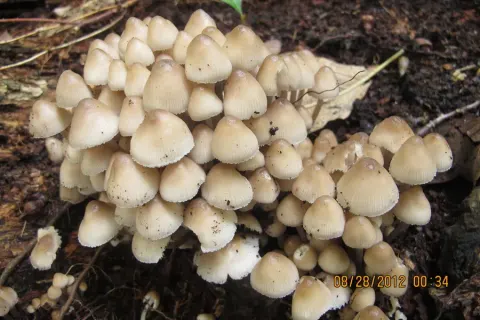
In North America, M. haematopus is distributed from Alaska southward. According to Mycena specialist Alexander H. Smith, it is "the commonest and the most easily recognized one in the genus". The species is common in Europe and has also been collected from Japan, and Mérida, Venezuela (as the variety M. haematopus var. marginata). In the Netherlands, M. haematopus is one of many mushrooms that can regularly be found fruiting on ancient timber wharves. The fruit bodies can be found year-round in mild weather. The mushroom obtains nutrients from decomposing organic matter (saprobic) and the fruit bodies can typically be found growing on stumps and well-decayed logs, usually in groups that are joined together by a common base. The decomposition of woody debris on the forest floor is the result of the combined activity of a community of fungal species. In the sequential succession of mushrooms species, M. haematopus is a "late colonizer" fungus: its fruit bodies appear after the wood has first been decayed by white rot species. The initial stage of wood decay by white rot fungi involves the breakdown of "acid-unhydrolyzable residue" and holocellulose (a mixture of cellulose and hemicellulose).

Sebagian uraian ditampilkan dalam bahasa sumber; terjemahannya belum tersedia atau belum lolos pemeriksaan.

Rujukan: [1]

Habitat atau konteks temuan
hutan
Substrat
Informasi belum tersedia pada sumber rilis ini.
Peran atau konteks
Pengurai
Temukan hubungan serupa
03 / Siklus hidup

Reproduksi

The fruit bodies of Mycena haematopus are the reproductive structures produced by cellular threads or hyphae which grow in rotting wood. The shape of the cap of the fruit body will vary depending on its maturity. Young caps, or "buttons", are ovoid (egg-shaped) to conical; later they are campanulate (bell-shaped), and as the fruit body matures, the margins (cap edge) lift upward so that the cap becomes somewhat flat with an umbo (a central nipple-shaped bump). The fully grown cap can reach up to 4 cm in diameter. The surface of the cap initially appears dry and covered with what appears to be a very fine whitish powder, but it soon becomes polished and moist. Mature caps appear somewhat translucent, and develop radial grooves mirroring the position of the gills underneath.

Sebagian uraian ditampilkan dalam bahasa sumber; terjemahannya belum tersedia atau belum lolos pemeriksaan.

Rujukan: [1]

Sinonim menurut acuan taksonomi rilis: Agaricus haematopus; Agaricus haematopus var. umbilicatus; Galactopus haematopus; Mycena haematopus var. chilensis; Mycena haematopus var. cuspidata; Mycena haematopus var. marginata; Mycena haematopus var. umbilicata; Mycena sanguinolenta var. cuspidata
04 / Batas informasi

Catatan identitas dan cakupan

  • Nama diterima mengikuti Catalogue of Life Base2026-09-11; uraian mempertahankan konsep dan nama sumber aslinya.
  • Original geographic, specimen and life-cycle scope retained; source import awaits individual editorial review.
  • Impor dan terjemahan otomatis belum diperiksa editorial per profil. Struktur reproduktif yang disebutkan tidak membuktikan seluruh siklus hidup diketahui.
  • Pengukuran pada uraian mengikuti spesimen, kultur, dan metode sumber; angka tidak diperluas ke semua populasi.

Catatan distribusi dalam narasi mengikuti sumbernya. Dokumentasi spesimen atau foto mengikuti catatan sumber. Bukti wilayah Indonesia dan penilaian konservasi tidak disimpulkan dari gambar.

05 / Dokumentasi

Melihat dengan konteks

Dokumentasi Mycena haematopus menurut asosiasi foto pada record takson iNaturalist. Kredit: Alan Rockefeller. Identitas mengikuti sumber; bukan penentuan spesimen independen.

Jenis
Fotografi
Kredit
(c) Alan Rockefeller, some rights reserved (CC BY), uploaded by Alan Rockefeller
Lisensi
CC BY 4.0
Sumber media
Buka entri sumber

Gambar menunjukkan objek menurut identifikasi sumber, bukan verifikasi independen spesimen oleh Fungi. Tidak ada skala baru yang ditambahkan.

Dokumentasi tambahan

06 / Rujukan

Sumber profil

  1. [1] Mycena haematopus — Wikipedia (en)Bagian sumber: Frozen revision 1342970710
    Tanggal penghimpunan sumber: 2026-10-12
    Teks sumber: CC BY-SA4.0 · Wikipedia contributors
  2. [2] Catalogue of Life Base2026-09-11 — Mycena haematopusBagian sumber: ColDP NameUsage.tsv ID 44T88; accepted species; source 2073
    Tanggal penghimpunan sumber: 2026-10-12
  3. [3] Dokumentasi visual — Mycena haematopusBagian sumber: Identitas mengikuti sumber dokumentasi; bukan penentuan spesimen independen.
    Tanggal penghimpunan sumber: 2026-10-17
    Media sumber: CC BY 4.0 · (c) Alan Rockefeller, some rights reserved (CC BY), uploaded by Alan Rockefeller
  4. [4] Dokumentasi visual — Mycena haematopusBagian sumber: Identitas mengikuti sumber dokumentasi; bukan penentuan spesimen independen.
    Tanggal penghimpunan sumber: 2026-10-17
    Teks sumber: CC BY 4.0 · (c) Alan Rockefeller, some rights reserved (CC BY), uploaded by Alan Rockefeller

Adaptasi teks: CC BY-SA 4.0. Wikipedia contributors — Mycena haematopus — Wikipedia (en)

Uraian asli dan riwayat sumber

Riwayat atau halaman sumber

Ringkasan sumber

Mycena haematopus, commonly known as the bleeding fairy helmet, the burgundydrop bonnet, or the bleeding Mycena, is a species of fungus in the family Mycenaceae, of the order Agaricales. First described scientifically in 1799, it is classified in the section Lactipedes of the genus Mycena, along with other species that produce a milky or colored latex. The fruit bodies of M. haematopus have caps that are up to 4 cm wide, whitish gills, and a thin, fragile reddish-brown stem with thick coarse hairs at the base.

Revisi sumber

Morfologi sumber

The fruit bodies of Mycena haematopus are the reproductive structures produced by cellular threads or hyphae which grow in rotting wood. The shape of the cap of the fruit body will vary depending on its maturity. Young caps, or "buttons", are ovoid (egg-shaped) to conical; later they are campanulate (bell-shaped), and as the fruit body matures, the margins (cap edge) lift upward so that the cap becomes somewhat flat with an umbo (a central nipple-shaped bump). The fully grown cap can reach up to 4 cm in diameter. The surface of the cap initially appears dry and covered with what appears to be a very fine whitish powder, but it soon becomes polished and moist. Mature caps appear somewhat translucent, and develop radial grooves mirroring the position of the gills underneath. The color of the cap is reddish- or pinkish-brown, often tinged with violet, and paler towards the edge. The margin is wavy like the edge of a scallop and may appear ragged because of lingering remnants of the partial veil. The gills have an adnate attachment to the stem, meaning they are more or less directly attached to it. They are initially whitish or "grayish vinaceous" in color, and can develop reddish-brown stains. Between 20 and 30 gills reach from the cap edge to the stem, resulting in a gill spacing that is described as "close to subdistant"—gaps are visible between adjacent gills. There are additional gills, called lamellulae, that do not extend directly from the margin to the stem; these are arranged in two or three series (tiers) of equal length. The stem is 3-9 cm tall and 0.1–0.2 cm thick, hollow and brittle, and a dark reddish-brown color.

Revisi sumber

Ekologi sumber

In North America, M. haematopus is distributed from Alaska southward. According to Mycena specialist Alexander H. Smith, it is "the commonest and the most easily recognized one in the genus". The species is common in Europe and has also been collected from Japan, and Mérida, Venezuela (as the variety M. haematopus var. marginata). In the Netherlands, M. haematopus is one of many mushrooms that can regularly be found fruiting on ancient timber wharves. The fruit bodies can be found year-round in mild weather. The mushroom obtains nutrients from decomposing organic matter (saprobic) and the fruit bodies can typically be found growing on stumps and well-decayed logs, usually in groups that are joined together by a common base. The decomposition of woody debris on the forest floor is the result of the combined activity of a community of fungal species. In the sequential succession of mushrooms species, M. haematopus is a "late colonizer" fungus: its fruit bodies appear after the wood has first been decayed by white rot species. The initial stage of wood decay by white rot fungi involves the breakdown of "acid-unhydrolyzable residue" and holocellulose (a mixture of cellulose and hemicellulose).

Revisi sumber

Struktur reproduksi sumber

The fruit bodies of Mycena haematopus are the reproductive structures produced by cellular threads or hyphae which grow in rotting wood. The shape of the cap of the fruit body will vary depending on its maturity. Young caps, or "buttons", are ovoid (egg-shaped) to conical; later they are campanulate (bell-shaped), and as the fruit body matures, the margins (cap edge) lift upward so that the cap becomes somewhat flat with an umbo (a central nipple-shaped bump). The fully grown cap can reach up to 4 cm in diameter. The surface of the cap initially appears dry and covered with what appears to be a very fine whitish powder, but it soon becomes polished and moist. Mature caps appear somewhat translucent, and develop radial grooves mirroring the position of the gills underneath.

Revisi sumber

Rujukan halaman ini

Fungi. Mycena haematopus. Rilis data fungi-2026-10-12-expansion-2. https://fungi-atlas.mgadib.chatgpt.site/jamur/mycena-haematopus/.

Status: impor sumber; pemeriksaan editorial per profil belum selesai. Untuk klaim biologis, gunakan rujukan pada bagian terkait dan periksa konteks sumber aslinya.