01 / Morfologi

Ciri dan struktur

Pileus concave with slight pruinose. Lamellae distant. Stipe with dense white fibrils and swollen base. Acanthocysts forming two types. Caulocystidia long-elliptic with conical excrescences, up to 120 μm long. Pileus 1.5–2.5 mm in diam., campanulate to hemispherical, applanate or slightly concave at centre, white with greyish shade (6B1), shallowly sulcate, translucent-striate, slightly pruinose, pubescent. Context white, thin and very fragile. Lamellae distant, sparse, white, concolorous with the sides. Stipe 4.5–8.2 × 0.5–0.8 mm, cylindrical, hollow, fragile, pure white (5A1) with a greyish (5B1) base, covered with dense white fibrils, base swollen and not forming basal disc, hirsute. Odour and taste indistinctive. Basidiospores (6.9-)7.2-8.9(-9.3) × (5.3-)6.4-6.7(-7.1) μm, Q=1.2–1.5, Qav=1.31, broadly-ellipsoid, hyaline in water and 5% KOH, amyloid, smooth. Basidia 15–21 × 7–9 μm, 4- or 2-spored, clavate, hyaline. Cheilocystidia 23–37 × 19–28 μm, subglobose, sphaero-pedunculate to utriform with numerous sharp spines, thin-walled and hyaline, inamyloid. Pleurocystidia absent. Pileipellis hyphae 3–9 μm wide, dextrinoid; cherocytes absent; a cutis overlaid by elements of universal veil, not in chains; acanthocysts forming two types, pyriform to vesicular, 13–29 × 11–24 μm, clavate to ovoid or obovoid, 29–42 × 14–20 μm, inamyloid. Hyphae of the stipitipellis 3–7 μm wide, smooth, dextrinoid; caulocystidia abundant, clavate, long-elliptic, 32–122 × 8–11 μm, with numbers of conical spines, inamyloid. Clamps present in all tissues.

Sebagian uraian ditampilkan dalam bahasa sumber; terjemahannya belum tersedia atau belum lolos pemeriksaan.

Rujukan: [1]

Pengukuran mengikuti objek, spesimen atau kultur, dan metode yang disebutkan sumber. Baca uraian asli untuk konteks lengkap.

02 / Kehidupan

Habitat dan peran ekologis

Mycena hygrophoroides could be considered to be a member of Hemimycena Singer owing to the tiny basidiomata and sparse lamellae, but the absence of a basal disc, amyloid spores and spinulose cheilocystidia, acanthocysts and caulocystidia are diagnostic characters for M. hygrophoroides, which should be placed in Mycena sect. Amparoina stirps Alphitophora. Mycena acanthophila J.C.Zamora&Català, of which the holotype was collected from Spain growing on dead branches of Leguminosae, most resembles M. hygrophoroides, but differs in having a yellow pileus, smaller cheilocystidia (13.5–22 × 8.5–12 μm) and diverse caulocystidia (Zamora and Català 2012). Mycena depilata, a species of stirps Alphitophora, shows some morphological similarities to M. hygrophoroides in possessing white and tiny basidiomata, distant lamellae (L = 7–9) and globose-pedicellate acanthocysts with hyaline contents. However, M. depilata differs in producing ellipsoid spores (Q = 1.64 ± 0.11), broadly clavate cheilocystidia and shorter caulocystidia (16–50 × 5–16 μm; Singer 1989). Mycena hemitrichialis is difficult to distinguish from M. hygrophoroides, but M. hemitrichialis has free to subfree lamellae, longer caulocystidia (100–300 × 5–15 μm) and ellipsoid spores (Singer 1989).

Sebagian uraian ditampilkan dalam bahasa sumber; terjemahannya belum tersedia atau belum lolos pemeriksaan.

Rujukan: [1]

Habitat atau konteks temuan
Informasi belum tersedia pada sumber rilis ini.
Substrat
kayu
Peran atau konteks
Belum dikategorikan pada rilis ini.
Temukan hubungan serupa
03 / Siklus hidup

Reproduksi

Pileus 1.5–2.5 mm in diam., campanulate to hemispherical, applanate or slightly concave at centre, white with greyish shade (6B1), shallowly sulcate, translucent-striate, slightly pruinose, pubescent. Context white, thin and very fragile. Lamellae distant, sparse, white, concolorous with the sides. Stipe 4.5–8.2 × 0.5–0.8 mm, cylindrical, hollow, fragile, pure white (5A1) with a greyish (5B1) base, covered with dense white fibrils, base swollen and not forming basal disc, hirsute. Odour and taste indistinctive. Basidiospores (6.9-)7.2-8.9(-9.3) × (5.3-)6.4-6.7(-7.1) μm, Q=1.2–1.5, Qav=1.31, broadly-ellipsoid, hyaline in water and 5% KOH, amyloid, smooth. Basidia 15–21 × 7–9 μm, 4- or 2-spored, clavate, hyaline.

Sebagian uraian ditampilkan dalam bahasa sumber; terjemahannya belum tersedia atau belum lolos pemeriksaan.

Rujukan: [1]

04 / Batas informasi

Catatan identitas dan cakupan

  • Nama diterima mengikuti Catalogue of Life Base2026-09-11; uraian mempertahankan konsep dan nama sumber aslinya.
  • Preserve original treatment localities, hosts and substrate scope. Materials examined describe documented specimens, not the full global range.
  • Impor dan terjemahan otomatis belum diperiksa editorial per profil. Struktur reproduktif yang disebutkan tidak membuktikan seluruh siklus hidup diketahui.
  • Pengukuran pada uraian mengikuti spesimen, kultur, dan metode sumber; angka tidak diperluas ke semua populasi.

Catatan distribusi dalam narasi mengikuti sumbernya. Dokumentasi spesimen atau foto mengikuti catatan sumber. Bukti wilayah Indonesia dan penilaian konservasi tidak disimpulkan dari gambar.

05 / Dokumentasi

Melihat dengan konteks

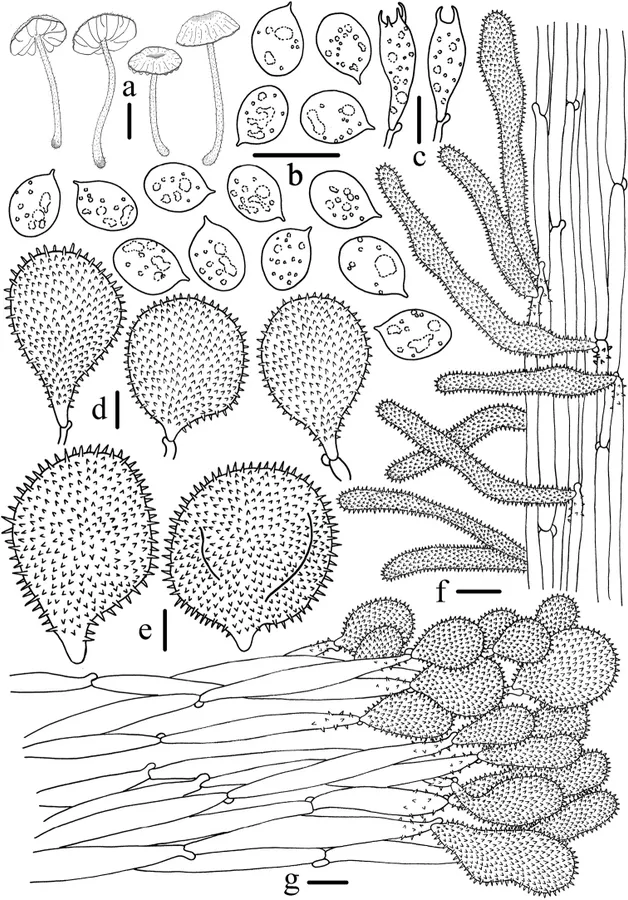
Microscopic features of Mycena hygrophoroides (HMJAU 43417, holotype) a Basidiomata b Basidia c Basidiospores d Cheilocystidia e Universal veil acanthocysts f Caulocystidia g Pileipellis. Scale bars: 2 mm (a); 10 μm (b–g). Drawing by Qin Na.

Jenis
Pelat ilmiah
Kredit
Qin Na, Tolgor Bau
Lisensi
CC BY 4.0
Sumber media
Buka entri sumber

Gambar menunjukkan objek menurut identifikasi sumber, bukan verifikasi independen spesimen oleh Fungi. Tidak ada skala baru yang ditambahkan.

06 / Rujukan

Sumber profil

  1. [1] Recognition of Mycena sect. Amparoina sect. nov. (Mycenaceae, Agaricales), including four new species and revision of the limits of sect. Sacchariferae — Mycena hygrophoroidesBagian sumber: PMC6533235_section_29
    Tanggal penghimpunan sumber: 2026-10-12
    Teks sumber: CC BY 4.0 · Na Q, Bau T.
  2. [2] Catalogue of Life Base2026-09-11 — Mycena hygrophoroidesBagian sumber: ColDP NameUsage.tsv ID 44T9B; accepted species; source 2073
    Tanggal penghimpunan sumber: 2026-10-12
  3. [3] Dokumentasi visual — Mycena hygrophoroidesBagian sumber: Individual media record; identification follows the source, not independent determination
    Tanggal penghimpunan sumber: 2026-10-12
    Media sumber: CC BY 4.0 · Qin Na, Tolgor Bau

Adaptasi teks: CC BY 4.0. Na Q, Bau T. — Recognition of Mycena sect. Amparoina sect. nov. (Mycenaceae, Agaricales), including four new species and revision of the limits of sect. Sacchariferae — Mycena hygrophoroides

Uraian asli dan riwayat sumber

Riwayat atau halaman sumber

Ringkasan sumber

Pileus concave with slight pruinose. Lamellae distant. Stipe with dense white fibrils and swollen base. Acanthocysts forming two types. Caulocystidia long-elliptic with conical excrescences, up to 120 μm long. Pileus 1.5–2.5 mm in diam., campanulate to hemispherical, applanate or slightly concave at centre, white with greyish shade (6B1), shallowly sulcate, translucent-striate, slightly pruinose, pubescent. Context white, thin and very fragile. Lamellae distant, sparse, white, concolorous with the sides.

Revisi sumber

Morfologi sumber

Pileus concave with slight pruinose. Lamellae distant. Stipe with dense white fibrils and swollen base. Acanthocysts forming two types. Caulocystidia long-elliptic with conical excrescences, up to 120 μm long. Pileus 1.5–2.5 mm in diam., campanulate to hemispherical, applanate or slightly concave at centre, white with greyish shade (6B1), shallowly sulcate, translucent-striate, slightly pruinose, pubescent. Context white, thin and very fragile. Lamellae distant, sparse, white, concolorous with the sides. Stipe 4.5–8.2 × 0.5–0.8 mm, cylindrical, hollow, fragile, pure white (5A1) with a greyish (5B1) base, covered with dense white fibrils, base swollen and not forming basal disc, hirsute. Odour and taste indistinctive. Basidiospores (6.9-)7.2-8.9(-9.3) × (5.3-)6.4-6.7(-7.1) μm, Q=1.2–1.5, Qav=1.31, broadly-ellipsoid, hyaline in water and 5% KOH, amyloid, smooth. Basidia 15–21 × 7–9 μm, 4- or 2-spored, clavate, hyaline. Cheilocystidia 23–37 × 19–28 μm, subglobose, sphaero-pedunculate to utriform with numerous sharp spines, thin-walled and hyaline, inamyloid. Pleurocystidia absent. Pileipellis hyphae 3–9 μm wide, dextrinoid; cherocytes absent; a cutis overlaid by elements of universal veil, not in chains; acanthocysts forming two types, pyriform to vesicular, 13–29 × 11–24 μm, clavate to ovoid or obovoid, 29–42 × 14–20 μm, inamyloid. Hyphae of the stipitipellis 3–7 μm wide, smooth, dextrinoid; caulocystidia abundant, clavate, long-elliptic, 32–122 × 8–11 μm, with numbers of conical spines, inamyloid. Clamps present in all tissues.

Revisi sumber

Ekologi sumber

Mycena hygrophoroides could be considered to be a member of Hemimycena Singer owing to the tiny basidiomata and sparse lamellae, but the absence of a basal disc, amyloid spores and spinulose cheilocystidia, acanthocysts and caulocystidia are diagnostic characters for M. hygrophoroides, which should be placed in Mycena sect. Amparoina stirps Alphitophora. Mycena acanthophila J.C.Zamora&Català, of which the holotype was collected from Spain growing on dead branches of Leguminosae, most resembles M. hygrophoroides, but differs in having a yellow pileus, smaller cheilocystidia (13.5–22 × 8.5–12 μm) and diverse caulocystidia (Zamora and Català 2012). Mycena depilata, a species of stirps Alphitophora, shows some morphological similarities to M. hygrophoroides in possessing white and tiny basidiomata, distant lamellae (L = 7–9) and globose-pedicellate acanthocysts with hyaline contents. However, M. depilata differs in producing ellipsoid spores (Q = 1.64 ± 0.11), broadly clavate cheilocystidia and shorter caulocystidia (16–50 × 5–16 μm; Singer 1989). Mycena hemitrichialis is difficult to distinguish from M. hygrophoroides, but M. hemitrichialis has free to subfree lamellae, longer caulocystidia (100–300 × 5–15 μm) and ellipsoid spores (Singer 1989).

Revisi sumber

Struktur reproduksi sumber

Pileus 1.5–2.5 mm in diam., campanulate to hemispherical, applanate or slightly concave at centre, white with greyish shade (6B1), shallowly sulcate, translucent-striate, slightly pruinose, pubescent. Context white, thin and very fragile. Lamellae distant, sparse, white, concolorous with the sides. Stipe 4.5–8.2 × 0.5–0.8 mm, cylindrical, hollow, fragile, pure white (5A1) with a greyish (5B1) base, covered with dense white fibrils, base swollen and not forming basal disc, hirsute. Odour and taste indistinctive. Basidiospores (6.9-)7.2-8.9(-9.3) × (5.3-)6.4-6.7(-7.1) μm, Q=1.2–1.5, Qav=1.31, broadly-ellipsoid, hyaline in water and 5% KOH, amyloid, smooth. Basidia 15–21 × 7–9 μm, 4- or 2-spored, clavate, hyaline.

Revisi sumber

Rujukan halaman ini

Fungi. Mycena hygrophoroides. Rilis data fungi-2026-10-12-expansion-2. https://fungi-atlas.mgadib.chatgpt.site/jamur/mycena-hygrophoroides/.

Status: impor sumber; pemeriksaan editorial per profil belum selesai. Untuk klaim biologis, gunakan rujukan pada bagian terkait dan periksa konteks sumber aslinya.