Ciri dan struktur
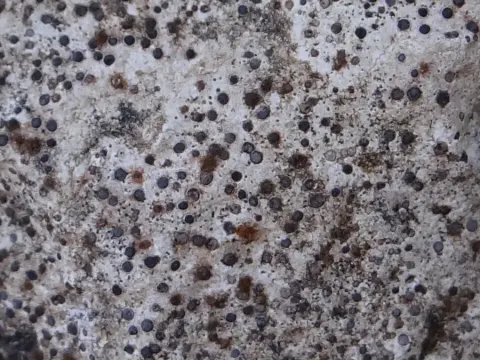
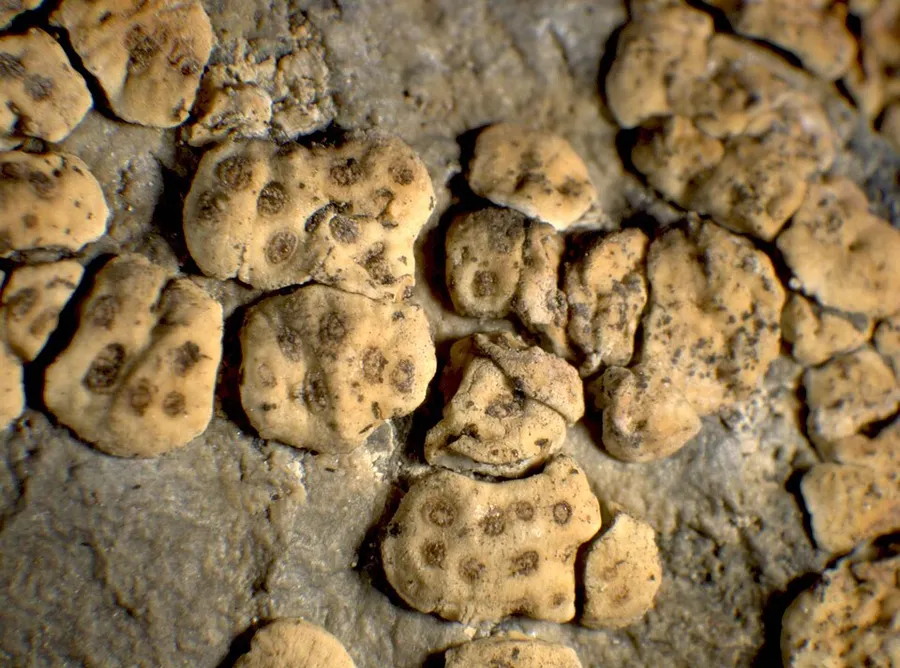
The thallus of Myriospora myochroa grows directly on rock surfaces (epilithic), forming a crust of individual patches () that may remain separate or merge and lift at the edges into small, scale-like plates () up to about 4.5 mm across. These patches are typically 1.0–2.4 mm wide (occasionally as small as 0.6 mm) and range in colour from whitish or grey to brownish-grey and even dark brown or black. The surface is mostly uneven and dull, sometimes showing faint, concentric ripples. A thin, often uneven film of dead fungal cells (the ), 2–45 micrometre (μm) thick) lies just above the , which itself is 30–60 μm thick and contains scattered groups of crystals. Underneath this layer lies the algal partner and inner fungal tissue. In Baltic collections the cortex usually reacts K+ (yellow) and contains norstictic acid crystals visible under polarised light; the areoles are markedly convex and the apothecial discs uneven. Reproductive structures (apothecia) occur in groups of one to four (rarely up to fourteen) within each areole. These begin immersed in the thallus before expanding into saucer-shaped 0.15–0.70 mm across, flush or slightly sunken relative to the surrounding crust and coloured dark brown. The (the rim formed by fungal tissue around the disc) is clear and about 30 μm thick at its base, widening to 90 μm above, while the layer just above the spore sac (the ) is reddish to dark brown. The hymenium (spore-bearing layer) stands 120–230 μm high and contains unbranched or slightly branched supporting filaments (paraphyses) about 1–1.5 μm thick, with tips up to 2 μm wide.
Habitat dan peran ekologis
Myriospora myochroa specialises on silicate rocks, particularly favouring undercut or overhanging surfaces where moisture is retained. It tolerates a wide elevational range, from sea-level coastal outcrops subjected to sea spray through to montane exposures above 2,400 m. The species has a broad Eurasian distribution, with verified records from Asia and Europe, including the Czech Republic, Finland, France, Germany, Italy, Norway, Poland, Russia (Siberia) and Sweden. In coastal settings it often inhabits the splash zone where waves deposit salt-laden moisture, while inland it is typically found on shaded rock overhangs that provide stable humidity and protection from direct precipitation. Myriospora myochroa is firmly saxicolous, growing almost exclusively on siliceous substrates. Throughout its range it frequents sheltered, moisture-retaining microhabitats such as undercut faces, shallow caves and overhanging ledges, but it also persists on fully exposed boulders where the rock retains enough surface water to prevent desiccation. In the Baltic coastal zone of Germany the species is most abundant in the epilittoral belt (entirely above the normal water level and never submerged by water), colonising wave-washed granite or gneiss blocks that form beaches, harbour walls and rip-rap sea defences.
- Habitat atau konteks temuan
- Informasi belum tersedia pada sumber rilis ini.
- Substrat
- Informasi belum tersedia pada sumber rilis ini.
- Peran atau konteks
- Pembentuk liken
Reproduksi
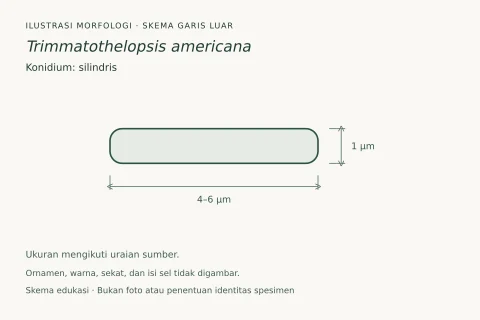
Reproductive structures (apothecia) occur in groups of one to four (rarely up to fourteen) within each areole. These begin immersed in the thallus before expanding into saucer-shaped 0.15–0.70 mm across, flush or slightly sunken relative to the surrounding crust and coloured dark brown. The (the rim formed by fungal tissue around the disc) is clear and about 30 μm thick at its base, widening to 90 μm above, while the layer just above the spore sac (the ) is reddish to dark brown. The hymenium (spore-bearing layer) stands 120–230 μm high and contains unbranched or slightly branched supporting filaments (paraphyses) about 1–1.5 μm thick, with tips up to 2 μm wide. Asci (spore sacs) reach 120 × 22 μm and release narrowly ellipsoid measuring roughly 3–5 × 1–1.5 μm.
Catatan identitas dan cakupan
- Nama diterima mengikuti Catalogue of Life Base2026-09-11; uraian mempertahankan konsep dan nama sumber aslinya.
- Original geographic, specimen and life-cycle scope retained; source import awaits individual editorial review.
- Impor dan terjemahan otomatis belum diperiksa editorial per profil. Struktur reproduktif yang disebutkan tidak membuktikan seluruh siklus hidup diketahui.
- Pengukuran pada uraian mengikuti spesimen, kultur, dan metode sumber; angka tidak diperluas ke semua populasi.
Catatan distribusi dalam narasi mengikuti sumbernya. Dokumentasi spesimen atau foto mengikuti catatan sumber. Bukti wilayah Indonesia dan penilaian konservasi tidak disimpulkan dari gambar.
Melihat dengan konteks
Dokumentasi Myriospora myochroa dari Wikimedia Commons. The crustose, rock-dwelling lichen Myriospora myochroa Identifikasi mengikuti record berkas sumber.
- Jenis
- Fotografi
- Kredit
- Pier Luigi Nimis
- Lisensi
- CC BY-SA 4.0
- Sumber media
- Buka entri sumber
Sumber profil
- [1] Myriospora myochroa — Wikipedia (en)
- [2] Catalogue of Life Base2026-09-11 — Myriospora myochroa
- [3] Dokumentasi visual — Myriospora myochroa
Rujukan halaman ini
Fungi. Myriospora myochroa. Rilis data fungi-2026-10-12-expansion-2. https://fungi-atlas.mgadib.chatgpt.site/jamur/myriospora-myochroa/.
Status: impor sumber; pemeriksaan editorial per profil belum selesai. Untuk klaim biologis, gunakan rujukan pada bagian terkait dan periksa konteks sumber aslinya.