01 / Morfologi

Ciri dan struktur

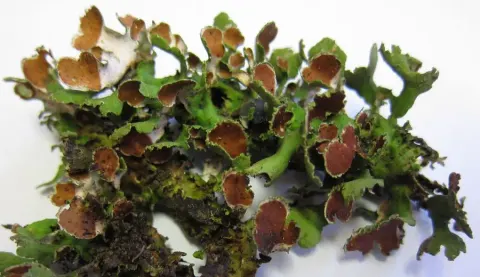
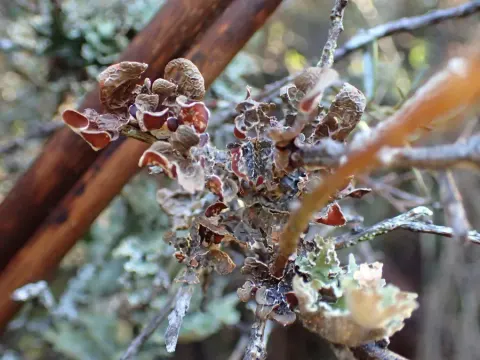
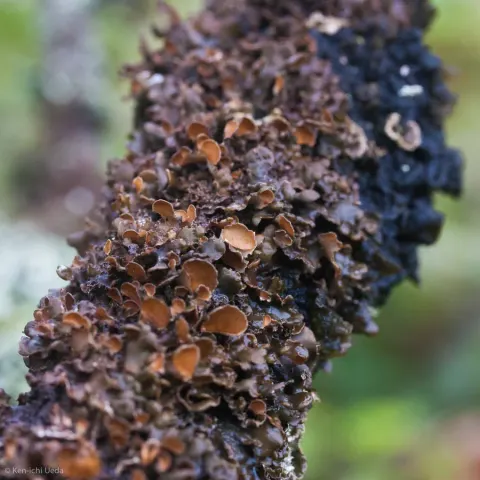
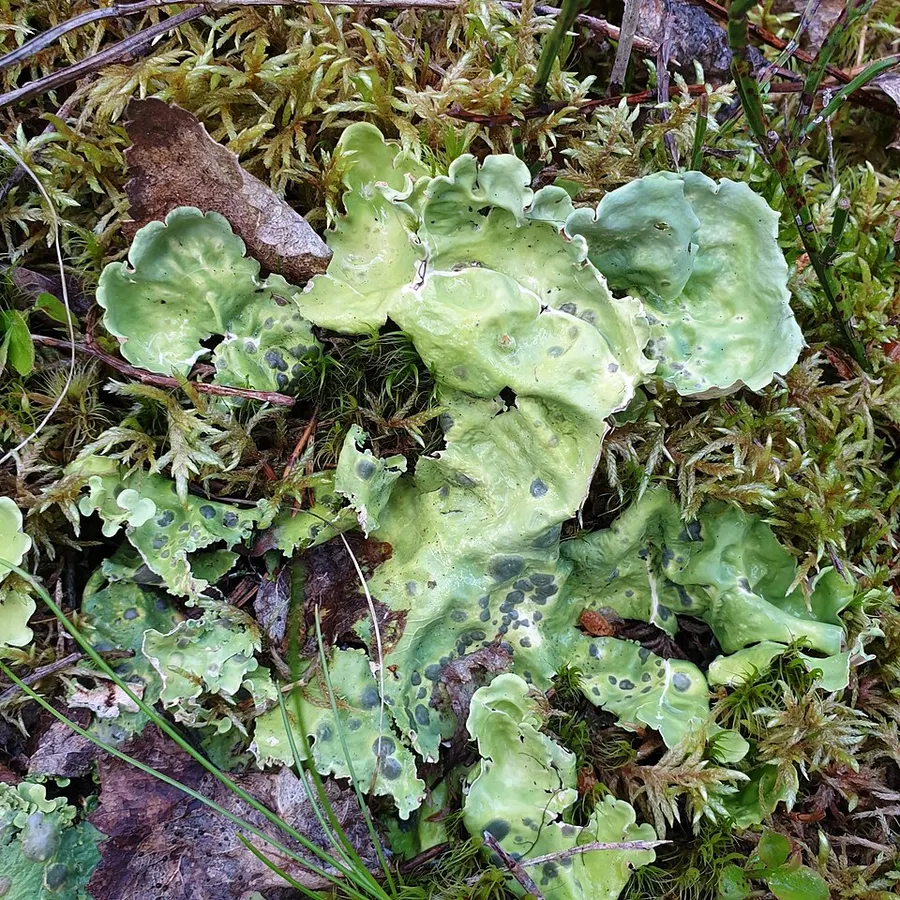
Nephroma arcticum has a foliose thallus that sometimes forms rosettes and sometimes is irregular, reaching up to about 8 cm, or rarely up to 15 cm across. Individual thalli can merge to form loose colonies up to 1 m wide. Individual of the thallus are up to 2 – 5 cm wide; they are smooth or slightly pitted, tongue-like, and have ascending margins. The upper thallus surface is yellow-green, blue-green or bright green, and often glossy. In contrast, the undersurface is dull with paler margins, and is darker towards the centre. It has a thick . The absence of and rhizines helps distinguish this species from similar-looking Peltigera species. Apothecia are common in Nephroma arcticum. They are red-orange to red-brown in colour, kidney-shaped, and typically measure 1 – 2 cm in diameter. Spores are 23–30 by 4–5 μm, have a somewhat shape, and contain three septa (internal partitions). Conidiomata are rare; when they occur, they appear at the margins of the lobes. They produce conidia (asexual spores) 3–4 by 1–2 μm. The photobiont is green (from the genus Coccomyxa); cyanobacteria (from genus Nostoc) are present in large, bluish cephalodia that are readily apparent in moist thalli. Neither isidia nor soredia, vegetative propagules found in many lichens, occur in this species. A blue-green (same fungal partner but different algae or cyanobacteria) of Nephroma arcticum was first reported from Norway in 1983. The chemistry of the blue-green phycotype is identical to that of the more common green phycotype, except for the absence of usnic acid in the blue-green. The cephalodia of N. arcticum can occasionally grow into separate thalli of moderate size.

Sebagian uraian ditampilkan dalam bahasa sumber; terjemahannya belum tersedia atau belum lolos pemeriksaan.

Rujukan: [1]

Pengukuran mengikuti objek, spesimen atau kultur, dan metode yang disebutkan sumber. Baca uraian asli untuk konteks lengkap.

02 / Kehidupan

Habitat dan peran ekologis

The species has a primarily arctic range, occurring throughout northern Canada from Alaska to Newfoundland, with isolated populations extending into New England and Wyoming. In Canada, it is abundant (S5) in British Columbia, Labrador, Quebec, and Yukon Territory, while being rare (S1) in Saskatchewan and imperiled (S2) in Nova Scotia and New Brunswick. In coastal Alaska, the species can be found growing on tree trunks, particularly those of Sitka spruce (Picea sitchensis) and Western hemlock (Tsuga heterophylla) in high-elevation forests. In British Columbia, it occurs in the Spruce-Willow-Birch biogeoclimactic zone. In Greenland, N. arcticum grows among mosses on soil in dwarf shrub heath. Nitrogen fixation by its cyanobacterial partner enables N. arcticum to outcompete neighbouring plants and colonise moss-covered rocks in nutrient-poor environments. The species reaches its largest sizes and produces abundant reproductive structures in arctic climates. It is classed as a "somewhat oceanic lichen", occurring most frequently in oceanic areas and more rarely in continental areas. One study of nearly 300 species of Western Carpathian flora (including vascular plants, bryophytes, and terrestrial lichens) suggests that Nephroma arcticum is one of the few species with a high probability of being a glacial relict.

Sebagian uraian ditampilkan dalam bahasa sumber; terjemahannya belum tersedia atau belum lolos pemeriksaan.

Rujukan: [1]

Habitat atau konteks temuan
hutan
Substrat
tanah
Peran atau konteks
Pembentuk liken
Temukan hubungan serupa
03 / Siklus hidup

Reproduksi

Apothecia are common in Nephroma arcticum. They are red-orange to red-brown in colour, kidney-shaped, and typically measure 1 – 2 cm in diameter. Spores are 23–30 by 4–5 μm, have a somewhat shape, and contain three septa (internal partitions). Conidiomata are rare; when they occur, they appear at the margins of the lobes. They produce conidia (asexual spores) 3–4 by 1–2 μm. The photobiont is green (from the genus Coccomyxa); cyanobacteria (from genus Nostoc) are present in large, bluish cephalodia that are readily apparent in moist thalli. Neither isidia nor soredia, vegetative propagules found in many lichens, occur in this species.

Sebagian uraian ditampilkan dalam bahasa sumber; terjemahannya belum tersedia atau belum lolos pemeriksaan.

Rujukan: [1]

Sinonim menurut acuan taksonomi rilis: Lichen arcticus; Lichen polaris; Nephroma polare; Nephromium arcticum; Opisteria arctica; Peltidea arctica; Peltidea polaris; Peltigera arctica; Peltigera polaris
04 / Batas informasi

Catatan identitas dan cakupan

  • Nama diterima mengikuti Catalogue of Life Base2026-09-11; uraian mempertahankan konsep dan nama sumber aslinya.
  • Original geographic, specimen and life-cycle scope retained; source import awaits individual editorial review.
  • Impor dan terjemahan otomatis belum diperiksa editorial per profil. Struktur reproduktif yang disebutkan tidak membuktikan seluruh siklus hidup diketahui.
  • Pengukuran pada uraian mengikuti spesimen, kultur, dan metode sumber; angka tidak diperluas ke semua populasi.

Catatan distribusi dalam narasi mengikuti sumbernya. Dokumentasi spesimen atau foto mengikuti catatan sumber. Bukti wilayah Indonesia dan penilaian konservasi tidak disimpulkan dari gambar.

05 / Dokumentasi

Melihat dengan konteks

Dokumentasi Nephroma arcticum dari Wikimedia Commons. Arctic Kidney Lichen ( Nephroma arcticum ) Identifikasi mengikuti record berkas sumber.

Jenis
Fotografi
Kredit
Cilla Moerman
Lisensi
CC BY 4.0
Sumber media
Buka entri sumber

Gambar menunjukkan objek menurut identifikasi sumber, bukan verifikasi independen spesimen oleh Fungi. Tidak ada skala baru yang ditambahkan.

06 / Rujukan

Sumber profil

  1. [1] Nephroma arcticum — Wikipedia (en)Bagian sumber: Frozen revision 1334907379
    Tanggal penghimpunan sumber: 2026-10-12
    Teks sumber: CC BY-SA4.0 · Wikipedia contributors
  2. [2] Catalogue of Life Base2026-09-11 — Nephroma arcticumBagian sumber: ColDP NameUsage.tsv ID 4725B; accepted species; source 2073
    Tanggal penghimpunan sumber: 2026-10-12
  3. [3] Dokumentasi visual — Nephroma arcticumBagian sumber: Individual media record; identification follows the source, not independent determination
    Tanggal penghimpunan sumber: 2026-10-12
    Media sumber: CC BY 4.0 · Cilla Moerman

Adaptasi teks: CC BY-SA 4.0. Wikipedia contributors — Nephroma arcticum — Wikipedia (en)

Uraian asli dan riwayat sumber

Riwayat atau halaman sumber

Ringkasan sumber

Nephroma arcticum, the arctic kidney lichen, is a species of foliose (leafy), terricolous (ground-dwelling) lichen in the family Parmeliaceae. It has a yellowish-green thallus up to 8 cm across made of large , with a dark, lower surface. It is a , consisting of a fungus and two photobiont partners: a species of nitrogen-fixing cyanobacteria (contained within dark, blistered cephalodia), and a species of green alga. First described by Carl Linnaeus in 1753, it is one of only two Nephroma species in North America that use green algae as their primary photobiont.

Revisi sumber

Morfologi sumber

Nephroma arcticum has a foliose thallus that sometimes forms rosettes and sometimes is irregular, reaching up to about 8 cm, or rarely up to 15 cm across. Individual thalli can merge to form loose colonies up to 1 m wide. Individual of the thallus are up to 2 – 5 cm wide; they are smooth or slightly pitted, tongue-like, and have ascending margins. The upper thallus surface is yellow-green, blue-green or bright green, and often glossy. In contrast, the undersurface is dull with paler margins, and is darker towards the centre. It has a thick . The absence of and rhizines helps distinguish this species from similar-looking Peltigera species. Apothecia are common in Nephroma arcticum. They are red-orange to red-brown in colour, kidney-shaped, and typically measure 1 – 2 cm in diameter. Spores are 23–30 by 4–5 μm, have a somewhat shape, and contain three septa (internal partitions). Conidiomata are rare; when they occur, they appear at the margins of the lobes. They produce conidia (asexual spores) 3–4 by 1–2 μm. The photobiont is green (from the genus Coccomyxa); cyanobacteria (from genus Nostoc) are present in large, bluish cephalodia that are readily apparent in moist thalli. Neither isidia nor soredia, vegetative propagules found in many lichens, occur in this species. A blue-green (same fungal partner but different algae or cyanobacteria) of Nephroma arcticum was first reported from Norway in 1983. The chemistry of the blue-green phycotype is identical to that of the more common green phycotype, except for the absence of usnic acid in the blue-green. The cephalodia of N. arcticum can occasionally grow into separate thalli of moderate size.

Revisi sumber

Ekologi sumber

The species has a primarily arctic range, occurring throughout northern Canada from Alaska to Newfoundland, with isolated populations extending into New England and Wyoming. In Canada, it is abundant (S5) in British Columbia, Labrador, Quebec, and Yukon Territory, while being rare (S1) in Saskatchewan and imperiled (S2) in Nova Scotia and New Brunswick. In coastal Alaska, the species can be found growing on tree trunks, particularly those of Sitka spruce (Picea sitchensis) and Western hemlock (Tsuga heterophylla) in high-elevation forests. In British Columbia, it occurs in the Spruce-Willow-Birch biogeoclimactic zone. In Greenland, N. arcticum grows among mosses on soil in dwarf shrub heath. Nitrogen fixation by its cyanobacterial partner enables N. arcticum to outcompete neighbouring plants and colonise moss-covered rocks in nutrient-poor environments. The species reaches its largest sizes and produces abundant reproductive structures in arctic climates. It is classed as a "somewhat oceanic lichen", occurring most frequently in oceanic areas and more rarely in continental areas. One study of nearly 300 species of Western Carpathian flora (including vascular plants, bryophytes, and terrestrial lichens) suggests that Nephroma arcticum is one of the few species with a high probability of being a glacial relict.

Revisi sumber

Struktur reproduksi sumber

Apothecia are common in Nephroma arcticum. They are red-orange to red-brown in colour, kidney-shaped, and typically measure 1 – 2 cm in diameter. Spores are 23–30 by 4–5 μm, have a somewhat shape, and contain three septa (internal partitions). Conidiomata are rare; when they occur, they appear at the margins of the lobes. They produce conidia (asexual spores) 3–4 by 1–2 μm. The photobiont is green (from the genus Coccomyxa); cyanobacteria (from genus Nostoc) are present in large, bluish cephalodia that are readily apparent in moist thalli. Neither isidia nor soredia, vegetative propagules found in many lichens, occur in this species.

Revisi sumber

Rujukan halaman ini

Fungi. Nephroma arcticum. Rilis data fungi-2026-10-12-expansion-2. https://fungi-atlas.mgadib.chatgpt.site/jamur/nephroma-arcticum/.

Status: impor sumber; pemeriksaan editorial per profil belum selesai. Untuk klaim biologis, gunakan rujukan pada bagian terkait dan periksa konteks sumber aslinya.