Ciri dan struktur
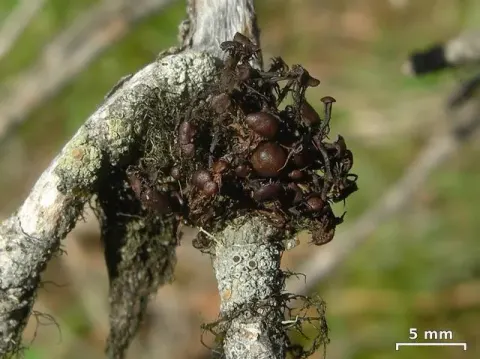
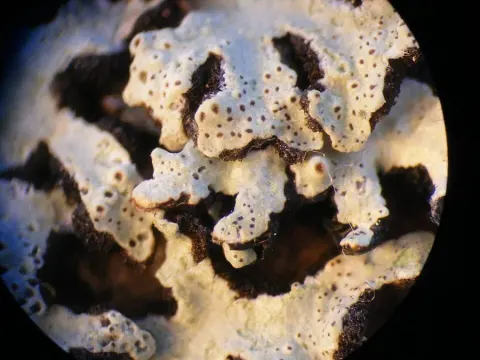
Nipponoparmelia pseudolaevior forms foliose rosettes up to about 10 cm across that are closely to somewhat loosely attached to bark or rock and become rather brittle when dry. The thallus is dull greenish- to brownish grey, with narrow, more or less linear lobes 1–3 mm wide whose margins often lift slightly from the substrate[ and overlap one another. Towards the centre of older thalli the lobes frequently break up into rounded to irregular secondary lobules a few millimetres across. These lobules and the lobe margins bear abundant, slender cylindrical isidia 0.7–2 mm long and 0.1–0.3 mm wide, which are suberect to erect, only sparingly branched and do not crumble into soredia with age. Small, round white pseudocyphellae 0.1–0.3 mm across occur mainly along the lobe edges and sometimes on the isidia, remaining relatively inconspicuous and not developing into granular or coralloid outgrowths. The upper surface is shiny, sometimes partly dusted with white pruina and becoming somewhat wrinkled in older parts of the thallus; the medulla is white. The lower surface is black, often with a narrow paler brownish margin, and carries a moderate to dense cover of simple to forked rhizines up to about 1.5–2 mm long. Apothecia are rare; they are short-stalked to almost stalkless, 1–8 (sometimes up to 11) mm in diameter, with a smooth thalline margin that becomes toothed or lobulate and is punctured by elevated pseudocyphellae. The brown disc commonly splits radially with age. The spore-bearing layer (hymenium) is about 60–65 μm tall, and the ascospores are broadly ellipsoid, measuring roughly 10–12 by 15–17 μm with a wall about 1 μm thick.
Habitat dan peran ekologis
Nipponoparmelia pseudolaevior is primarily an epiphyte on the bark and branches of trees in mixed forests, where it favours relatively open, humid sites such as forest margins and stream corridors. Specimens have been collected from the trunks of Cryptomeria japonica and a range of deciduous broad-leaved trees, with more occasional records from conifers such as Tsuga diversifolia, Abies veitchii and A. sachalinensis, and in some cases directly from rock surfaces. It often forms part of corticolous lichen communities together with species of Menegazzia, Parmelia and Lepraria. The species appears to be restricted to eastern Asia. It is widely distributed in Japan and has been reported from scattered localities in South Korea and the southern Russian Far East. In South Korea it is currently known only from the montane sites Mt Taebaek and Mt Baegun, whereas Russian collections come from mixed and deciduous–coniferous forests on Sakhalin Island, the southern Kuril Islands and several sites in Primorsky and Khabarovsk Krais.
- Habitat atau konteks temuan
- hutan
- Substrat
- Informasi belum tersedia pada sumber rilis ini.
- Peran atau konteks
- Pembentuk liken
Reproduksi
Nipponoparmelia pseudolaevior forms foliose rosettes up to about 10 cm across that are closely to somewhat loosely attached to bark or rock and become rather brittle when dry. The thallus is dull greenish- to brownish grey, with narrow, more or less linear lobes 1–3 mm wide whose margins often lift slightly from the substrate[ and overlap one another. Towards the centre of older thalli the lobes frequently break up into rounded to irregular secondary lobules a few millimetres across. These lobules and the lobe margins bear abundant, slender cylindrical isidia 0.7–2 mm long and 0.1–0.3 mm wide, which are suberect to erect, only sparingly branched and do not crumble into soredia with age. Small, round white pseudocyphellae 0.1–0.3 mm across occur mainly along the lobe edges and sometimes on the isidia, remaining relatively inconspicuous and not developing into granular or coralloid outgrowths.
Catatan identitas dan cakupan
- Nama diterima mengikuti Catalogue of Life Base2026-09-11; uraian mempertahankan konsep dan nama sumber aslinya.
- Original geographic, specimen and life-cycle scope retained; source import awaits individual editorial review.
- Impor dan terjemahan otomatis belum diperiksa editorial per profil. Struktur reproduktif yang disebutkan tidak membuktikan seluruh siklus hidup diketahui.
- Pengukuran pada uraian mengikuti spesimen, kultur, dan metode sumber; angka tidak diperluas ke semua populasi.
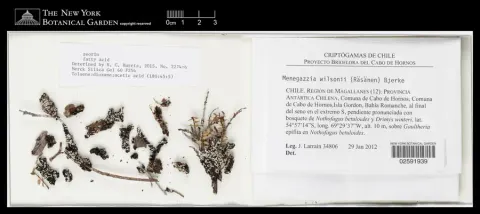
Catatan distribusi dalam narasi mengikuti sumbernya. Dokumentasi spesimen atau foto mengikuti catatan sumber. Bukti wilayah Indonesia dan penilaian konservasi tidak disimpulkan dari gambar.
Melihat dengan konteks
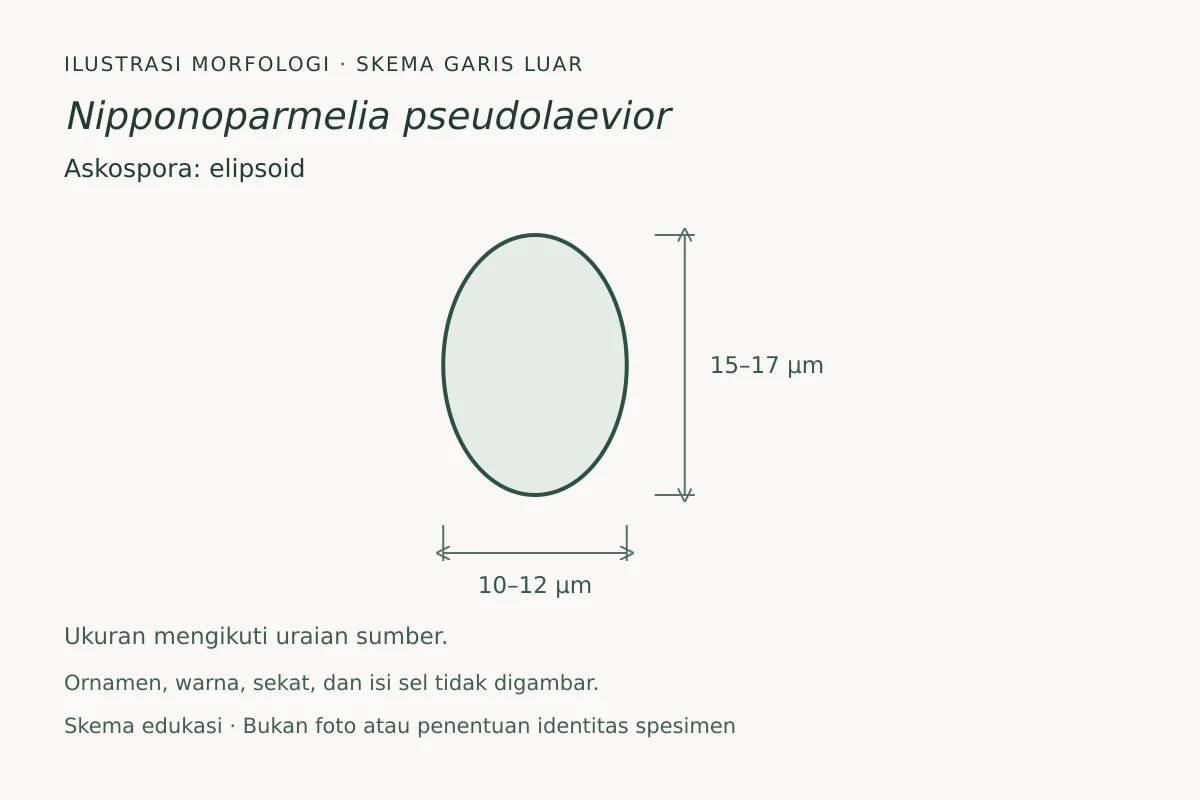
Ilustrasi skematis garis luar askospora Nipponoparmelia pseudolaevior, berdasarkan uraian sumber; ukuran yang dilaporkan 10–12 × 15–17 µm dalam urutan sumber. Proporsi disederhanakan, bukan salinan satu spesimen. Ornamen permukaan, warna, sekat, dan isi sel tidak direkonstruksi. Askospora elipsoid lebar. Sumber melaporkan sekitar 10–12 × 15–17 µm tanpa menamai sumbu; urutannya dipertahankan. Ketebalan dinding tidak direkonstruksi. Ornamen, warna, sekat, dan isi sel tidak digambar. Skema edukasi, bukan alat identifikasi.
- Jenis
- Ilustrasi skematis
- Kredit
- Fungi, ilustrasi orisinal (2026); fakta morfologi berdasarkan Wikipedia contributors
- Lisensi
- CC BY-SA 4.0
- Sumber media
- Buka entri sumber
Sumber profil
- [1] Nipponoparmelia pseudolaevior — Wikipedia (en)
- [2] Catalogue of Life Base2026-09-11 — Nipponoparmelia pseudolaevior
Rujukan halaman ini
Fungi. Nipponoparmelia pseudolaevior. Rilis data fungi-2026-10-12-expansion-2. https://fungi-atlas.mgadib.chatgpt.site/jamur/nipponoparmelia-pseudolaevior/.
Status: impor sumber; pemeriksaan editorial per profil belum selesai. Untuk klaim biologis, gunakan rujukan pada bagian terkait dan periksa konteks sumber aslinya.